Central India

9%

Seventh-day Adventist Publishing Association · Battle Creek, Mich. · Apr 14, 1903

FromReview and Herald, Vol. 80, No. 15.

Read the full edition

Central India

W. W. QUANTOCK
AMONG the many districts of India that are waiting for the truth for this time are the Central Provinces. To get an idea of the exact location of this territory, draw a straight line on the map from Calcutta to Bombay, and it will pass through the center of it. The Central Provinces are very irregular in shape, but cover an area of about five hundred miles north and south and four hundred miles east and west.
It was my privilege about a month ago to spend a little over two weeks traveling through this district, calling at the principal places on the Bengal and Nagpur Railway, going as far west as Nagpur. This place is near the western border, where the Central Provinces join the district of Berar. Nagpur is the principal city of these provinces, and is where the chief commissioner lives. He is the head man of the government. The provinces of Bengal, Burma, Punjab, and the Northwest Provinces have a lieutenant governor, and the Bombay and Madras Presidencies have a governor something similar to the States and Territories in America.
I made this trip in the interest of the Oriental Watchman and the book work, and obtained eighty subscriptions for the paper, and sold about twenty-five dollars' worth of books. These places were canvassed about two years ago, and as a result I found many who liked the paper very much. We need workers stationed throughout India, so that every place where there are Europeans can be visited annually during the cool season. When we canvass a place for the paper, many of the people expect us to come again the next year to get their renewals. It was only the other day that I visited a place where I had been two years ago. None of our workers had been there since that time. Many say to me, “You did not come last year, and I did not get the paper.” By visiting the people from year to year we can become acquainted with them, and be a help to those who become interested in the truth.
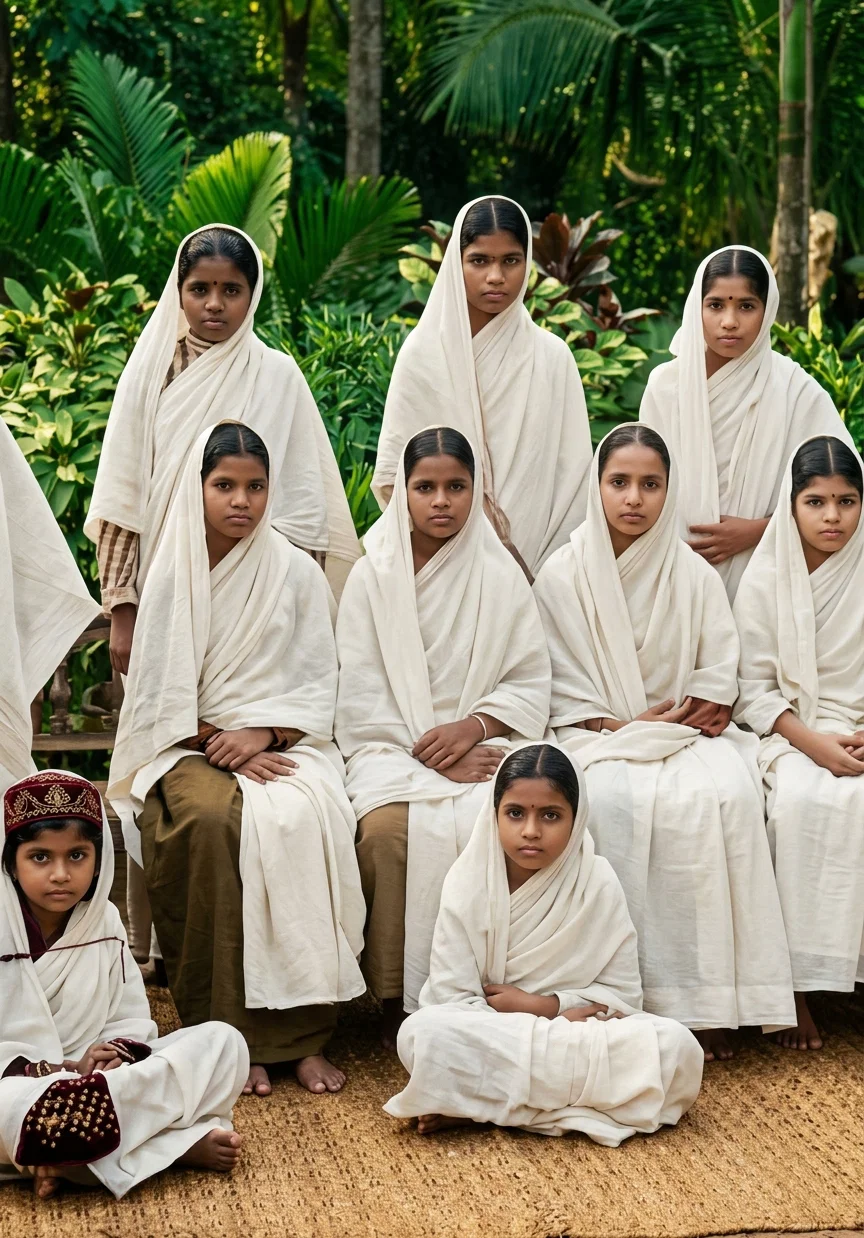
INDIAN GIRLS
Orphans from the Famine of 1897. Pupils of an American School in Bombay.
INDIAN GIRLS Orphans from the Famine of 1897. Pupils of an American School in Bombay.
Bilaspur is the principal place in the eastern part of the Central Provinces. At this place I met a Disciple minister who had been there for twenty years. During this time he and a number of other workers had raised up a church of two hundred natives. From the experience, of those who have been here for twenty or thirty years, it is evident that it takes time to do much for the native people. For this reason workers ought now to be scattered all over India, to hold up the truth, and to teach these people the love of God, for the time is short.
At Bilaspur and in the surrounding country the main crop is rice. The season that has just passed, the rice has not amounted to anything, because of drought. Consequently many are at the point of starvation. The poor people are dependent upon what they raise, and if one crop fails, they are left without anything. The government has already started famine works in several places, in order to give the people work, that they may earn a livelihood. It has been some time since India was entirely free from plague or famine. Every year hundreds, and even thousands, become victims of these life destroyers.
At Nagpur, the principal place in the western part of the Central Provinces, cotton is the main product. The past season they have had what they call a ten or twelve anna crop (about three fourths).
This part of India is a great timber country. Much timber is cut every year, and shipped to other parts where timber is scarce. The name of it is “sal;” it is very hard, and much heavier than any hard-wood timber that I ever saw in America. The Central Provinces are quite hilly. Another occupation that has been begun within a few years is the mining of a kind of iron ore called “manganese.” This ore is being mined and shipped to Europe and America by ship loads for manufacturing purposes. This is a blessing to the country, as it furnishes work for many of the people.
Our work has been almost wholly among the European people. Here is India, with its three hundred million; and just across the border is China, with its vast multitudes. What is being done for these lands? As we see the greatness of the work, let us as a people reconsecrate our lives to God day by day for service. Those of us who can not go to the front can help in this great work by giving of our means as the Lord has prospered us. In doing this we shall receive a blessing. Let us all be united in this great work, and by the Spirit and power of God it will soon be accomplished, and we shall all share in the blessings of the harvest home.