Remarkable Discoveries—The Men and the Work—The Rocks That Were “Keys”—How the Critics Are Answered and Silenced
By A. EARL HALL, B. A.
This is the third of Professor Hall’s articles in the reply of archeology to present-day Bible criticism. His first article told what the higher critic movement really represents.
His article last week contained some startling statements concerning the inroads of higher criticism into theological seminaries and the leading pulpits of the land, and how this criticism, instead of cultivating faith in the Bible, really disguised infidelity, and has resulted in decaying morality.
His article next week will present what the tablets and monuments of the ancient world have to say of creation, the Deluge, the Tower of Babel, and the confusion of tongues.
EDITOR.
“SPEAK to the earth, and it shall teach thee.” “The stones will cry out.” The opening paragraphs of a work by Prof. Ira M. Price are most fitting with which to introduce this subject:
“This is the century of romance—romance in exploration, in discovery, in invention, in thought, and in life. The achievements of man have far exceeded the vast sanguine dreams of the forefathers. We have not only made but discovered vast periods of history. It has been dug out of mounds, tombs, and pyramids. It has been found written on granite, alabaster, wood, clay, and papyrus. It has been translated from tablets, rolls, cylinders, statues, and temples. Through a series of marvelous discoveries and romantic events, we have been led into the secrets of wonderful centuries of hitherto unknown peoples and events. . . . Now, through the cooperation of explorer, archeologist, and linguist, we are the heirs of what was formerly regarded as prehistoric times. . . . These marvelous revelations from the archives of the nations of the past have painted for us a new background, in fact, our first background, of the Old Testament, and have shown us the relations of Israel, religiously, socially, commercially, and politically, to their powerful contemporaries.”—“Monuments and the Old Testament,” pages 17, 18.
PRICELESS TREASURES IN THE MOUNDS OF BABYLON AND ASSYRIA
The reader will doubtless remember that in Babylonia especially, sundried bricks were largely used for building purposes. Even the cities were built upon platforms of this material. After the vicissitudes of fire and sword and the disintegrating forces of nature, they soon became large, shapeless mounds, with nothing by which they could be identified as once being the towns and capitals of ancient empires. Until the nineteenth century, little interest was aroused by these mounds; and it seems to have occurred to but few that priceless treasures in unlimited supply lay hidden there, awaiting the time for uncovering and the necessary agencies to accomplish that work.
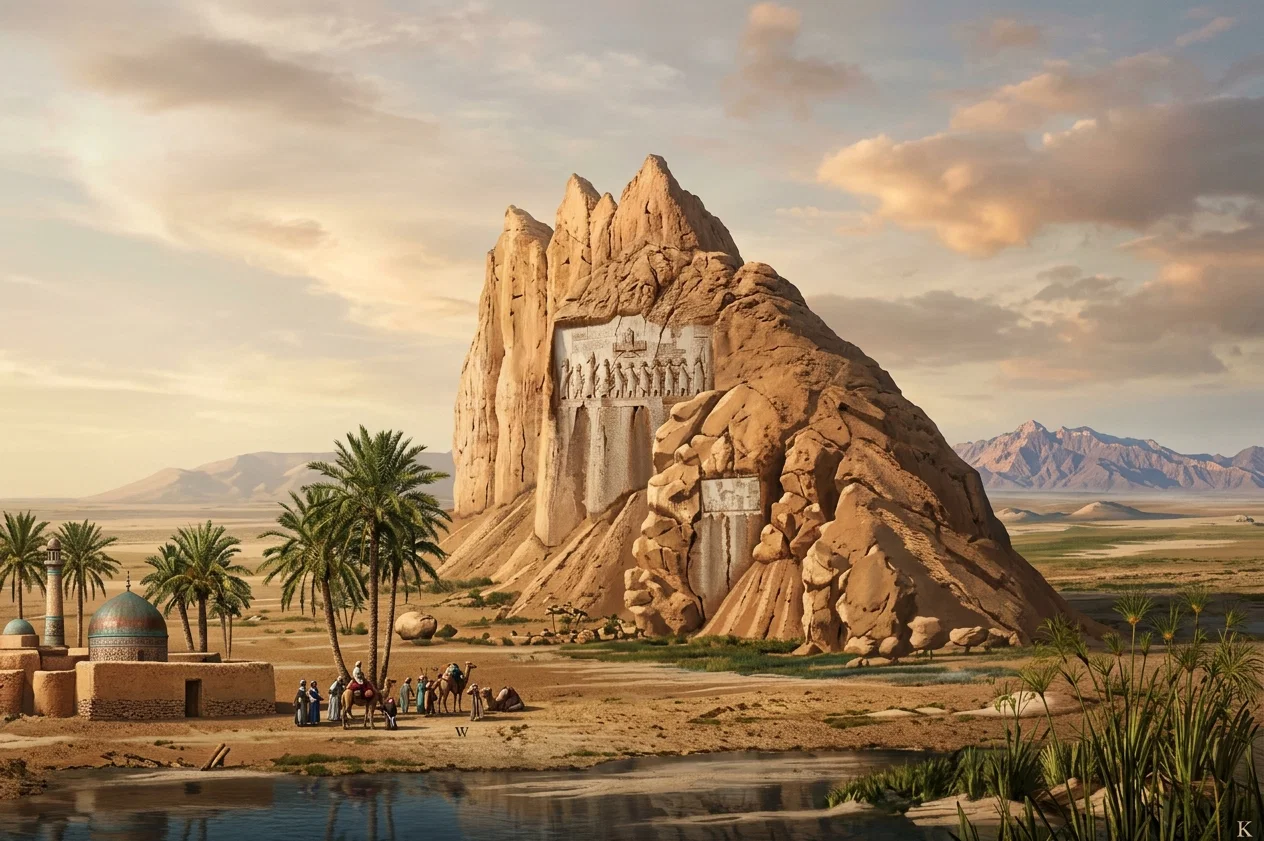
The Rock of Behistun, Showing the Great Inscription in Three Languages
An excerpt from A. H. Layard, one of the foremost men in this work of discovery in the early period, gives the reader an excellent word picture of the scenes in the Tigro-Euphrates valley:
“The observer is now at a loss to give any form to the rude heaps upon which he is gazing. Those of whose works they are the remains, unlike the Roman and the Greek, have left no visible traces of their civilization or their arts; their influence has long since passed away. The more he conjectures, the more vague the results appear. The scene around is worthy of the ruin he is contemplating; desolation meets desolation; a feeling of awe succeeds to wonder; for there is nothing to relieve the mind; to lead to hope, or to tell of what has gone by. These huge mounds of Assyria made a deeper impression upon me, gave rise to more serious thought and more earnest reflection, than the temples of Baalbek or the theaters of Ionia.”—“Nineveh and Its Remains,” volume 1, page 29. Quoted in Goodspeed’s “History of the Babylonians and Assyrians,” page 15.
“It is not surprising, therefore, that men came to have only vague and often fantastic notions of these ancient empires, and that the sites of their long famous capitals were lost.”—Id., page 15.
It might be remembered, in this connection, that when Xenophon and the Greeks returned through Assyria in 400 B. C., they passed the ruins of Nineveh, and were unable to learn even the name of them; and this was only two hundred years after the destruction of the famous capital of the great Assyrian empire.
LEADING ARCHÆOLOGISTS—REMARKABLE DISCOVERIES
The era of discovery is divided into three periods: the preparatory period, 1750–1820, during which time nothing definite was accomplished, in fact hardly a general interest was aroused; the heroic period was begun in 1820 by the extensive excavations by James Rich, and 1842 to 1845 witnessed new developments under P. E. Botta and others; the modern scientific period was inaugurated by George Smith in 1873, and continues to the present.
James Rich worked on the ruins at Babylon in 1811, and did a similar work at Nineveh in 1820. Surveys were made, plans of the sites were prepared, and a large quantity of the inscriptions, gems, and like material was sent to the British Museum. In connection with this campaign, the now famous “East India House Inscription” of Nebuchadnezzar II was found. It is so called because the work was done under the direction of the East India Company. This tablet refers in a general way to his campaigns. The greater part of the inscriptions of this king found thus far deal with his building operations. Did he not often say, “Is not this great Babylon, that I have built?” The work of Rich aroused much interest both in England and in America.740
P. E. Botta was a French consul at Mosul, the ancient Nineveh. He began digging on the site selected by Rich. He was unsuccessful at first, but soon turned his attention to a mound near, called Khorsabad. He here uncovered the palace of Sargon II, an Assyrian king who ruled from 722 to 705 B. C. Work was continued here for a period of ten years, and the material was sent to the Louvre, in Paris.
INVALUABLE DISCOVERIES
But it was reserved for A. H. Layard to arouse the interest of the world as no one else had yet done. From 1845–1847, he unearthed three palaces belonging to Ashurnasir-pal, Shalmaneser II, and Esarhaddon. In one of these palaces, he found the famous Black Obelisk. From 1849–1851, he located the palaces of Sennacherib, Hadad-nirari III, and Esarhaddon. In 1852, he found and identified the site of Assur, the earliest Assyrian capital. In 1853, his assistant, Hormuzd Rassam, found the palace of Ashur-bani-pal, in which was found the far-famed library of over thirty thousand tablets.
During this time, many discoveries were made in Babylonia. W. K. Loftus, J. E. Taylor, Henry C. Rawlinson, and J. Oppert were at work in and around the city of Babylon and to the south. This period witnessed the successful decipherment of the Behistun Rock inscription.
CREATION AND DELUGE TABLETS
George Smith worked very diligently at Nineveh and Babylon. He secured more tablets from the library mentioned, among which were those telling of the creation and the Deluge.
The expeditions of the University of Pennsylvania are of the greatest interest and importance. Many thousands of tablets and much material of value are now at the museum at the university.
THE TEL-EL-AMARNA LETTERS
The discovery, through information from a peasant woman, of the Tel-el-Amarna letters near Cairo is said to have a greater bearing upon questions of historical criticisms and upon matters relating to Palestine than any other information yet found. An attempt has been made to give the reader a tangible idea of the countries where this intensively interesting work is carried on, and of some of the great discoveries that have been made. Nothing has been said about the difficulties encountered. That is not the province of this article. Suffice it to say that the Turkish empire and the Arab, the hieroglyphic and cuneiform languages, scanty supplies, heat and fevers, were the constant lot of these men, and presented difficulties that only the most resolute purpose could overcome.
ROSETTA STONE
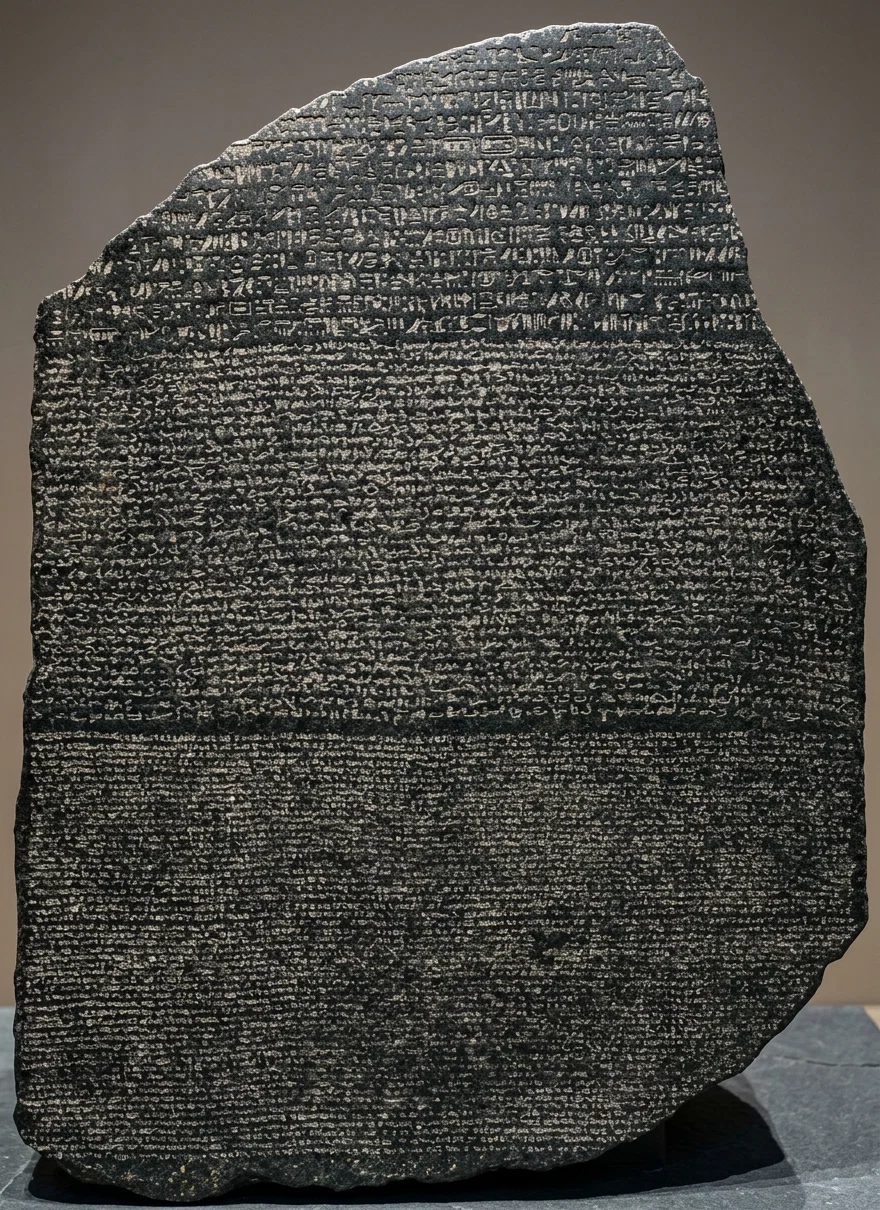
This invaluable stone was found by a French soldier while excavating in the Rosetta mouth of the Nile, in August, 1799. Two skilled lithographers were sent to Cairo to make copies of it, and these copies were sent to the various scholars of Europe. According to the treaty of 1801, the British secured possession of the original, and it may now be seen in the British Museum. The specimen is irregularly shaped, of black basalt, about three feet nine inches long, two feet four and one half inches wide, and eleven inches thick.
The inscription is written in two languages, the Egyptian and the Greek. The former is in two styles: the hieroglyphic, the old picture writing, with which the reader is doubtless familiar, and the demotic character, which is an abbreviated and modified form of the cursive form of the hieroglyphic. The Greek portion is cut in the ordinary bold, square characters.
The first step in guessing the meaning of the inscription was that the Greek contained the same subject matter that the other two sections contained. After considerable effort, this was found to be true. It was further thought that the name in the oval-shaped place was that of some royal personage, and the name of Ptolemy was used to work on.
THE ROSETTA STONE
Much assistance was rendered by J. W. Bankes, who in 1818 deciphered the name Cleopatra from an obelisk found by him on the island of Philae. In this way, the value of the Egyptian characters was ascertained, and the work of twenty years was rewarded. Credit is usually given to J. F. Champollion for the completion of the work. The subject matter concerns the favors shown by Antiochus Epiphanes to the priests and people of Egypt. It was set up in 195 B. C., in his honor, by the priests.
To give a complete account of just how the decipherment was accomplished, would take the space of this whole article. Let it be remembered that now, because the Egyptian characters are known, and can be read wherever found, all the treasures and history of this ancient empire are ours. Much of the information thus gathered goes to confirm, directly and indirectly, the contents of the Old Testament.
Two very significant quotations will be used to close this section:
“This apparently insignificant stone,” says Baron Bunsen, “shares with the great and splendid work ‘La Description de l’Egypte,’ the honor of being the only result of vital importance to universal history accruing from a vast expedition, a brilliant conquest, and a bloody combat for the possession of Egypt.”—Ira M. Price, “Monuments and the Old Testament,” page 41.
“The pick and shovel, unearthing these writings in demotic characters, is furnishing more proof of the correctness of ancient Bible records than comes from any other source outside the Scriptures themselves.”—Quoted in “Great Second Advent Movement,” page 83.
THE BEHISTUN ROCK INSCRIPTION
In the year 1835, Henry C. Rawlinson, serving as an officer in the Persian army, found in the Zagros Mountains a huge limestone cliff rising about 1,700 feet. On one side of the mass was a large space that had been prepared for writing. Here was a bas-relief of figures, a king and a number of bound captives. But the important item was the columns of cuneiform characters. Just under the writing was a ledge about fourteen inches in width, parts of which were worn away. By the use of ladders, a swing, and other devices, he succeeded, during a period of four years, in copying the complete inscription. This long period was necessary because of the other duties he looked after all the time.
But what did he have, now that the task was done? He had risked his life, and the work was most difficult. He learned, first, that the inscription was in three languages, the Persian, the Susian (Elamitic), and the Babylonian text, a part of which was destroyed by a torrent that had made its way over it. Formerly the Elamitic was called Scythian, Turanian, or Median; but we now know, from numerous inscriptions of Susa, that it is the language of Elam, which was spoken in Susa, the capital of the Persian empire. See the “Encyclopædia Britannica,” eleventh edition, article “Behistun.”
LEARNING TO READ THE ROCK’S INSCRIPTION
Knowing the modern Persian, Rawlinson was partially prepared for his task, and started a study of the Sanskrit, Zend, and Pahlavi languages. The scheme here used was the same as that mentioned in the section on the Rosetta Stone,—that of employing the characters which probably stood for a royal name. Darius, Hystaspis, and Xerxes were selected for the purpose. Again it proved successful. In ten years, the task was completed; and in 1847, the entire translation, with notes, appeared in the Journal of the Royal Asiatic Society. He wrestled with a language that contains about 550 signs of different values. There are also endless combinations of from two to six. In one published list, there are about 15,000 such combinations.
The text itself was written for Darius Hystaspis, sometimes called the second, founder of the Medo-Persian kingdom. He tells of the troubles arising from the usurpation of the false Smerdis—the Artaxerxes of Ezra 4:7—and how he was killed by a band of nobles, he leading them and then seizing the throne. This was done while Cambyses was on the campaign in Egypt. Darius is mentioned in Ezra 4:5, 24; 5:6; 6:1, 14; Haggai 1:1; 2:10. He also issued the second decree for the return of the Jews in 519 B. C.
SUPREME TEST OF THE TRANSLATION
The reader is perhaps wondering if the correct key was found to this wedge-shaped writing. Let us see if Mr. Rawlinson’s translation was correct. It was far different from stumbling over or guessing at the translation of a passage in Cæsar or Xenophon. It was real, serious business. As Professor Price says, “as in all cases of great advance in any one department, there were doubters and skeptics.”
The following test was planned by the directors of the museum, and accepted by Rawlinson, Talbot, Hincks, and Oppert. A copy of a historical inscription was given to each man, with the instructions that the translation was to be done independently, and to be handed in at a specified time. It was done, the work compared, and to the satisfaction and surprise of all, the results were practically the same. “The triumph was almost incredible, the victory was complete. This new philological solution was the greatest achievement ever made in the field of language or archeology.”—Price, “Monuments and the Old Testament,” page 60.
FOUND ITS COMPANION
But another test, from a quarter wholly unexpected, is of interest. We quote from “The Bible and the British Museum,” by Miss Ada R. Habershon:
“The discovery of this monolith (inscription of Shalmaneser II) gave an incidental proof of the accuracy of former work. This stone was found at Kurkh, . . . sent to England,741and deciphered by Rawlinson. He read there that Shalmaneser had set it up by the side of a similar inscription by his father, Ashur-nasir-pal. Word was sent to those working there, to dig in the same place, and the companion monolith was found.”—Page 20.
RECORDS OF EMPIRES ACCESSIBLE
Now that the Egyptian characters are known from the successful decipherment of them on the Rosetta Stone, all the records of Egypt can be read, and we are greatly enriched by this large amount of information. A similar statement is true from the discussion just closed. The languages of the Tigro-Euphrates valley and the country of Persia can be read by scholars, and the records of those mighty empires are accessible in the leading languages of Europe. Two sciences have thus been added to the long list—Assyriology and Egyptology.
The reader is now ready to take up a study of some of the more important “finds,” and see their relation in the light of what is said against the Old Testament records. This is the subject of the remaining articles of the series.