He Carefully Taught the Twelve—The Disciples an Inner Circle—The Leading Spirits Among the Apostles—Transformation of the Self-Confident and the Sons of Thunder
By the late MRS. E. G. WHITE
THE most complete illustration of Christ’s methods as a teacher is found in His training of the twelve first disciples. Upon these men were to rest weighty responsibilities. He had chosen them as men whom He could imbue with His Spirit, and who could be fitted to carry forward His work on earth when He should leave it. To them, above all others, He gave the advantage of His own companionship. Through personal association, He impressed Himself upon these chosen colaborers. “The Life was manifested,” says John the beloved, “and we have seen it, and bear witness.” 1 John 1:2.
GAVE THEM CONSTANT COMPANIONSHIP
Only by such communion,—the communion of mind with mind, and heart with heart, of the human with the divine,—can be communicated that vitalizing energy which it is the work of true education to impart. It is only life that begets life.
In the training of His disciples, the Saviour followed the system of education established at the beginning. The twelve first chosen, with a few others who through ministry to their needs were from time to time connected with them, formed the family of Jesus. They were with Him in the house, at the table, in the closet, in the field. They accompanied Him on His journeys, shared His trials and hardships, and, as much as in them was, entered into His work.
THE DISCIPLES THE INNER CIRCLE
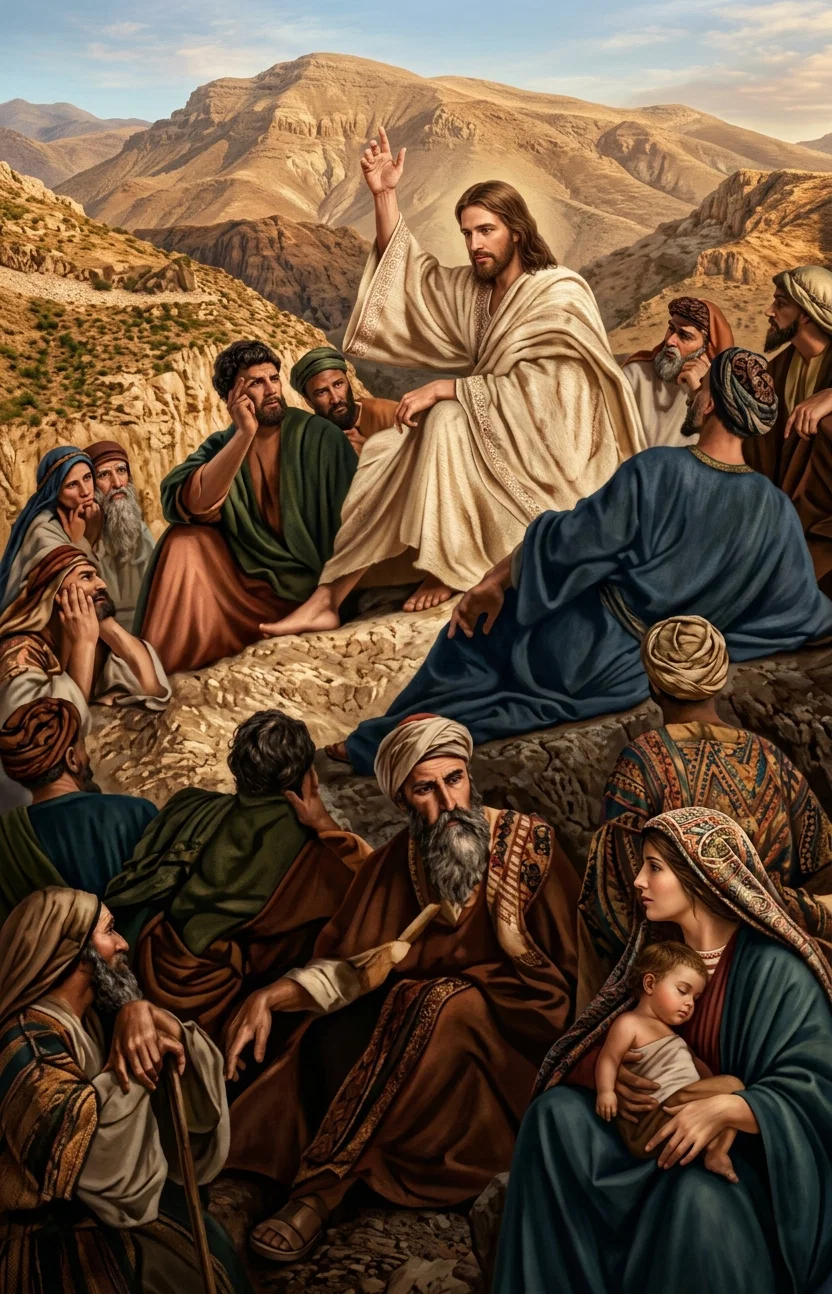
Sometimes He taught them as they sat together on the mountain side, sometimes beside the sea or from the fisherman’s boat, sometimes as they walked by the way. Whenever He spoke to the multitude, the disciples formed the inner circle. They pressed close beside Him, that they might lose nothing of His instruction. They were attentive listeners, eager to understand the truths they were to teach in all lands and to all ages.
NATIVE ABILITY, BUT UNSCHOOLED
The first pupils of Jesus were chosen from the ranks of the common people. They were humble, unlettered men, these fishers of Galilee; men unschooled in the learning and customs of the rabbis, but trained by the stern discipline of toil and hardship. They were men of native ability and of teachable spirit; men who could be instructed and molded for the Saviour’s work.
DIVERSIFIED CHARACTERS OF THE APOSTLES
In these first disciples was presented a marked diversity. They were to be the world’s teachers, and they represented widely varied types of character. There was Levi-Matthew the publican, called from a life of business activity and subservience to Rome; the zealot Simon, the uncompromising foe of the imperial authority; the impulsive, self-sufficient, warm-hearted Peter, with Andrew his brother; Judas the Judean, polished, capable, and mean-spirited; Philip and Thomas, faithful and earnest, yet slow of heart to believe; James the Less and Jude, of less prominence among the brethren, but men of force, positive both in their faults and in their virtues; Nathanael, a child in sincerity and trust; and the ambitious, loving-hearted sons of Zebedee.
In order successfully to carry forward the work to which they had been called, these disciples, differing so widely in natural characteristics, in training, and in habits of life, needed to come into unity of feeling, thought, and action. This unity it was Christ’s object to secure. To this end He sought to bring them into unity with Himself. The burden of His labor for them is expressed in His prayer to the Father, “that they all may be one; as Thou, Father, art in Me, and I in Thee, that they also may be one in Us: . . . that the world may know that Thou hast sent Me, and hast loved them, as Thou hast loved Me.” John 17:21, 23.
THE FOUR LEADING SPIRITED APOSTLES
Of the twelve disciples, four were to act a leading part, each in a distinct line. In preparation for this, Christ taught them, foreseeing all,—James, destined to swift-coming death by the sword; John, longest of the brethren to follow his Master in labor and persecution; Peter, the pioneer in breaking through the barriers of ages, and teaching the heathen world; and Judas, in service capable of preeminence above his brethren, yet brooding in his soul purposes of whose ripening he little dreamed.
“He taught them as they sat together on the mountain side.”
Peter, James, and John sought every opportunity of coming into close contact with their Master, and their desire was granted. Of all the twelve, their relationship to Him was closest.
BY NATURE A SON OF THUNDER, YET BECOMES THE BELOVED
John could be satisfied only with a still nearer intimacy, and this he obtained. At that first conference beside the Jordan, when Andrew, having heard Jesus, hurried away to call his brother, John sat silent, rapt in the contemplation of wondrous themes. He followed the Saviour, ever an eager, absorbed listener.
Yet John’s was no faultless character. He was no gentle, dreamy enthusiast. He and his brother were called “the sons of thunder.” John was proud, ambitious, combative; but beneath all this, the divine Teacher discerned the ardent, sincere, loving heart. Jesus rebuked his self-seeking, disappointed his ambitions, tested his faith; but He revealed to him that for which his soul longed,—the beauty of holiness, His own transforming love.
John’s was a nature that longed for love, for sympathy and companionship. He pressed close to Jesus, sat by His side, leaned upon His breast. As a flower the sun and dew, so did he drink in the divine light and life. In adoration and love he beheld the Saviour, until likeness to Christ and fellowship with Him became his one desire, and in his character was reflected the character of his Master.
TEACHING SELF-CONFIDENT PETER
The history of no one of the disciples better illustrates Christ’s method of training than does the history of Peter. Bold, aggressive, and self-confident, quick to perceive and forward to act, prompt in retaliation yet generous in forgiving, Peter often erred, and often received reproof. Nor were his warm-hearted loyalty and devotion to Christ the less decidedly recognized and commended. Patiently, with discriminating love, the Saviour dealt with His impetuous disciple, seeking to check his self-confidence, and to teach him humility, obedience, and trust.
But only in part was the lesson learned. Self-assurance was not uprooted.
Often Jesus, the burden heavy upon His own heart, sought to open to the disciples the scenes of His trial and suffering. But their eyes were holden. The knowledge was unwelcome, and they did not see. Self-pity, that shrank from fellowship with Christ in suffering, prompted Peter’s remonstrance, “Pity Thyself, Lord: this shall not be unto Thee.” Matt. 16:22, margin. His words expressed the thought and feeling of the twelve.
SELF-TRUST DEFEATED IN TRIAL
For them all, Peter’s experience had a lesson. To self-trust, trial is defeat. The sure outworking of evil still unforeseen, Christ could not prevent. But as His hand had been outstretched to save when the waves were about to sweep over Peter, so did His love reach out for his rescue when the deep waters swept over his soul. Over and over again, on the very verge of ruin, Peter’s words of boasting brought him nearer and still nearer to the brink. Over and over again was given the warning, “Thou shalt . . . deny that thou knowest Me.” It was the grieved, loving heart of the disciple that spoke out in the avowal, “Lord, I am ready to go with Thee, both into prison, and to death;” and He who reads the heart gave to Peter the message, little valued then, but that in the swift-falling darkness would shed a ray of hope: “Simon, Simon, behold, Satan hath desired to have you, that he may sift you as wheat: but I have prayed for thee, that thy faith fail not: and when thou art converted, strengthen thy brethren.” Luke 22:31-34.
CHRIST’S PRAYER A STAY TO HIS SOUL
When, in the judgment hall, the words of denial had been spoken; when Peter’s love and loyalty, awakened under the Saviour’s glance of pity and love and sorrow, had sent him forth to the garden where Christ had wept and prayed; when his tears of remorse dropped upon the sod that had been moistened with the blood drops of His agony,—then the Saviour’s words, “I have prayed for thee: . . . when thou art converted, strengthen thy brethren,” were a stay to his soul. Christ, though foreseeing his sin, had not abandoned him to despair.
If the look that Jesus cast upon him had spoken condemnation instead of pity; if, in foretelling the sin, He had failed of speaking hope,—how dense would have been the727darkness that encompassed Peter! how reckless the despair of that tortured soul!
TAKE THIS MESSAGE TO PETER
It was not John, the one who watched with Him in the judgment hall, who stood beside His cross, and who of the twelve was first at the tomb,—it was not John, but Peter, that was mentioned by name in the first message sent to the disciples by Christ after His resurrection. “Tell His disciples and Peter,” the angel said, “that He goeth before you into Galilee: there shall ye see Him.” At the last meeting of Christ with the disciples by the sea, Peter, tested by the thrice-given question, “Lovest thou Me?” was restored to his place among the twelve. His work was appointed him; he was to feed the Lord’s flock. Then, as His last personal direction, Jesus bade him, “Follow thou Me.” John 21:15-22.
SENSED HIS WEAKNESS AND CHRIST’S POWER
Now he could appreciate the words. The lesson Christ had given when He set a little child in the midst of the disciples and bade them become like him, Peter could now better understand. Knowing more fully both his own weakness and Christ’s power, he was ready to trust and to obey. In His strength, he could follow his Master.
And at the close of his experience of labor and sacrifice, the disciple once so unready to discern the cross, counted it a joy to yield up his life for the gospel, feeling only that, for him who had denied the Lord, to die in the same manner as his Master died was too great an honor.
A miracle of divine tenderness was Peter’s transformation. It is a life lesson to all who seek to follow in the steps of the Master Teacher.