What They Say of Creation, the Fall of Man, the Deluge, the Tower of Babel, and the Confusion of Tongues—Archeology Arraigns Present-Day Biblical Criticism
By A. EARL HALL, B. A.
This is the fourth of Professor Hall’s articles on the reply of archeology to present-day Biblical criticism. In previous articles, he has stated the principles of the higher critic movement, and has shown that the teachings of the critics have filled the world with a disguised infidelity cloaked with the Christian religion. Last week, his article told of the finding of the Rosetta Stone and the Behistun Rock, and how these monuments of antiquity enabled the archeologist to read the inscriptions that hitherto had baffled the profoundest scholarship.
His article next week will show, from the monuments, that the record in Genesis 14, as well as other portions of the Old Testament, is founded on fact. These scriptures are not fiction, as the critics had affirmed before men learned how to read the tablets and monuments of antiquity.
EDITOR.
“If these should hold their peace, the stones would immediately cry out.” Before proceeding to a study of archeological evidence as related to the Old Testament, let a few principles be thoroughly understood. The reader will then have a better idea of the nature of the evidence, what is claimed for it, and just to what extent the historical portions of the Bible are corroborated.
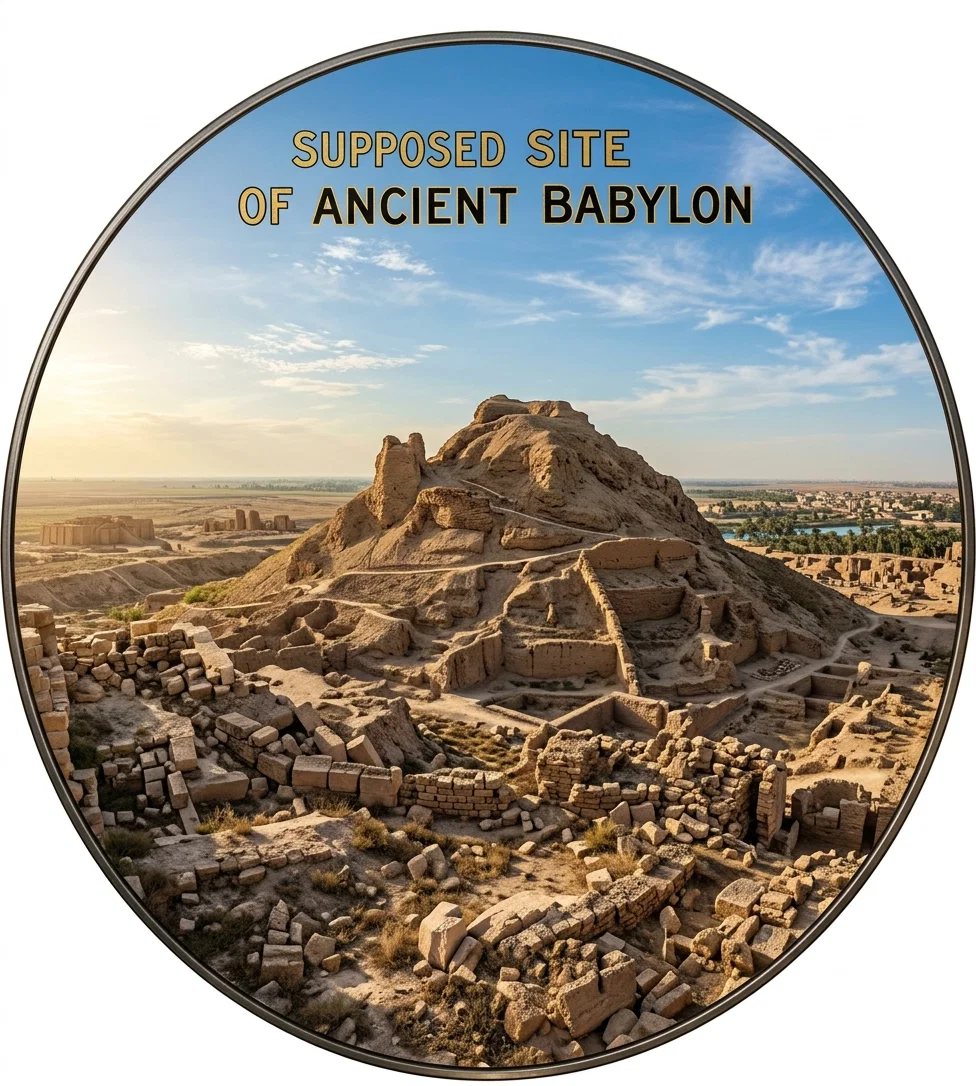
SUPPOSED SITE OF
THE CRITIC MUST PROVE
First: It must be remembered that here, as well as in similar discussions, “the burden of proof lies with the critic.” This is not to say, by any means, that a doctrine is right simply because, for a long period of time, it has been believed to be true. But we do contend for the truthfulness of the following statement,—that certain facts handed down by the Jews through their long career, believed and taught by Christ, accepted by the apostles and the apostolic church, and universally held by the Christian churches until well into the past century, ought not to be given up on such slight evidence as has thus far been given, despite the vast amount of literature which professes to expose the so-called “errors” of the Bible.
One author thus states this principle of the one who is to furnish the proof in such controversies: “In presence of undeniable facts of which a certain explanation has been traditionally given, the historian is bound to admit the explanation so generally given, or to offer another and more credible one.”—Alexander Stewart, “Handbook of Christian Evidences,” chapter on the resurrection, note 1. Again, quoting from Keim, who, after giving his views on the same subject, says, “Let those who ridicule, present us with a better explanation.”
Second: It is not claimed that the monuments will substantiate every statement of a historical nature,—that Jericho fell as the Bible says; that Moses wrote Genesis, or that he did not copy his laws; where the garden of Eden was; or that there was a drought in the days of Ahab. It has already been shown that we are not called on to “defend” the Bible; we are doing more than the case demands, but are glad to do so for the help it will be for our own faith and that of others. In harmony with this, the articles that follow will be written along this plan:
(a) The discoveries made up to date give accurate historical background for the Old Testament.
(b) In a multitude of instances, the records have found exact confirmation in the facts of archeological discovery.
(c) This is especially the case in instances which, for lack of information, were formerly regarded as difficult or suspicious.
(d) New discoveries have brought into stronger relief the marvelous exactness of the Bible writers in matters that depend on men’s being careful observers.
(e) The discoveries have brought into relief, by contrast, the soberness and reticence of our Scriptures by the side of legendary literature found elsewhere and alleged to be parallel. (John Urquhart, “Archeology’s Solution to Old Testament Puzzles,” in preface by Willis J. Beecher.)
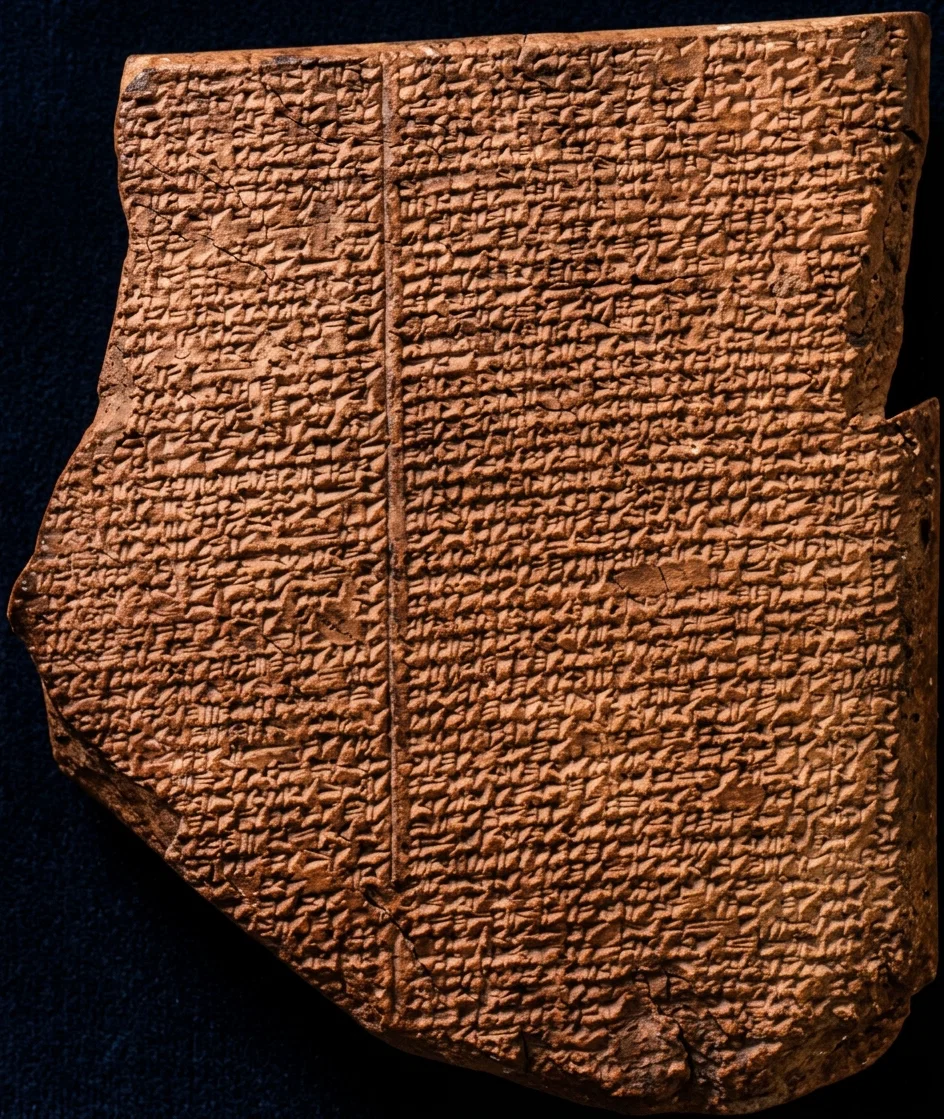
Fragment of a baked clay tablet inscribed with the Babylonian account of the Deluge. The original is in the Nineveh Gallery of the British Museum.
Third: No theory of Biblical criticism is to be fully accepted, and made a part of faith and life, until tested and attested by archeological facts. The functions of archeology are here given for the benefit of the reader:
I. It is to supply the historical setting of Scripture.
II. It is to be a guide to critical methods.
III. It is to be a guide concerning interpretation of ancient literature.
IV. To provide facts with which to test the critical theories. (M. G. Kyle, “Deciding Voice of the Monuments,” preface, page 10; pages 17, 20, 26, 29.)
Two significant sentences are here given for close consideration:
WHAT THE CRITICAL SKEPTIC SAID
“This conception—Israel’s dependence upon Babylonia—has grown steadily within the last few decades, so that the edifice which has been reared has now reached its full height, the capstone has been set, and the structure is complete. A change of names, that is all, and a Babylonian deity, Marduk or Bel, becomes Christ.”—A. T. Clay, “Amurru, Home of the Northern Semites,” page 20.
REPLY FROM THE ASSYRIOLOGIST
“It seems as though God had held back the knowledge of facts that men might give free scope to their unbelief, and then let the full flood of information sweep away the objections raised against His word, as the tide sweeps away the structures children had erected on the sand.”—Thomas Laurie, “Assyrian Echoes of the Word,” page 3, preface.
In 1845, A. H. Layard said that four years before, “a case scarcely three feet square inclosed all that remained not only of the great city Nineveh, but of Babylon itself.”—“Nineveh and Its Remains,” volume 1, page 17, quoted by Goodspeed in “History of the Babylonians and Assyrians,” page 17. But now the museums of Europe and America are crowded with this material. A few years ago, the “British Museum alone had more than thirty thousand tablets, awaiting the patient toil of the cuneiform expert. To-day in published form there is more than six times as much literature as is contained in the Hebrew of the Old Testament. . . . Not one quarter of all the inscriptions has been published.”—Price, “Monuments and the Old Testament,” page 62.
THE ASSYRIAN TABLETS OF CREATION
The clay tablets of the creation were found by Smith in the library of Ashur-bani-pal, king of Assyria 668–626, and are now in the British Museum. This king’s name is found as Asnapper in Ezra 4:10—Osnappar in the Revised Version.
As it is not possible to give the translation of this tablet, the following table will help the reader in comparing the two accounts—the Babylonian, and the record as found in Genesis:756
GENESIS
Earth waste and void.
Light dispels darkness.
Dry land appears.
Sun, moon, and stars placed.
Animals and creeping things created by God.
God creates mankind.
BABYLONIAN
Time when all was chaos.
Merodach overthrows Tiamat, demon of chaos.
Merodach creates dust.
Merodach places sun, moon, and stars as mansions of the gods.
Numerous gods create animals.
Merodach creates mankind.
One marked feature differentiates these two accounts: Genesis mentions one God as Creator; the Babylonian has no such Being or work done, but many gods have a share in the “beginning of things.”
THE SABBATH OF THE BIBLE AND THE TABLETS
BIBLICAL
Sabbath was made for man.
God never angry with His people.
Occurred regularly every seventh day.
Israel was to prepare food on Friday; special sacrifices on that day; day of worship for all; lawful to do good on the Sabbath day; enemies to be prayed for at all times.
BABYLONIAN
Day or rest of the heart.
Gods ceased from their anger on that day.
Occurred on seventh, fourteenth, nineteenth, twenty-first, and twenty-eighth days of the month.
King could not eat meat roasted, or put on his royal robes, or go into his chariot, or enter the temple; physicians could not visit the sick; enemies could not be cursed on those days.
A few excerpts from A. T. Clay will be offered here:
“For some years, a number of the Assyriologists who have written upon the Sabbath of the Hebrews have reached the conclusion that not only ‘the word “Sabbath” is Babylonian indeed,’ but also that the institution originated in the Tigro-Euphrates valley, . . . expressed in the statement, ‘The Sabbath rest was essentially of Babylonian origin.’”—“Amurru,” page 55.
Professor Clay shows clearly, using even statements from the critics as to the meaning of the term in the cuneiform, that the word “Sabbath” comes from the word shapattam, and means, “appeasement of the gods, expiation, from the root that means to conciliate.” Also it is a synonym for gamara, which means, “to be complete, to be full.”
It is now known “that shapattam was the name of the fifteenth day of the month; and considered in connection with the synonym gamara, it doubtless had reference, as has been suggested, to the full of the moon in the middle of the month. But until some evidence is forthcoming, we cannot justifiably assume . . . that there was a cessation of work, or that it was a rest day from human labor. No other conclusion, therefore, can be reached than that the Babylonians did not observe a day in every seven, that was called the Sabbath.”—Id., pages 56, 57.
THE FALL OF MAN
We do not hesitate to acknowledge that we have in the tablets no direct evidence concerning this subject, but mention is to be made of a very interesting seal cylinder. On this, there is a group of figures, in the center of which is a tree, upon which fruit may be seen. A figure of a man is seen on one side, and that of a woman on the other side, of the tree. Behind the latter is a figure representing a serpent. We know, from the cuneiform records, that the early people of Babylonia knew of “a wicked serpent,” which was responsible for the fall of man, and “a tree of life.” Not a word is found on the cylinder. Where only could such an idea be obtained? The reader may answer for himself.
STORY OF THE DELUGE IN THE TABLETS
The following facts can readily be noted by a reading of these tablets of the Deluge as related to the account in Genesis. We quote from Price: 1. The building of an ark (ship). 2. The preservation of the seed of life. 3. The deluge of water, with a great storm. 4. A landing on a mountain. 5. A sending out of a bird. 6. An offering of sacrifice upon landing . 7. An acceptance of a sweet savor by the deity (gods). (“Monuments and the Old Testament,” page 94.)
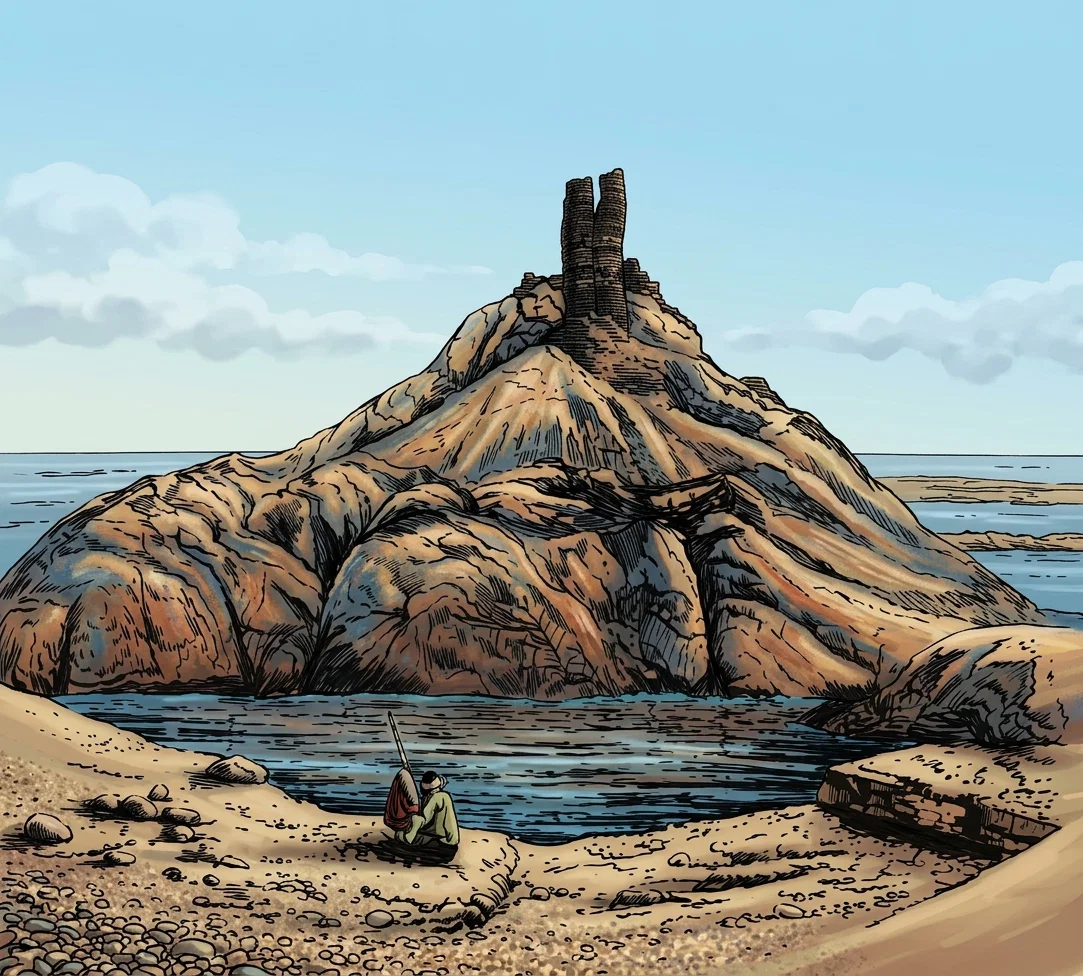
BIRS NIMRUD, NEAR BABYLON
Aside from the tablets found by Smith, three more are mentioned by Clay, the most important of which was in the possession of the late J. Pierpont Morgan. It is thought that this was written about 2,000 B.C. (“Amurru,” page 73.) It is to be remembered that the Chaldean account of the Deluge is the only one that gives a moral reason for this judgment by God, or, we add, by the gods.
In this connection, we wish to call attention to a fact discussed fully by Lenormant, concerning the number of generations from creation to the Flood. From his researches, it seems that the Egyptians, the Assyrians, the Armenians, the Chinese, the Germans, the Scandinavians, and the Arabs have a common tradition that there were ten generations, or heroes, or mythological personages, who lived during a similar period of time. In the Assyrian list, the seventh is Edomachus, who corresponds to Enoch of the Biblical list. The fact that “both conversed with their deities, and the former ruled 365 years, the same number that the latter lived on earth, and the further fact that the tenth and last of each list are the heroes of the Deluge—Xisuthros and Noah—seem to be points that cannot be considered simply as coincidence.”—Clay, “Amurru,” page 69.
TOWER OF BABEL
For the subject of the Tower of Babel, a note will be copied from George Rawlinson, giving the ancient authority upon the subject:
“At that time, the men of antiquity are said to have been so puffed up with strength and haughtiness that they despised even the gods, and undertook to build that lofty obelisk which is now called Babylon. And when they had already built it up into the heavens almost as high as the gods, the gods, by the help of the winds, smote the well-contrived but futile work, and prostrated it to the ground. And that rubbish took the name of Babel. For up to that time, men relied upon the use of one language; but then a various and discordant confusion of tongues was sent by the gods upon those who had heretofore used but one language.”—“Historical Evidences,” note 69, lecture 2.
The reader will have no trouble in comparing the foregoing account with that in Genesis. In the British Museum there is a tablet which, though badly broken, gives in substance the facts in the preceding note. See “Records of the Past,” old series, volume 7, pages 129, 132.
WHAT IS PROVED?
Now that we have this material, of what value is it? Does it prove anything? How do you know that the writer of Genesis did not copy his accounts from these sources? No one now living saw Moses write his book, neither can we go back a number of generations and ascertain the fact in reference to it. The monuments do not, and in the very nature of the case, cannot, answer that question. We ask the reader, in view of the statements in the previous articles and in this one, to read carefully, and weigh the evidence, and judge for himself as to whether the “stories” of Genesis are copied from Babylonian sources, or are inspired by the Creator of the universe. Note particularly what the following authorities say:
“These are not traditions peculiar to Semitic peoples and religions as growing out of their characteristics. They are common to all civilized nations of antiquity. Their common elements point to a time when the human race occupied a common home and held a common faith. . . . Early races of men, wherever they wandered, took with them these primeval traditions; and with the varying latitudes and climes, their habits and modes of life have carried these, and present them to us to-day in their different dresses. One ancient religion did not borrow these universal traditions from another, but each possessed primitively these traditions in their original form. A careful examination of all these traditions shows that the Genesis record is the purest, the least colored by extravagances, and the nearest to what we must conceive to have been the original form of these traditions.”—Price, “Monuments and the Old Testament,” pages 95, 96.
“Principal Cave quotes extensively from the literature of ancient Babylon, Egypt, India, China, Persia, Japan, Siam, Greece, Rome, and the traditions of Mexico, Nicaragua, Brazil, Cuba, Borneo, the Scandinavians, the Tartars, the North American Indians, the South Sea Islanders, all confirming, in the most remarkable manner, the historical accuracy of the first fourteen chapters of Genesis.”—J. H. Brookes, “Testimony of History to the Bible,” page 13.
“A voice out of the tombs of thirty centuries confirms the historical accuracy of Moses, and demolishes the whole system of Biblical criticism, which has taught that this portion of the book of Genesis was impossible of truth, a pure imagination.”—W. C. Prime, in Brookes, pages 13 and 14.
“The Bible has undergone a certain amount of revival in credit and authority in consequence of these criticisms. My own protracted observation of the controversy, parallel and in some important respects analogous to that on the poems of Homer, compels me to entertain but a mean opinion of negative speculation.”—W. E. Gladstone, quoted in Brookes, page 15.
PERSUASIVE EVIDENCE
Circumstantial evidence is sometimes misleading, although, as Thoreau once said, circumstantial evidence is quite persuasive, as “when one finds trout in the milk.”
The fact that the accounts of Scripture are similar to the Babylonian account, is not proof in the least that the former narratives were copied from the latter. A further discussion of this principle will be given in the next article in connection with the Code of Hammurabi and the charge that Moses also copied from it.