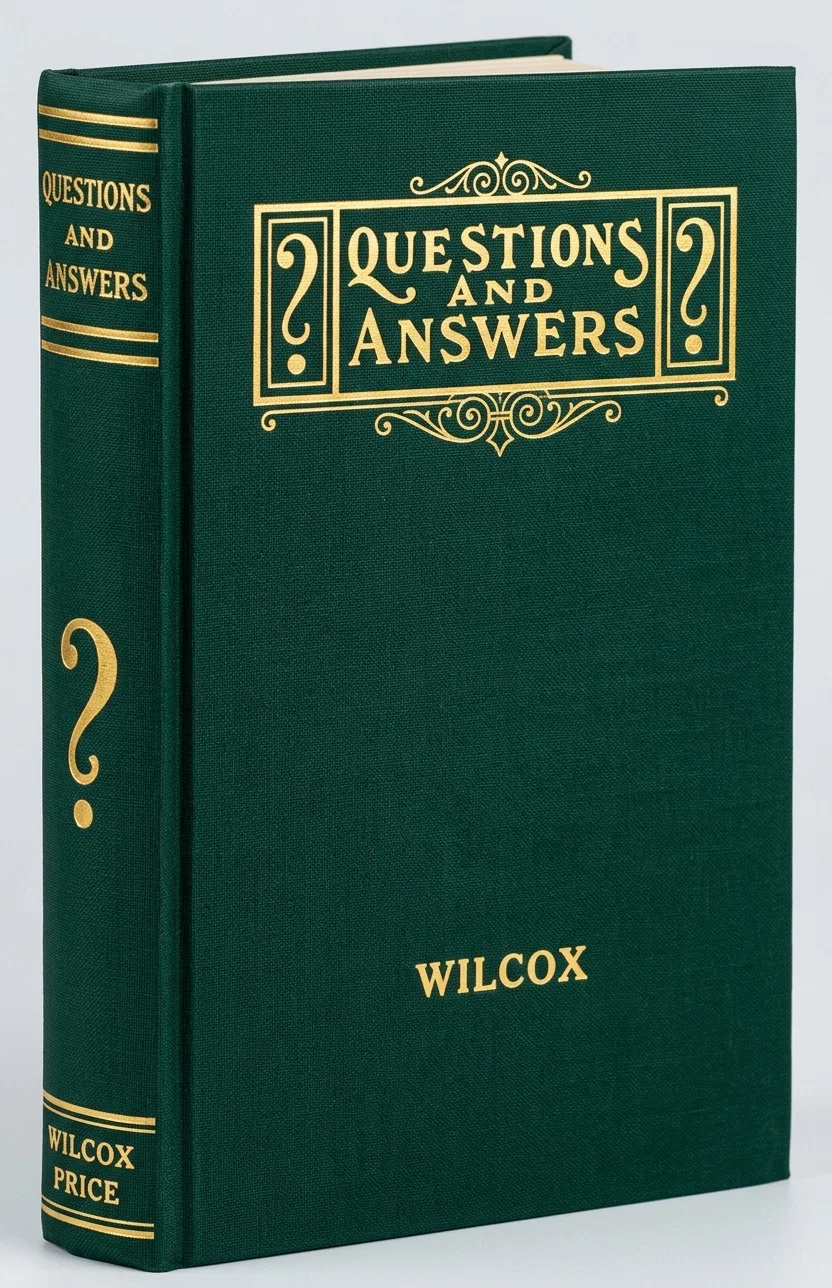
Questions and Answers

2%

Pacific Press Publishing Association · Mountain View, California · Sep 28, 1915

FromSigns of the Times, Vol. 42, No. 38.

Read the full edition

Questions and Answers

THE PREMIUM OF THE SIGNS of the TIMES WEEKLY
“I would not take a great deal for it unless it could be replaced.”
The following section headings, and the number of pages devoted to each section, show how fully the subjects in “Questions and Answers” are treated:
Section I — The Bible — 9-17
Section II — Christ — 18-34
Section III — Nature of Man — 35-63
Section IV — Prophecy and Second Advent — 64-88
Section V — The Moral Law — 89-97
Section VI — The Sabbath — 98-125
Section VII — Ceremonial Law — 126-132
Section VIII — The Covenants — 133-138
Section IX — Historical — 139-145
Section X — The Church; Its Ordinances — 146-161
Section XI — Religious Liberty — 162-164
Section XII — Christian Experience — 165-179
Section XIII — The Spirit; Its Work — 180-187
Section XIV — Marriage and Divorce — 188-191
Section XV — “Meats and Drinks” — 192-200
Section XVI — Satan — 201-206
Section XVII — Tithing — 207-212
Section XVIII — Seventh-Day Adventists — 213-215
Section XIX — Miscellaneous — 216-248
“I esteem it very highly”
It makes difficult Bible texts clear, harmonizes apparent contradictions, answers your perplexing questions, can help you comprehend the real beauty and harmony of the Scriptures. If there are any hard texts in the Bible for you, let “Questions and Answers” help you with them. Do not continue in that doubtful, destructive uncertainty. Smooth out the rough places, and enjoy real confidence and freedom in your Scripture study.
The question and answer given below indicate the style and completeness of answer to the 270 questions in the book:
The Sabbath
119. The First Day of the Week, Acts 20:7
Will you please explain Acts 20:7? Did some of the apostles keep the first day of the week as the Sabbath?
If you will read the text carefully you will note this, that there is absolutely nothing regarding Sabbath-keeping in the text, or either in the context. The first six verses tell us of the journeys of Paul, and how he came at last to Troas, where he stayed seven days; then as he was about to leave, he held a farewell meeting with the brethren. Verses 7 to 11 simply give us an account of this meeting. The meeting was an evening meeting, held on what is our Saturday night, for the day began at sunset. Paul preached until midnight, then the young man Eutychus, overcome with sleep, fell from a window and was taken up for dead. Paul restored him again, came up, talked again a long time, broke bread with them, and at break of day departed.
The reason for speaking of the meeting is doubtless on account of the miracle that was there wrought. There was absolutely nothing in the record to indicate that the day was a sacred day. The breaking of bread was evidently the meal that was taken together before they left. If it referred to the Lord’s Supper, that did not constitute the day holy, nor establish a custom. The day began, according to the Bible reckoning, in the evening. The remainder of that day was spent by the apostle Paul in travel, waiting until daybreak, and then going across the peninsula to Assos, a journey of about twenty miles. If that first day had been a Sabbath day, evidently the apostle Paul would have observed it with the Christians at Troas, while Luke and the others would have waited for him at Assos; but he used it as a common day for work.
If it is thought, as some speculate, that the meeting was held on Sunday night, there is then nothing to show that the day was kept as a Sabbath, and the breaking of the bread came on what we would call Monday morning.
This is the one text used almost above all others to prove that Sunday is a holy day, but candor must admit that there is nothing in either text or context which intimates such a thing.

Questions and Answers

contains 262 pages and 270 questions and answers, table of contents, Scripture and topical indexes, substantially bound in red cloth, valued in its technical class of books at about $2.50.

4 PROPOSITIONS

Proposition No. 1 — SIGNS OF THE TIMES WEEKLY the balance of the year 1915 and all of 1916 with “Questions and Answers” for $2.00.
Proposition No. 2 — “QUESTIONS AND ANSWERS” FREE to any individual paying for five or more SIGNS mailed to different addresses for a year.
Proposition No. 3 — “QUESTIONS AND ANSWERS” FREE with each church club of five or more copies ordered for a year. This book makes a valuable addition to any church library.
Proposition No. 4 — “QUESTIONS AND ANSWERS” FREE to any individual paying for a club of five or more copies for a year mailed to private address or with church club.
Scores have already accepted the above liberal offers. Order now while we are still able to make this inducement. Send orders and remittances through our depository in your state. See list on page 14.