What Was Nailed to the Cross? — Is the Seventh-Day Sabbath One of the Shadows That Vanished?
By J. W. McCOMAS
BETWEEN the Jew and the gentile, until the first advent of Christ, there was a marked difference. The Jew was God's man, with all the promises, with all the glory, and the covenants, and the law, and the service of God. Rom. 9: 4. Such was the man God chose to be a vessel through which and in which He might carry to a thirsty world the waters of salvation. He was to be a cup in God's hand. Gen. 26: 4.
But this people rebelled in the beginning of their work, and became a stiff-necked race. So it became necessary for God to bring to them some work which would constantly remind them that they were rebellious. This law “stood only in meats and drinks, and divers washings, and carnal ordinances, imposed on them until the time of reformation.” Heb. 9: 8-10. This law was not of itself good, neither would it give them life. Eze. 20: 25.
THE ONE BLOTTED OUT
This law of ordinances was blotted out, and nailed to the cross with Christ. The wall was broken down. These meat offerings, drink offerings, holy days, new moons, and sabbath days, “which are a shadow of things to come; but the body is of Christ” (Col. 2: 14-17), all came to an end in Christ; hence they must have pointed to Christ.
Did this law include the Ten Commandment law? If so, this Ten Commandment law would be a shadow, and when we reach Christ, its binding obligation would cease, and the people would be privileged to break it, and still be justified in the sight of God; for man is held guiltless now in disregarding the law of ordinances, which was nailed to the cross.
IS IT LAWFUL TO STEAL AND LIE?
It would be lawful for a man to lie, steal, commit adultery, and break every other command, if this law against such things came to an end at the cross. But no one would take such a position; and those who believe that the Ten Commandment law was nailed to the cross, are glad to resurrect nine of them, leaving out the fourth, and making the nine binding upon Christians. Thus they show that in truth they do not believe that the Ten Commandments were abolished—nailed to His cross.
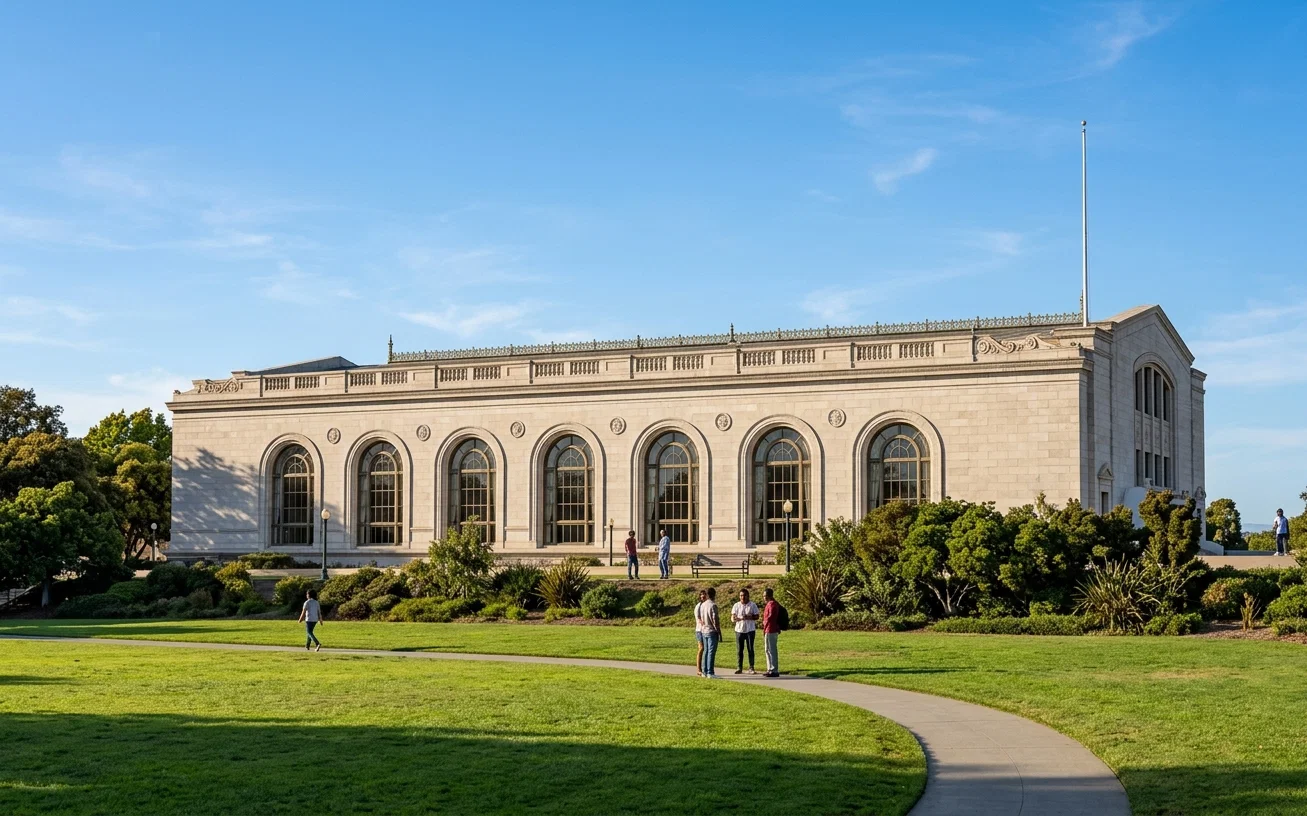
Municipal Auditorium, Oakland, California, is one of the small audience chambers of which the International Lord's Day Congress was held.
That whole story is told to make the fourth commandment—which requires the seventh-day Sabbath—of none effect, not binding upon the world with the other nine. Jesus says, “It is easier for heaven and earth to pass, than one tittle of the law to fail.” Luke 16: 17.
THE SABBATHS NAILED TO THE CROSS
Then how does God account for these sabbath days that were nailed to the cross? In Deut. 31: 9 we find that Moses wrote a law, and in verses 24-26 we are told that he wrote it in a book. But there was another law, written upon stone, and God Himself wrote this one with His own finger. Deut. 9: 10. This law James refers to when he says, “Whosoever shall keep the whole law, and yet offend in one point, he is guilty of all.” James 2: 8-12.
In the law that Moses wrote, we find sabbath days which came to the Jews just as our fourth of July comes to us, once a year. Lev. 23: 24 says, “In the seventh month, in the first day of the month, shall ye have a sabbath.” Again in verses 27-32 we find that the tenth day of this seventh month was to be a sabbath. This chapter also tells us in verses 37 and 38, that these and other feast days were besides the Sabbath of the Lord.
Then God made a distinction between the501Sabbath found in the law which He wrote, and those commanded in the law Moses wrote. In fact, God says, “I will also cause all her mirth to cease, her feast days, her new moons, and her sabbaths, and all her solemn feasts.” Hosea 2: 11. He calls them “her sabbaths”; but in His law, He calls the seventh-day Sabbath “the Sabbath of the Lord thy God.” Again in Isa. 58: 13, He calls it “My holy day.”
By this we see there were sabbaths besides the seventh day of the week. Their origin was with Israel, and continued until Christ; but the making of the seventh day as a blessed, sanctified rest day was in Eden, before sin came into the world. And in Eden restored, the good Book tells us, “as the new heavens and the new earth, which I will make, shall remain before Me, saith the Lord, so shall your seed and your name remain. And it shall come to pass, that from one new moon to another, and from one Sabbath to another, shall all flesh come to worship before Me, saith the Lord.” Isa. 66: 22, 23.
This Sabbath, says the Saviour, was made for man. Mark 2: 27, 28. And by the text quoted from Isaiah, it is plain that in our redeemed state, we will still observe the Sabbath which God made in Eden.
For a man to belong to the family of the eternal world, he must be a stranger in this world. Heb. 11: 10-13. He must live as did Billy Miner, who said, when asked how the world was getting along, “I don't know, I haven't lived there for twenty years;” and as did the old Scotchman who was asked, “Are you on your way to heaven?” and said, “I live there.”
Then let us begin now, so that the scenes of the new home will not be strange; for Sabbath keeping is a part of the worship of Jehovah.