In Touch with the War

3%

Pacific Press Publishing Association · Mountain View, California · May 4, 1915

FromSigns of the Times, Vol. 42, No. 18.

Read the full edition

In Touch with the War

A Stern Military Order—All Our Papers Taken—A Troop Fleet on the High Seas—In Danger from the Emden—Arrival in India, and Conditions There
By ARTHUR G. DANIELLS
We announced some months ago the departure of Elder A. G. Daniells, the president of our General Conference, for an extended visit among our conferences and mission stations throughout the Orient. It was arranged for him to give us frequent accounts of the progress of his trip; but owing to the confusion created by the war, the mails have been very uncertain, and some of the matter reported to have been sent has not reached us. We are still hoping for it, even though belated. His article herewith gives an interesting glimpse of what it means to be in the war zone. EDITOR.
Among the conditions and events that have given me serious impressions since leaving Australia for India have been those connected with the terrible war in Europe. It is doubtful if any one knows or can possibly conceive how far-reaching and calamitous this desperate contest could easily and may yet become. Referring to the dreadful possibilities of a European war, Lord Salisbury, when prime minister of England, said, “The danger would be that the fire there lit should involve all that is most powerful and civilized in Europe in a dangerous and calamitous contest.” Three years ago, Sir Edward Grey, secretary for foreign affairs, addressing the House of Commons, said: “It is really as if, in the atmosphere of the world, there were some mischievous influence at work which troubles and excites every part of it. We are passing, this year, through a period of excitement. It is so still. Some countries are in revolution, others are at war; and in several countries which are neither in revolution nor at war, there are people who seem to delight in discussing how near they have been, or are, or are likely to be, either to revolution or to war in the past, the present, or the future. Really it is as if the world were indulging in a fit of political alcoholism, and the best that can be done bythose of us who are in positions of responsibility is to keep cool and sober.”

Such a Far-Stretching Landscape of Battle

And now that the war has come, it is proving to be all that was feared. “Was there ever before such a far-stretching landscape of battle? It is not merely that central Europe is in flames; the fire extends to Asia and Africa. . . . It may easily prove to be a literal Armageddon; a war such as history has never yet seen, and which may inflict injuries on civilization itself which will take centuries to heal.”

Took All Our Papers

Before we left the West Australian port for Colombo, events began to happen that told us we were facing the war zone. As soon as the gang planks of the Orient liner Osterly were raised, before we cut loose from the pier, all passengers were ordered to the dining saloon. What this meant, none but those who gave the orders knew. It was rumored that the doctor wanted to see us. This raised the suspicion of smallpox or plague.
But we were not left in suspense very long. One of the officers of our ship stepped in and told us that orders had been received from the admiralty to collect and destroy all Australasian newspapers before leaving port, and we were directed to bring all our papers to the dining saloon.
This was a shocking order to many, who had gathered papers and magazines of all sorts to read during the voyage.
Of course everybody began to beg off, but the hard reply came back that any one found on the ship disobeying this order would be subject to such punishment as might be decided when we reached Colombo.
This was enough. We must part with our papers or the ship. There was a scurry to the cabins, and in a short time there was a stack of papers in the dining saloon that must have made even our stern officer feel sorry for us.

Danger of Being Captured

As soon as we had rallied from this shock, and had waved good-by to our friends on the pier, everybody began to ask, “Why did the naval authorities want these papers destroyed?”
Of course many conjectures were offered. We could get no explanation from the officers of our ship.
The general conclusion reached was that it was to allow as little news as possible to fall into the hands of the enemy in the event of our ship’s being captured. Not a very pleasant theme to contemplate for a whole week, with the knowledge that the Emden was somewhere along our route!
It was easy to imagine that the admiralty must be in possession of secret intelligence of a serious nature to take such drastic steps. This foreboding was not relieved by the orders passed along, when we were fairly well to sea, that all the lights of the ship be turned off at eight o’clock each evening. Not a light could be seen about the ship—not even in the masthead. Of course it was dangerous for a great vessel containing hundreds of people to drive along at the rate of fifteen or twenty miles an hour in total darkness. In a little confidential chat with an officer, I suggested the danger to which this exposed us. He replied that it was “mighty dangerous,” but that it was one of the accompaniments of war.

Overhauling a Fleet of Troops

When about three days out to sea, we saw in the distance what seemed like a forest of smokestacks, from which clouds of smoke were rolling upward, and then lazily drifting away with the currents of air.
We soon learned that this was a convoy of forty-four steamships. Thirty-six were transports loaded with thirty thousand or more Australasian soldiers for the battle fields of Europe. Eight were warships guarding the transports.
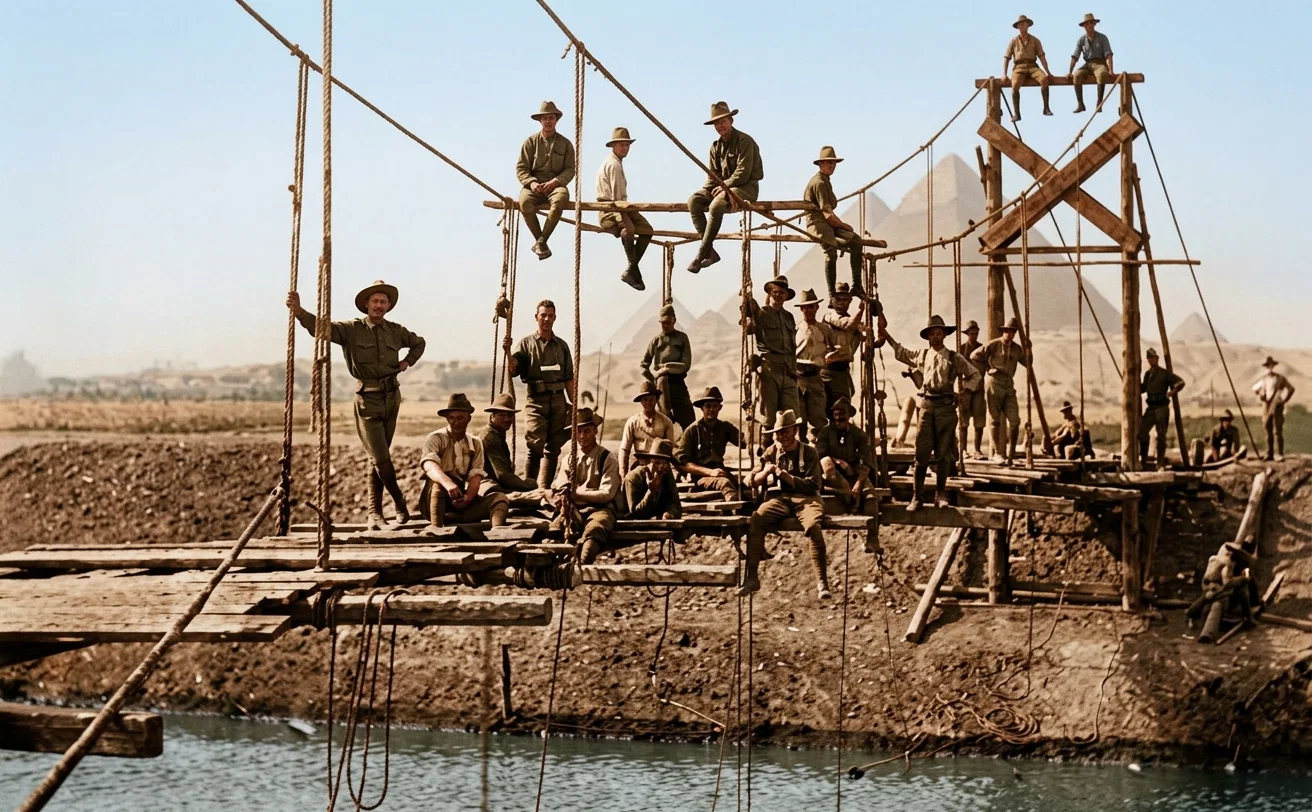
BRITISH FORCES IN EGYPT
As our vessel overtook the convoy, our captain drew near enough to the line of twelve ships nearest us to exchange friendly greetings. There were parents on our ship whose boys were on the transports, and there were women whose husbands were officers among these troops.
This was the strangest, most impressive sight of my life on the high seas. They formed a square, as nearly as we could judge, twelve miles wide and fifteen long. They were traveling in three lines of twelve ships each. Four men-of-war kept near—one leading, one guarding the rear, one protecting the right, and another the left. Two were scouting some distance to the front and left, while the remaining two kept vigilant watch to the front and right.
I have never seen anything that more impressively pictured “grim death” than those forty-four great ships, with bows all pointing toward the battle field, sailing in perfect order, but with steady progress toward the conflict.

A Lecture and an Order for the Captain

The commodore of the convoy flagged our captain a lecture for approaching so near to his ships, and gave orders that no letters telling of the convoy should be posted within fourteen days, and that all photographs that might have been taken should be destroyed or at least kept secret for a fortnight, by which time it was supposed the convoy would have reached its destination.
The fear our passengers had of meeting the Emden, which had become famous in its raids in the Indian Ocean and the Bay of Bengal, made them wish that our ship might be slipped in among the transports and receive the protection of the warships guarding them, but we were obliged to steam on ahead.

Barely Missed by the Emden

Our regular course lay along the Cocos Islands. This was the route followed on the last voyage out to Australia. But on this occasion, our captain altered his course a little, leaving the Cocos Islands about fifty or sixty miles to the north.
It was fortunate for us that he did this; for on our arrival at Colombo, three or four days later, we learned of the fate of the Emden at the Cocos. It is believed that she was waiting there for our boat, in order to get food and coal. Her attempt to put the wireless station on the island out of commission led the operator to send out the call for help that brought the warship Sydney, which ended the raids of the Emden. I understand the Sydney was one of the two scouts guarding the convoy on its right.
Taken all together, the events of this voyage gave us a fuller realization of the reality and the meaning of war. And this has been deepened, while traveling about India, by the manifestations of loyalty to the government, and by the outbreakings of sedition and rebellion. The war spirit certainly runs high on both sides, and this creates a very delicate situation to be handled.
As one writer of acknowledged authority in India says, “India flamed with an amazing burst of feeling in support of the empire. The swords of Indian princes leaped from their scabbards, and one and all immediately offered their forces, their funds, and themselves for the service of the raj.”

The Forces of Anarchy and Sedition

On the other hand, there were forces both in and out of India that were looking for an opportunity to fan the fires of anarchy, sedition, and rebellion into a devouring flame. This I saw while traveling in the northwest, along the borders of Afghanistan, where trainloads of troops were hurried to suppress the uprising; and again in Burma, where hill tribes were being put down; and later in Singapore, where a part of a regiment mutinied, and started war on innocent, unprotected civilians.
All these exhibitions of the fighting spirit are expressions of the thirst for carnage and bloodshed that possesses humanity the whole world over. They show the folly of crying, “Peace, peace,” when there is no peace. They are a sad commentary on the present state of civilization and religions of all names.

Conditions in India

India is undoubtedly the most religious country on the face of the earth. Gods, temples, shrines, images, and worshiping devotees are to be seen everywhere one turns. And the very presence of these gods and worshiping millions, coupled with the illiteracy, superstition, and wickedness that everywhere abound, overwhelms one with unutterable sadness and depression. Of the 315,000,000 of India, 313,000,000 are reported by statisticians to be religious. Of this number, only 4,000,000 profess the Christian religion, and these include Roman Catholicsand Protestants. The Protestants number nearly 1,000,000.
The 309,000,000 are composed of Hindus, 217,000,000; Mohammedans, 66,000,000; Buddhists, 11,000,000; animists, 10,000,000; and various other heathen divisions, 5,000,000. Of all these 309,000,000 heathen, only 20,000,000 can read and write in any language, 289,000,000 knowing only what they hear. They are surrounded by a great wall of ignorance cemented by superstition, which it is very difficult either to break through or to scale.
To the ignorance and superstition of centuries must be added the degradation, the sin, the moral pollution of body, mind, and heart, that naturally go with them. As I have gone about all India seeing and reflecting, I have been made sad and sick at heart. Yet I have been drawn to the country and to the task, stupendous as it is. And I have been amazed at the courage manifested by our missionaries in the field who are grappling with this great problem. In further reports, I shall endeavor to give a little clearer statement in detail of these different religions and their influence, and also to tell of the encouraging results of the self-sacrificing labors of devoted missionaries.