AMONG the most significant phenomena of our age is the general apprehension that mankind is nearing the great finale of earth’s prophetic scenes, Armageddon, the second coming of Christ, the end of the world. This great expectation is the more remarkable because it is not so much the result of what has been said or is being said, as it is of what is seen and felt; a conviction born of fear and alarm at the sudden veering of events toward threatening destruction; a premonition arising from the desolations of earthquakes, the calamities of an almost universal war, and the terrors of famine and pestilence, mixed with a consciousness of the striking similarity between what the world is now witnessing, and what God has foretold in His word.
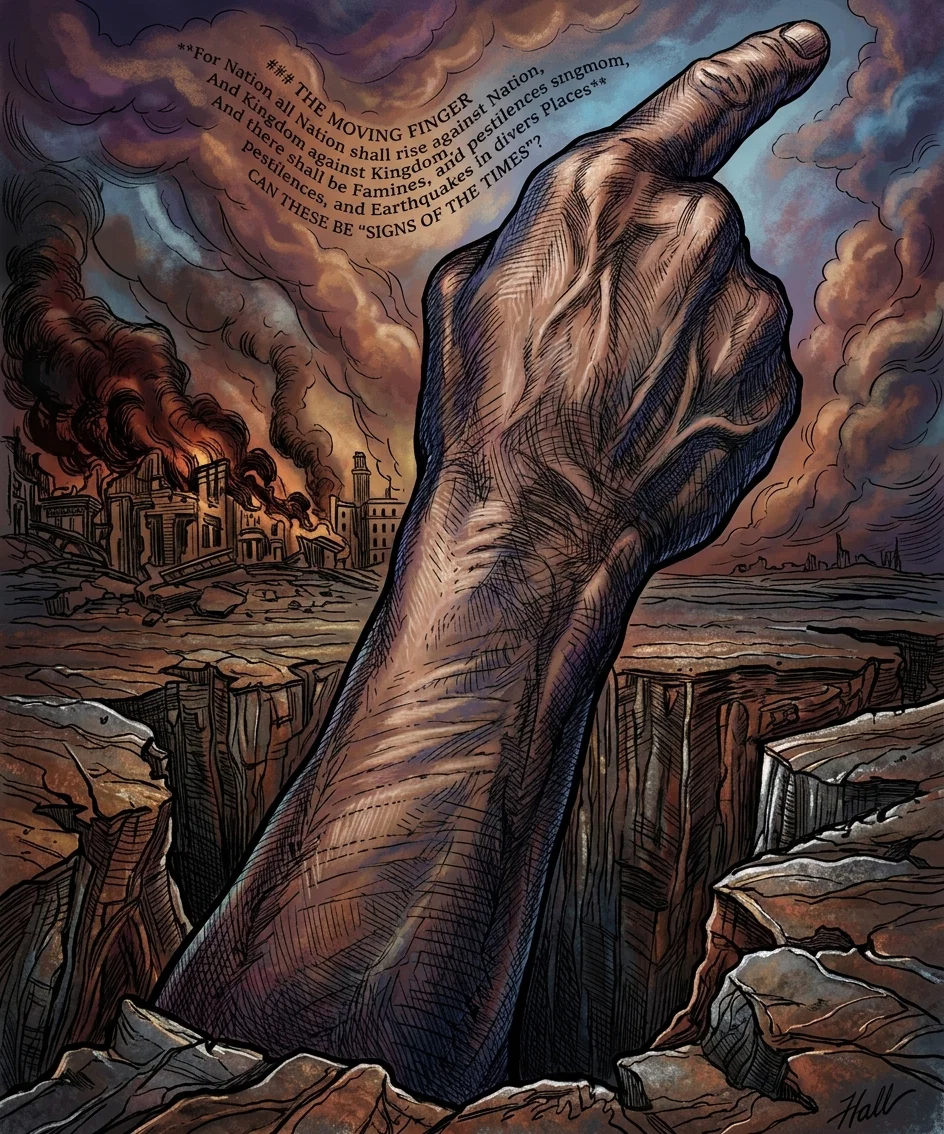
The impression which the present reverses of our woe-stricken world are producing upon the minds of men is illustrated by the accompanying cartoon, which appeared in a recent issue of the Baltimore American. The newspaper artist paints the very words of our Lord as found in Matt. 24:7, upon the clouds that overhang a scene of devastation; and a giant hand protruding from the rent earth, points to the divine prophecy. Underneath he asks a question that has come instinctively to the hearts of thousands: “Can these be ‘signs of the times’?”
Cardinal Expects End of World
Press dispatches from Baltimore on February 17 said: “The Scriptures prophecy of the conditions that shall prevail near the end of the world, seems to be in process of fulfilment , according to a statement made to-day by Cardinal James Gibbons. He was commenting upon the war news from Europe, which he said was terrible.”
“We cannot grasp its magnitude or what it means,” he said. “Does it not seem that the Scriptures are being fulfilled—‘Nation shall rise against nation, and there shall be sorrow throughout the world, and then shall the end come’?”
It may seem significant also that those countries most affected by these deplorable afflictions, as Belgium and Poland, are those which have adhered most faithfully to the Catholic religion. While these have been shattered by war, the very throne of the pope has been shaken by the ravages of earthquake in Italy, where a hundred thousand persons have been destroyed by such disasters since the opening of the twentieth century. Ominous already of prophetic wrath,
“Pale superstition flees the bloodstained sod, And wondering nations see the day of God.”
Turks Believe the End Near
Dr. G. Ermain, who has lived as a missionary among the Turks, writing to the Review and Herald, Washington, D. C., of the expectation which prevails among them with reference to the closing events of the age, says: “From my personal experience, I can say that the Turks generally believe that the end of the world is very near. They seem to believe this more firmly than most of the nominal Christians.”
In his book entitled “Kismet,” Mr. Macfarlane, referring to such belief among these people, says: “The Turks seem generally to be convinced that their final hour is approaching. ‘It is kismet. We cannot resist destiny.’ I heard words to this effect from many Turks, in Asia as well as in Europe.” — Page 409.
To March to Jerusalem
A few years ago, it was reported from Constantinople that a company of Turks from the Transcaucasus had arrived in Nicomedia, bringing all their possessions with them. When asked if they were intending to settle in that part, they replied that they would settle nowhere permanently, as they had come to follow their leader (the sultan) when he should leave Constantinople to go to Jerusalem. This incident shows the singular impression which has long possessed the Turkish mind, that they would have to flee to Jerusalem before the end of the world. Dan. 12:1-3.
Many Had Dreams
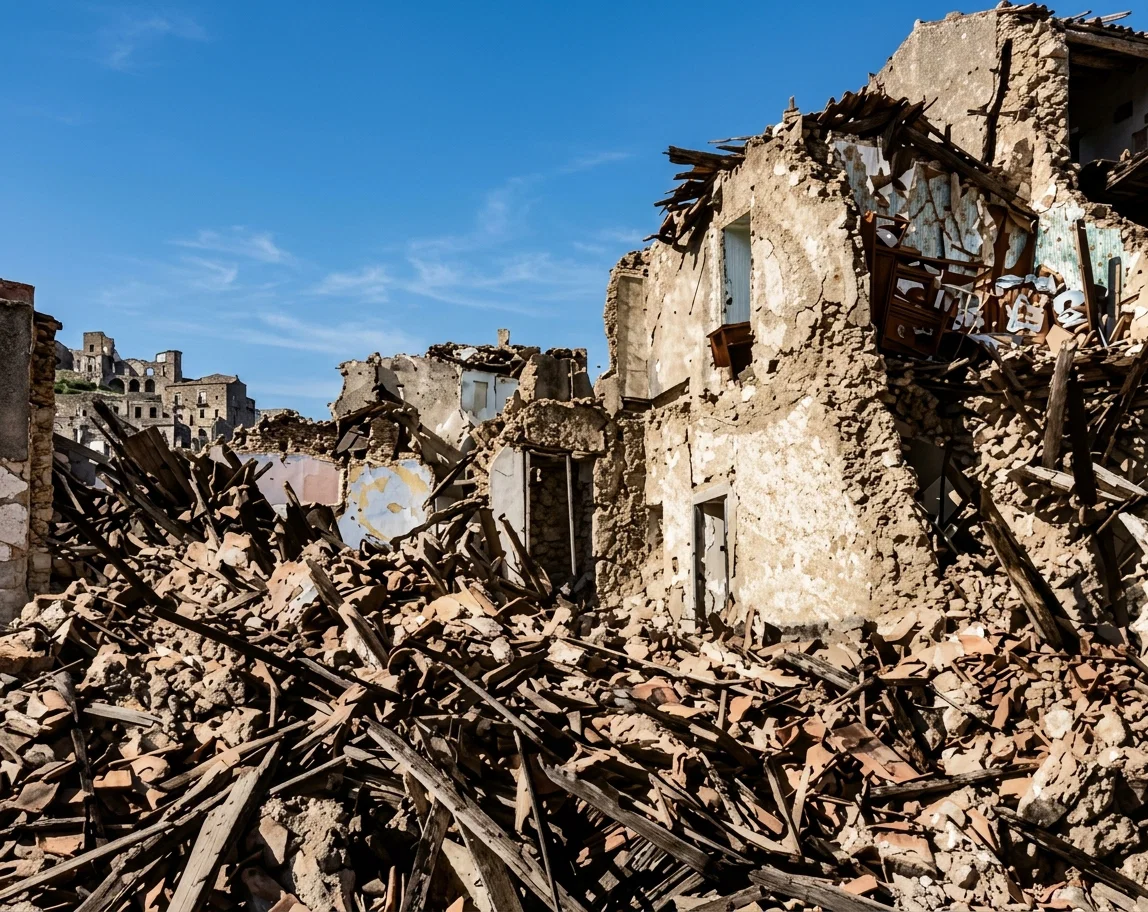
SICILIAN EARTHQUAKE RUINS, 1908
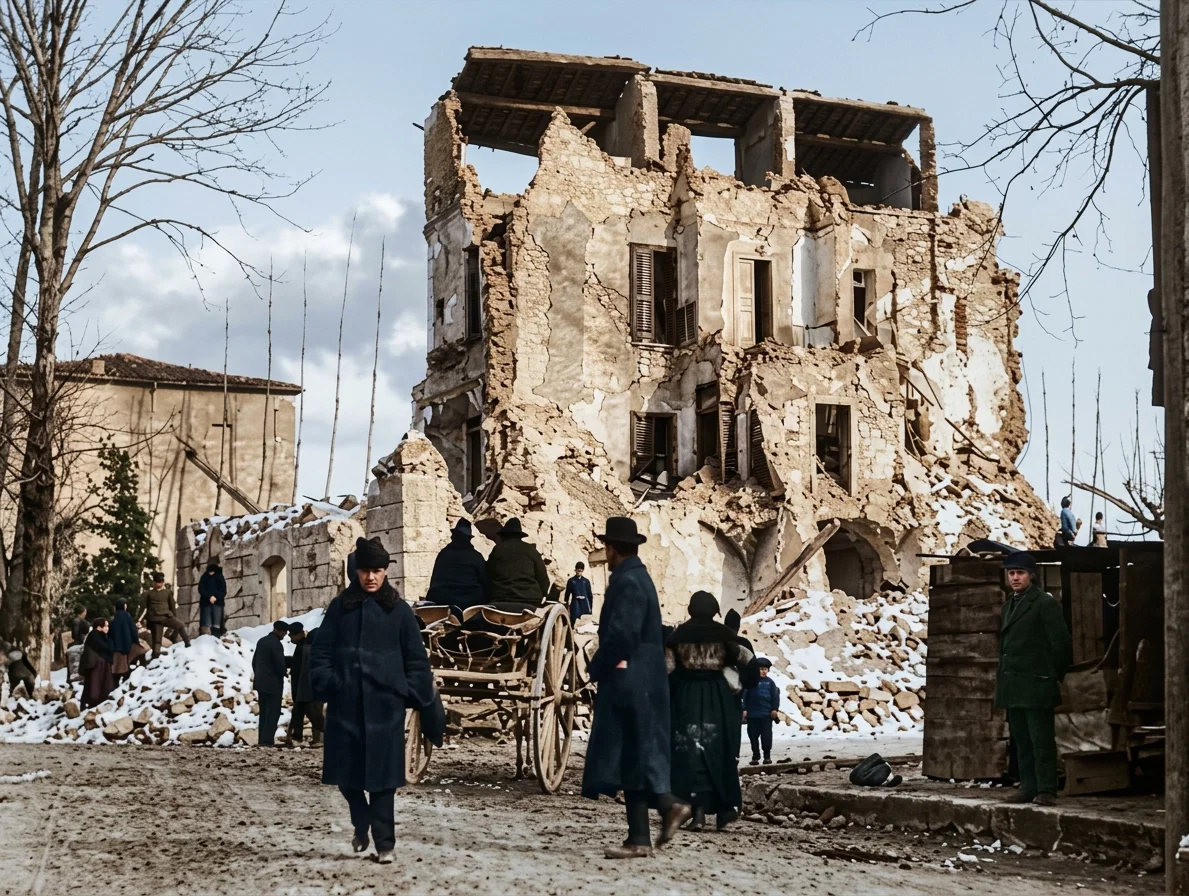
Work of Earthquake in Sora, Italy, 1915
Dr. Donald Carr, in speaking of mission experiences in Persia, relates that “a Mohammedan dreamed that Christ was coming soon again. He told his brother, who had the same dream.2They went to a friend. He had had the same dream. The three set out to find some one to teach them.” On the way, they met a converted robber who had received the knowledge of the gospel from an Arabic Bible found one day among the loot. This man directed them to the mission hospital, where they are now receiving instruction.
“Another man dreamed he saw a vision of a shining person who directed him a certain way. He felt that this was Jesus Christ, and told a friend, who agreed to go with him in search of light. They went two days’ journey to where a white man was, and asked him, expecting that he was a Christian; but he told them he could not help them. They traveled six days to another place with the same result. Finally they came to the mission, where the workers received them gladly and taught them.”
Are not these things in fulfilment of Joel’s prophecy of the outpouring of the Spirit “before the great and the terrible day of the Lord”? Joel 2:28-32.
The Heathen Awakening
In China last year three and a half million copies of the Bible and of portions of it were put into circulation. The story is told of a native teacher who came five hundred miles for a load of Bibles, which he took back on a wheelbarrow and distributed among his people.
Pastor R. C. Porter, in charge of mission work in that great country, in a published account, says: “New fields are most piteously calling for the message. One whole tribe of four thousand is appealing for teachers. Four hundred of them have forsaken their idols. In Pastor Hsi’s territory, hundreds are seeking for more light, in view of the signs which indicate the rapidly approaching end of all things.”
The Great Expectation
When Christ appeared in the world the first time, it is said in the New Testament that “the people were in expectation.” Luke 3:15. The Scriptures had been translated into the Greek language and scattered widely. Many among the nations of that day had pondered the prophecies of the coming Messiah, and were anxiously watching for His appearance.
“When Jesus was born in Bethlehem of Judea in the days of Herod the king, behold, there came wise men from the east to Jerusalem, saying, Where is He that is born King of the Jews? for we have seen His star in the east, and are come to worship Him.” Matt. 2:1-3. It was this general feeling, and the strange experience of the wise men, which so aroused the apprehensions of the crafty Herod. “He was troubled, and all Jerusalem with him.”
The historians “Tacitus, Suetonius, and Josephus speak expressly of this expectation as being very general throughout the east. . . . Virgil alludes to this expectation, and uses almost the very language of some of the prophets respecting the Messiah.” See Wharey’s “Church History,” pages 14-17.
Signs Produce Another Expectation
That the second coming of Christ will be preceded by a similar general expectation throughout the world is plainly taught by the Scriptures. Not only the proclamation of His advent as a prominent feature of the gospel of the kingdom, is to be given in all the world for a witness, before the end comes, but also the nature of the events which were set forth by Jesus as signs of His coming, is such as to stir the world with awe. Said He:
“There shall be signs in sun and moon and stars; and upon the earth distress of nations, in perplexity for the roaring of the sea and the billows; men fainting for fear, and for expectation of the things which are coming on the world. . . . But when these things begin to come to pass, look up, and lift up your heads; because your redemption draweth nigh.” Luke 21:25-28, A. R. V.
Such concussion of nature, such signal occurrences, are clearly intended to arouse the church from its lukewarm Laodicean state, and intensify its missionary love, “to serve the living and true God; and to wait for His Son from heaven.” 1 Thess. 1:9, 10.