Repudiating War Debts

8%

Pacific Press Publishing Association · Mountain View, California · Jun 1, 1915

FromSigns of the Times, Vol. 42, No. 22.

Read the full edition

Repudiating War Debts

THE discussion has already started as to whether or not Europe, following this war, will be able to carry the debt that will be created; and will not these warring nations repudiate their indebtedness? Theodore H. Price, in a recent number of the Outlook, discusses this question at length. He says:
“Nearly all students of the subject agree that the public debt of the belligerents, which was $22,300,000,000 before the war, will be about doubled by July 31. The taxation necessary to support and amortize this aggregated obligation of $44,600,000,000, together with the pensions and other financial burdens of the struggle, will be laid upon a population that found subsistence difficult enough on $57 per capita before the war, and will be terribly impoverished at its close.
“Bluntly stated, the question is: Will the people of Europe repudiate the debts now being incurred, either from choice or necessity?”
Following this statement, Mr. Price asks the further pertinent questions:
“Can they support the burden of the debt now being created? If they cannot, what will be the effect upon the world, and upon America in particular?”
In answering these questions, Mr. Price endeavors to show that it would not be such a great calamity; for to use his words:
“Nonpayment of a national debt simply means that a certain portion of the world's population is freed from the compulsion of being made to turn over part of its earnings to another portion who are thereby enabled to live with less effort. In this view of the matter, default would not be an unmixed evil. The result would probably be higher wages for the working classes, and increased cost of production in Europe, so that America would have less to fear from the competition of transatlantic industry.”
“Many of these theories are very interesting to think about; but why theorize on these great questions? A year ago, the world was convinced that it could never have any more war. It is now trying to make itself believe that this is the last war we will ever have, and many theories are presented as to what will be the outcome in the peace that concludes this strife.”
The hopeful and Utopian theories that are held out are not based upon a substantial foundation. Wherever you turn in this world, you find that society is crumbling. One of the difficult problems in England to-day is to keep down labor troubles while she is prosecuting her war. Germany must use a strong hand in order to hold the forces of socialism that are discontented with the present situation and would break away if they dared. And so it is throughout the world. These conditions of riotous discontent will be worse following this war than they have ever been in all past history. And instinctively, the people who do not know the ground upon which they are standing, will turn to a church and state religion as the only power that can curb these turbulent elements. We see already the strong currents that are tending in that direction.
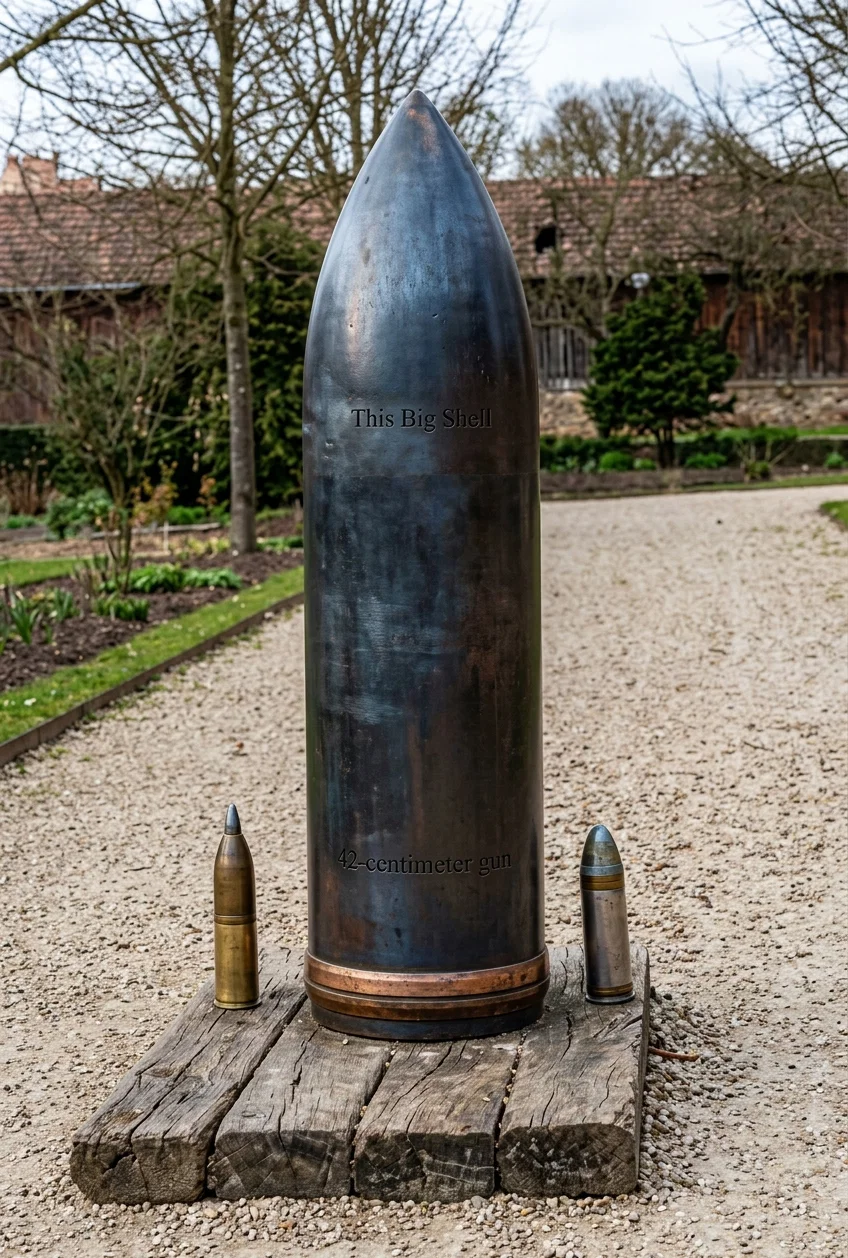
SHELL FOR BIG SIEGE GUN
There will be a brief calm during that time; but it will be a calm that will be ominous to the individual who knows, through the sure, clear light of the prophetic pages, what to expect next. It will be the time to which the apostle Paul referred in the words, “When they shall say, Peace and safety; then sudden destruction cometh upon them, as travail upon a woman with child; and they shall not escape.” 1 Thess. 5: 3.