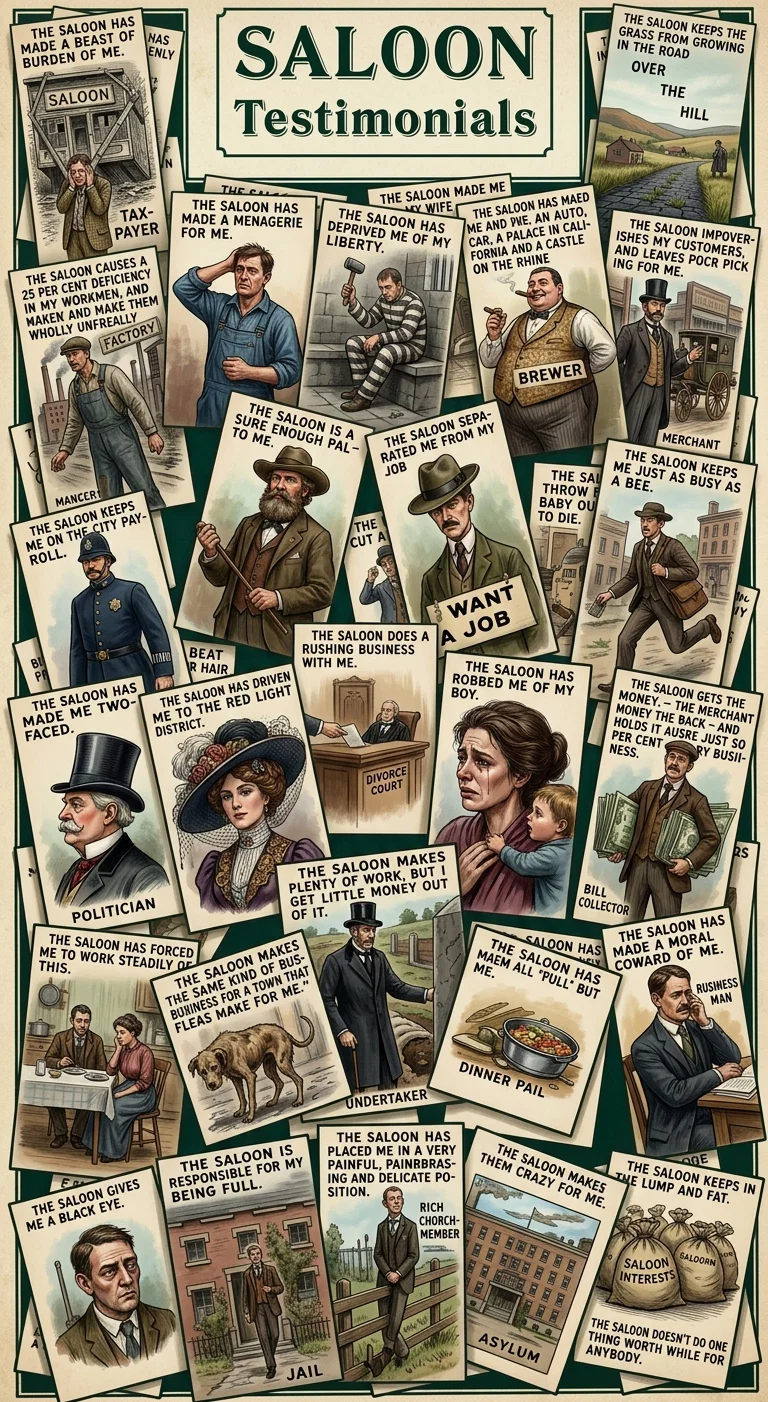
The Law of Self-Protection Demands the Overthrow of the Liquor Traffic—Twenty Thousand Good Homes Absorbed by One Man
By William Mayhew Healey
“EVERY man that striveth for the mastery is temperate in all things.” 1 Cor. 9:25. True temperance consists in the right use of proper things and total abstinence from wrong things.
The use of intoxicating drink is, all things considered, the worst form of intemperance.
Alcohol, the active agent in all intoxicating liquor, has no place or part in nature. No living animal or plant is nourished by it. It is death to them all. It is the product of death and corruption.
To physical nature, alcohol is death in solution. To the mental and moral nature, it is death in delusion.
A DECEIVER
“Wine is a mocker, strong drink is raging; and whosoever is deceived thereby is not wise.” Prov. 20:1.
It deceives the eye by its appearance of purity, while its work leads to vileness and death.
It causes its victims to believe they possess wisdom, wealth, joy, peace, and strength, while it has robbed them of all these, leaving them in folly, poverty, sorrow, strife, and weakness, unfitting them for any position in life.
Temperate men and women are wanted everywhere; but of the hundreds of thousands of drunkards, not one is wanted in any place requiring the highest efficiency.
That drunkenness is a curse, is generally admitted by all; but some deny the right to prohibit, by law, the manufacture or sale of intoxicating liquor; “because,” they say, “that takes away one’s personal liberty.” They claim that “certain places should be designated where liquor may be sold, and licenses issued to persons of good moral character to sell it in an orderly and respectable place.”
HAS NO INHERENT RIGHT
In granting a license for the sale of liquor, there is an admission that the business does not exist by its own right, but by sufferance, by permission.
If the officials or the people of a state, a county, or a city have the right to decide where and how many liquor-selling places are needed, and to govern them accordingly, then they have the right to decide that none are needed. The right to regulate the number and place of saloons, carries with it the right to abolish them entirely.
Why try to regulate the work of outlaws and rattlesnakes, when everything about them is bad? It is so with the liquor business. There is nothing good to regulate.
Personal liberty is a God-given, sacred right of manhood; but it does not give any one the right to perform acts that injure another. All admit that a person has no right to be on the streets in a state of intoxication, and that in such condition he may be arrested and deprived of his liberty. This is not simply for his benefit, either to punish or to reform him, but because he has become a menace to the rights and liberties of others. If one has no right to be intoxicated, he has no right to do, or to aid others in doing, that which will produce intoxication. This must be admitted. Then what right has any one to manufacture, sell, or give away for drinking purposes, or himself drink intoxicating liquor, as these acts all tend to intoxication, which endangers the peace, property, and lives of a community?
It is the law of self-protection, the first law of nature, that gives the right to prohibit the liquor business. The burning desire to see manufacturers, wholesalers, retailers, and drinkers reform, does not give the right to interfere with the liquor business; but the right to self-protection, which means protection of one’s person, property, home, city, country, and all that belongs to them, does give that right.
It is not the purpose of civil government to reform individuals. That work belongs to Christianity. Civil government is to protect its citizens from those whom Christianity has not reformed. If the law sends one person to jail because he needs reforming, it should send all there who need to be reformed; and if this were done, there would not be enough people at liberty to feed those who would be incarcerated.
It was a mistaken idea of the true purpose of civil government that led to the use of its power in religious persecution. The same error is leading some to ask for laws to compel a religious reform in Sunday observance. This would be coercion, not protection. The refusal of some to rest on Sunday, or on any other day, does not interfere with the liberty of others to do so. It does not endanger their lives or their property, nor increase their taxes.
The fast friend of shipwreck, and train wreck, and health wreck, and home wreck, and business wreck, and character wreck.—John G. Woolley.
From “The Shadow of the Bottle”
THE CHARGES PREFERRED
The liquor traffic is guilty of all these evils. Four fifths of all crime is caused by it. It wastes and destroys a large portion of our wealth. It greatly increases our taxes. The cost of crime in California directly caused by liquor, exceeds one dollar a month for each man, woman, and child in the state.
The state, by law, denies the right to produce, import, manufacture, sell, use, or even have in possession opium in any quantity. The right of the state to do so, goes unquestioned except by the opium fiend and those who would make money from the traffic. The same rights and truths apply with greater force to the liquor traffic.
It is said that prohibition will injure business. Doubtless it does interfere with some men’s business. So does the law against burglary and theft.
A SIXTY MILLION BEER FORTUNE
A beer manufacturer died recently, after accumulating a fortune of over $60,000,000. Prohibition would have interfered with his ruin of 20,000 homes at an average cost of $3,000 each to make up his colossal fortune. It would have interfered with taking the shoes and dollars that should have gone to feed the half naked, half starved children in thousands of families, who were crying for a crust of bread that the heartbroken mothers could not give. Prohibition might interfere with some men’s business, but not with any one’s rights.
The liquor interests are trying to create prejudice against prohibition in California, claiming that it would greatly injure the state by destroying its grape industry. Facts seldom make as much noise as do prejudice and personal interests, but they outlive both.
The United States census of 1910 gives the value of all grapes raised in California that year at $10,846,812, an average of about $4.50 per capita of population. Over one half of this value was for raisin and table grapes, leaving the value of the wine grapes, the only kind that would be affected by prohibition, at about $2.00 per capita.
IT COSTS TWELVE DOLLARS EACH
The cost of crime to the state in 1912 was $37,153,471. The best data obtainable shows that over 80% of this crime was caused by liquor. That is, $29,722,776 is what the liquor business cost the state for crime alone—in other words, $12 for each inhabitant of the state. If California should purchase all the wine grapes raised in the state, and destroy them, it would gain on this one item of crime $2,000,000 a month, $10 a year for each man, woman, and child in the state. This does not include the many millions that would be saved on paupers, insane,366feeble-minded, and orphans; the time saved to laborers, now lost through drink; the better grade and increased amount of work done; the lessening of accidents. The comfort, peace, and joy it would bring to thousands of homes cannot be reckoned in dollars and cents.
It may be said that while the state as a whole would be greatly benefited by prohibition, the producers of wine grapes would be left to bear the loss. But the loss is more in imagination than it would be in fact.
Some of the land now in vineyards would produce other crops equally profitable. In some localities it would be profitable to change to raisin and table grapes. The manufacture of grape juice is a rapidly increasing industry. Aside from all other demands, every grape in the state could find a profitable market, if dried for stock feed. Where necessary, wineries could readily be converted into driers and storehouses.
PROHIBITS ALL BUT OUTLAWS
The last stand taken by those defending the liquor interests is the cry that “prohibition does not prohibit. There is no use of prohibitory law, for more liquor is sold in dry than in wet territory.”
Prohibition must prohibit, else it would not be prohibition. If a prohibitory law does not prohibit, it is because the liquor business is an outlaw element that purposely and intentionally violates the law.
Why do liquor dealers claim that prohibition is an injury to business, if they do more business with it than without it?
If they sell more liquor in dry than in wet territory, why do they spend millions of dollars to keep a state from going dry?
This is not merely a question of politics or religion; its platform of human needs is broad enough to include both in a common brotherhood to oppose the deadly, unmerciful foe of all mankind, King Alcohol.