The Titanic Struggle of the Nations—What This War Will Leave Behind It
A Night of Anguish and a Morning of Joy
By E. E. Andross
Underwood & Underwood
King and Crown Prince of Italy
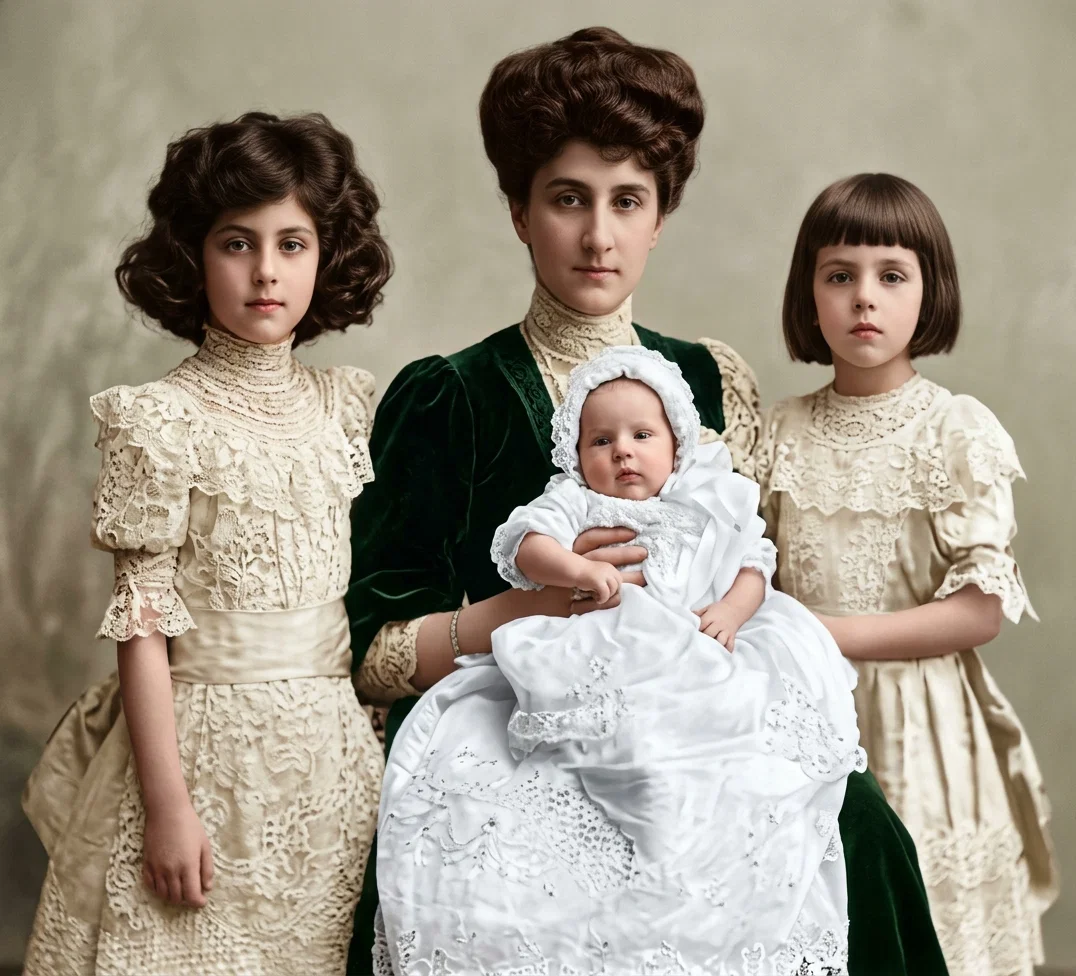
Underwood & Underwood
Queen of Italy and Three of Her Children
“Woe unto us! for the day goeth away, for the shadows of the evening are stretched out.” Jer. 6:4. Though more than twenty-five hundred years have come and gone since the holy seer uttered these words, how like a description of our times they are! Surely the shadows are lengthening, the sun is fast approaching the horizon, and earth’s dark night is coming.
STANDING AT ARMAGEDDON
“Europe stands to-day at Armageddon. On every hand, its proud peoples are rising in their virile strength, and are rushing with earth-shaking tread to that frightful holocaust which may check our civilization—giants grappling to the death in a modern ‘twilight of the gods.’”
Thus wrote George Harvey, editor of the North AmericanReview, in its September issue, 1914. And again, further on in the same editorial, he says:
“Consider also the momentous social possibilities involved in the great war. The existing social order may break down utterly beneath the frightful strain; the governments, with shattered armies and empty treasuries, may crumble in a combined military and financial bankruptcy before the sudden attack of a desperate, hunger-stricken proletariat already fired by the syndicalist gospel of violent social revolution, and the old Europe may disappear in a welter of anarchy. On the other hand, bloodshed and battle may intensify the national consciousness of the European peoples, deepen the hatreds between race370and race, plunge the world into a whole cycle of wars—a new iron age, in which the finer flowers of our civilization would be ruthlessly trampled under foot, and the present era of free thought and individual liberty be replaced by the hand of military despotism.
“Again, consider the possible reactions of this European conflagration upon the world at large. Up to a month ago, the white race was master of this planet. Africa was absolutely beneath European sway; while in Asia, only the island empire of Japan had made good its position, and this only by the grace of European disunion and the alliance of the European British Empire. But in these last ten years, a strange breath has passed over the Asiatic world. The victories of Japan have awakened the dormant spirit of the East; and the countless millions of the Orient, once so passive, to-day chafe sullenly at the European yoke. India is seething with unrest at the British ‘raj’; ‘unchanging’ China is changing at last; and their teeming populations are beating fiercely against the white man’s own frontier, and answering his exclusion laws with threats and menaces which may portend still mightier race struggles in the years to come—struggles beside which even the present battle of the nations might seem tame indeed. Also the recent movements in Turkey, Egypt, and Persia prove that in the Mohammedan world as well a new spirit is abroad. Islam is not dead. Its fires of fanaticism are banked, but are not cold; and its two hundred millions of adherents extend from Morocco to China, from Siberia to the Kongo and the Celebes. Should these new spirits continue to walk abroad, what would be the situation of a Europe bled to the point of death by a modern ‘Peloponnesian War?’”
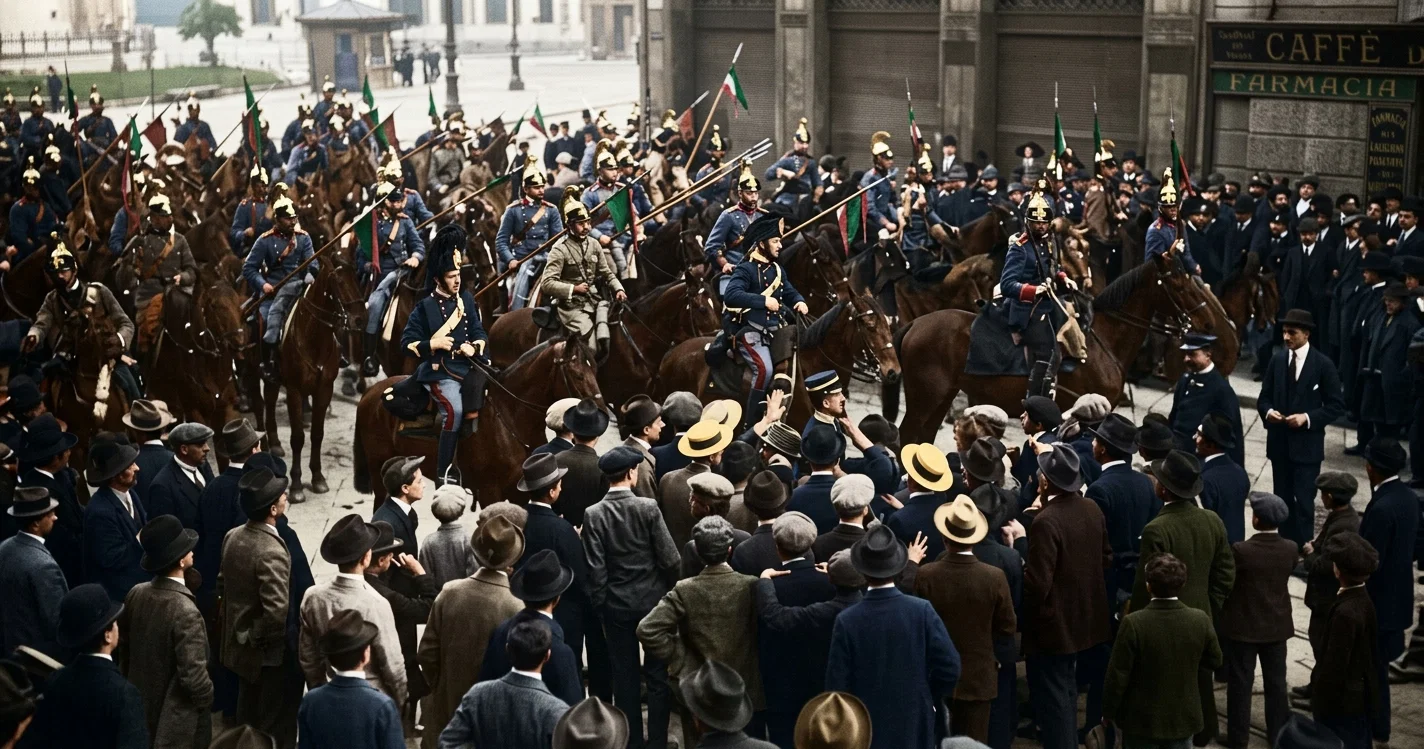
ITALIAN TROOPS PREPARING TO MARCH TO THE FRONT
Surely the dark picture of world conditions thus clearly portrayed points unmistakably to the lengthening shadows that tell us night is coming.
MILLIONS OF WIDOWS AND ORPHANS
From a computation of the cost of war, by Hamilton Holt, editor of the Independent, which appeared in an editorial in the Los Angeles Tribune, March 31, 1915, I take the following:
“It is estimated that by the earliest day that peace possibly can come, there will be in Europe more than two and a half million war-made widows, and more than six million seven hundred thousand fatherless children.
“It is impossible to compute statistically the grief, misery, and want necessarily involved in these amazing totals. Hunger and suffering do not lend themselves to the processes of arithmetic. Blasted homes are not to be expressed in algebraic symbols, and stunted lives are not to be interpreted by mathematics.”
The shades of night are falling fast; but, O, how we long for the morning that will bring eternal deliverance from strife and conflict, from war and bloodshed, from sickness, sorrow, pain, and death, to break over this dark, dark world! As sure as God sits upon the throne of the universe, and is “a God of truth and without iniquity,” so surely will that glorious morning dawn sometime; and we believe that the prophetic Word clearly reveals the fact that it will break soon—yea, more, that its gleams may, with the eye of faith, already be seen piercing the darkness.
After man’s fall in the Garden of Eden, the promise of a Saviour was given. The period intervening between the giving of that promise and the moment when our great High Priest will cease His work as man’s intercessor, is called “the day of salvation.” 2 Cor. 6:2.
Before the Saviour comes in power and glory, He will lay aside His priestly garments, and will put on the royal robes. “On His vesture and on His thigh a name [will be] written, King of kings, and Lord of lords.” On His head will be “a golden crown, and in His hand a sharp sickle.” An “angel came out of the temple, crying with a loud voice to Him that sat on the cloud, Thrust in Thy sickle, and reap: for the time is come for Thee to reap; for the harvest of the earth is ripe.” Rev. 19:16; 14:14, 15.
Following the close of our Lord’s work as High Priest and Advocate, the decree will go forth: “He that is unjust, let him be unjust still: and he which is filthy, let him be filthy still: and he that is righteous, let him be righteous still: and he that is holy, let him be holy still. And, behold, I come quickly; and My reward is with Me, to give every man according as his work shall be.” Rev. 22:11, 12. With the going forth of this decree, the day of salvation will close, and the night of trouble and anguish for the wicked will begin. Jesus said, “The night cometh, when no man can work.” John 9:4. “At that time shall Michael [Christ] stand up [begin His reign], the great Prince which standeth for the children of thy people: and there shall be a time of trouble, such as never was since there was a nation even to that same time.” Dan. 12:1.
THESE MIGHTY CONFLICTS FORETOLD
The prophet Jeremiah speaks of the time of trouble as follows: “Behold, a whirlwind of the Lord is gone forth in fury, even a grievous whirlwind: it shall fall grievously upon the head of the wicked. The anger of the Lord shall not return, until He have executed, and till He have performed the thoughts of His heart: in the latter days ye shall consider [‘understand,’ R. V.] it perfectly.” Jer. 23:19, 20.
The prophet speaks further of this time of trouble, this night of anguish to the wicked, graphically describing its results: “The Lord shall roar from on high, and utter His voice from His holy habitation; He shall mightily roar upon His habitation; He shall give a shout, as they that tread the grapes, against all the inhabitants of the earth. A noise shall come even to the ends of the earth; for the Lord hath a controversy with the nations, He will plead with all flesh; He will give them that are wicked to the sword, saith the Lord. Thus saith the Lord of hosts, Behold, evil shall go forth from nation to nation, and a great whirlwind shall be raised up from the coasts of the earth. And the slain of the Lord shall be at that day from one end of the earth even unto the other end of the earth: they shall not be lamented, neither gathered, nor buried.” Jer. 25:30–32.
One of the most prominent signs of the coming of the world’s night will be the driving of the Turk from Europe, and the final establishment of his capital in Jerusalem. When he shall have made the holy city his capital, the next event in the order of the prophecy will be the beginning of the reign of Christ, to be followed by the time of trouble. Dan. 11:45; 12:1.
BOTH NIGHT AND MORNING
But the prophet of God declares, “The morning cometh, and also the night.” Isa. 21:12. While the coming of Christ will bring the night of death to the wicked (2 Thess. 1:7–9; Rev. 6:14–17), it will bring the morning of deliverance to the righteous.
“At that time shall Michael stand up, the great Prince which standeth for the children of thy people: and there shall be a time of trouble, such as never was since there was a nation even to that same time: and at that time thy people shall be delivered, every one that shall be found written in the book. And many of them that sleep in the dust of the earth shall awake, some to everlasting life.” Dan. 12:1, 2.
“WE WILL BE GLAD AND REJOICE”
Though the wicked cry for the mountains and the rocks to fall on them and hide them “from the face of Him that sitteth on the throne, and from the wrath of the Lamb” (Rev. 6:16), with holy joy the righteous cry: “Lo, this is our God; we have waited for Him, and He will save us; this is the Lord; we have waited for Him, we will be glad and rejoice in His salvation.” Isa. 25:9. To the righteous dead, the coming of Jesus will be the morning of their eternal deliverance from the bondage of death. To the living righteous, it will be the ineffably glorious morning, when, with the entire family of the redeemed, delivered from the bondage of corruption, they enter upon their eternal reward.
“Soon, and forever, the breaking of day
Shall chase all the night clouds of sorrow away.
Soon, and forever, we’ll see as we’re seen,
And know the day’s meaning of things that have been.
Where fightings without and conflicts within
Shall weary no more in the warfare with sin,
Where tears and where fears and where death shall be never,
Christians with Christ shall be soon, and forever.
“Soon, and forever—such promise our trust,
Though ashes to ashes, and dust be to dust.
Soon, and forever, and union shall be
Made perfect, our glorious Redeemer, in Thee.
When the cares and the sorrows of time shall be o’er,
Its pangs and its partings remembered no more,
Where life cannot fail, and where death cannot sever,
Christians with Christ shall be soon, and forever.
“Soon, and forever, the work shall be done,
The warfare accomplished, the victory won;
Soon, and forever, the soldier lay down
The sword for a harp, the cross for a crown.
Then droop not in sorrow, despond not in fear.
A glorious to-morrow is brightening and near,
When—blessed reward for each faithful endeavor—
Christians with Christ shall be soon, and forever.”