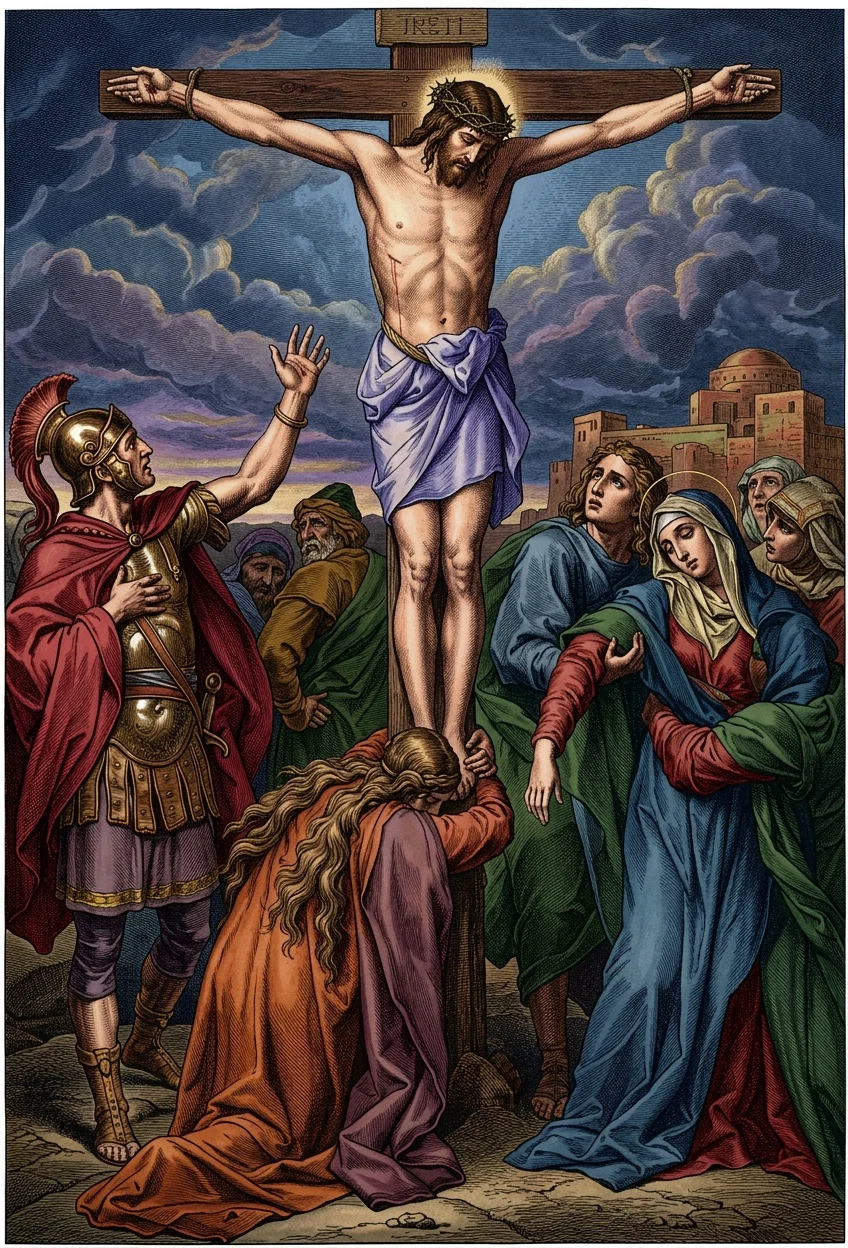
Think Not of Him as Destructive of “the Law”—Three Possible Ways to Have Deal with Sin—The Method of Upholding Law Was Chosen, Though It Involved the Suffering of Calvary
By RUFUS A. UNDERWOOD
“The cross of Calvary is the strongest evidence possible of the unchangeable and enduring character of the law and government of God.”
This is one of several articles that Mr. Underwood has furnished, setting forth the fundamentals of the gospel as presented by the Master in His Sermon on the Mount. Each article is independent of all the others, and hence may be understood whether you have read the others or not. This article comes as a sort of climax to what has gone before, and is exceptionally valuable. Editor.
“THINK not that I am come to destroy the law, or the prophets: I am not come to destroy, but to fulfill. For verily I say unto you, Till heaven and earth pass, one jot or one tittle shall in no wise pass from the law, till all be fulfilled. Whosoever therefore shall break one of these least commandments, and shall teach men so, he shall be called the least in the kingdom of heaven: but whosoever shall do and teach them, the same shall be called great in the kingdom of heaven. For I say unto you, that except your righteousness shall exceed the righteousness of the scribes and Pharisees, ye shall in no case enter into the kingdom of heaven.” Matt. 5: 17-20.
THE LAW UNDER THE SEARCHLIGHT
In these words, Christ puts His seal upon all that has gone before in His exposition of the requirements of the divine law. Christ turned the searchlight of truth upon the moral code, showing its scope, and breadth, and spiritual application, even to the thoughts of the soul. His comment upon the command, “Thou shalt not kill,” reveals that it is not necessary to commit the overt act to be guilty of murder.
Again in the twenty-eighth verse He says: “I say unto you, that whosoever looketh on a woman to lust after her hath committed adultery with her already in his heart.” This sermon, from beginning to end, is an example of Christ’s teaching, and a fulfillment of the prophecy of Isa. 42: 21: “The Lord is well pleased for His righteousness’ sake; He will magnify the law, and make it honorable.”
Christ has not only magnified the law in bringing to view its height, and depth, and breadth, which had never been seen before in their fullness; but in no way did He wish His disciples to entertain the thought that His precepts were to set aside or lessen the claims of the law.
ALL IS BINDING ON CHRISTIANS
Dr. Albert Barnes, in notes on Matt. 5: 18, 19, says: “First, we learn that all the law of God is binding on Christians; second, that all the commandments of God should be preached in their proper place by Christian ministers; third, that they who pretend that there are any laws of God so simple that they need not obey them are unworthy of His kingdom; and fourth, that true piety has respect to all the commandments of God and keeps them.”389
John Wesley said: “The moral law contained in the Ten Commandments, [Christ] did not take away. It was not the design of His coming to revoke any part of this. This is a law which never can be broken. It stands fast as the faithful witness in heaven. Every part of this law must remain in force upon all mankind in all ages, as not depending either on time or place, nor on any other circumstances liable to change; but on the nature of God and the nature of man, and their unchangeable relation to each other.”—“Wesley’s Sermons,” volume 1, sermon 25.
HE NEVER REJECTED THE LAW
Luther said: “He who pulls down the law pulls down at the same time the whole framework of human policy and society. If the law be thrust out of the church, there will be no longer anything recognized as sin in the world, since the gospel defines and punishes sin only by recurring to the law. I never rejected the law.”—“Life of Luther,” page 214.
Luke, in recording Christ’s words, places even stronger emphasis upon its unchangeable character, in these words: “It is easier for heaven and earth to pass, than one title of the law to fail.” Luke 16: 17. Through His prophet, Christ had previously said of His law, “My covenant will I not break, nor alter the thing that is gone out of My lips.” Ps. 89: 34. If the law could have been changed or set aside, it would have been done when man first transgressed the divine command in Eden.
WHAT ANTINOMIANISM INVOLVES
In the light of Christ’s statement and the permanency of His throne, let us look for a moment at what is involved in the theory of the abolition or change of the moral law. The statement and command to our first parents in Eden is given thus: “But of the tree of the knowledge of good and evil, thou shalt not eat of it: for in the day that thou eatest thereof thou shalt surely die.” Gen. 2: 17.
It is unnecessary to trace the steps that followed in the path of disobedience which plunged the world into sin and its consequences. We will suppose that after Adam became a transgressor, and sin had entered the world (Rom. 5: 12), Christ approached the Father in Their councils after this manner: “Are You apprised of what has taken place upon the new world, which started out with such promise under the new kingship of Adam?” With sadness the Father replies to the Son: “Yes; Adam is under the sentence of death. What can We do?”
THREE THINGS WERE POSSIBLE
Three things might have been done: First, Adam and Eve could have been left to their fate, and paid the penalty of sin, which is eternal death. This would have been strict justice. Second, suppose Christ had suggested to the Father that They abolish the law, and thereby set Adam free. This being agreed to, the message is sent in haste to the earth, stating that the councils of heaven had decided, in order to release Adam and Eve from the penalty of death, that the law be set aside.
In such a case, trouble in the government of God would have just begun. A little later, other worlds would have fallen, and the example of God the Father and His Son toward the head of this world must be followed if they are impartial rulers, and hence the violation of law in every world in space would sooner or later have led to the abolition of God’s moral law governing His creatures. One can see at once that these measures would soon have plunged the government of God into chaos.
The One upon whom the maintenance of the government rests (Isa. 9: 6) says it is an easier task for heaven and earth to pass away than for one title of the law to fail. In other words, Christ could have blown out the sun, plucked away the moon, and blotted out of existence this whole solar system, together with all the other systems, more easily than He could have changed one iota of the divine law.
This question had been previously considered, and settled, so far as the inhabitants of heaven were concerned, when Satan rebelled and he and his followers were cast out. The decision had been, “Forever, O Lord, Thy word is settled in heaven.”—Ps. 119: 89.
There was one more step that could be taken, which not only would magnify the law and make it honorable in the sight of the whole universe, but would draw the affections of the whole creation of God to its Author, in ever increasing love and loyalty to its precepts. This was the step that was taken. Christ offers to step into man’s place, to live and die for man as his substitute, meeting the obligations and penalties of the transgressor. In this He could exalt the law and maintain His government, as being of more value than life and all else.
THE SACREDNESS OF CONSTITUTIONS
Consider how the nations of the earth look upon the sacredness of their national constitutions and laws. Take, as an example, the United States of America in 1861, and the little kingdom of Belgium in 1914. Fathers and sons, wives and mothers, sweethearts and sisters, were not only willing that the treasures of gold and silver should be poured out to maintain their law and constitution, which had been invaded, but thousands and hundreds of thousands of lives were laid upon the altar of patriotism, to maintain the honor of the nation and save its foundations.
This principle of government is recognized as more sacred than treasures of gold or life itself. So heaven counted the cost, and was willing to pour out its best gift in the Son of God to save a lost world. This was done to sustain the fullest demands of the law, and also to reveal the love and mercy of an infinite God.
THE LOVE INVOLVED
The apostle says, “Herein is love, not that we loved God, but that He loved us, and sent His Son to be the propitiation for our sins.” I John 4: 10. The meaning of the word “propitiation” I quote from Webster: “The act of propitiating for sin by atonement; enduring to the full penalty, making satisfaction, removing guilt and exposedness to punishment in meeting the requirements of the law.”
Christ in the fullest manner not only paid the penalty for transgression, but He makes the atonement, by meeting the requirements of the law, and lived for man, as well as died for him. When the offer of Christ to live and die for man was accepted by Adam, then, in the mind and purpose of God and His covenant, Christ became a “Lamb slain from the foundation of the world.” Rev. 13: 8. Then the angels could sing, “Mercy and truth are met together; righteousness and peace have kissed each other.” Ps. 85: 10.
The cross of Calvary is the strongest evidence possible to the unchangeable and enduring character of the law and government of God. The whole question involving any possible change had been settled in heaven when Satan was cast out forever; and the same question was settled on earth when Christ on the cross cried out, “It is finished,” and gave up the ghost. John 19: 30.
The perfect moral law is the constitution of the government of God. It must of necessity coexist with the throne of the Almighty.