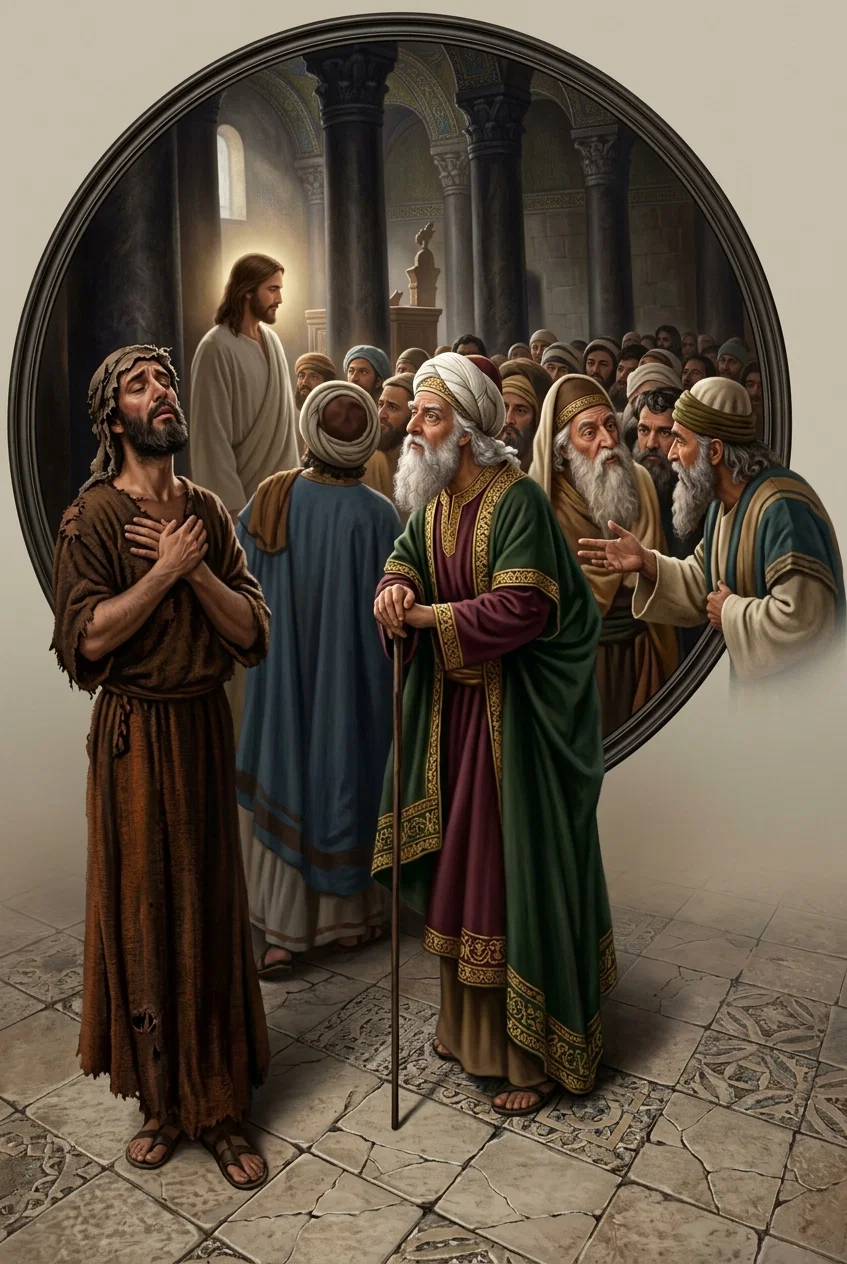
The Pharisee and the Publican—The Self-Righteous Can Get No Help—The Most Dangerous Sin—The Penitent Who Lays Hold of Omnipotence
By Mrs. E. G. White
Unto certain which trusted in themselves that they were righteous, and despised others (Luke 18:9), Christ spoke the parable of the Pharisee and the publican. The Pharisee goes up to the temple to worship, not because he feels that he is a sinner in need of pardon, but because he thinks himself righteous, and hopes to win commendation. His worship he regards as an act of merit that will recommend him to God. At the same time it will give the people a high opinion of his piety. He hopes to secure favor with both God and man. His worship is prompted by self-interest.
And he is full of self-praise. He looks it, he walks it, he prays it. Drawing apart from others as if to say, “Come not near to me; for I am holier than thou” (Isa. 65:5), he stands and prays “with himself.” Wholly self-satisfied, he thinks that God and men regard him with the same complacency.
SECRET OF HIS SELF-SATISFACTION
“God, I thank thee,” he says, “that I am not as other men are, extortioners, unjust, adulterers, or even as this publican.” Luke 18:11. He judges his character, not by the holy character of God, but by the character of other men. His mind is turned away from God to humanity. This is the secret of his self-satisfaction.
He proceeds to recount his good deeds: “I fast twice in the week, I give tithes of all that I possess.” Verse 12. The religion of the Pharisee does not touch the soul. He is not seeking Godlikeness of character, a heart filled with love and mercy. He is satisfied with a religion that has to do only with the outward life. His righteousness is his own,—the fruit of his own works, and judged by a human standard.
COULD NOT EVEN HOPE FOR PITY
The publican had gone to the temple with other worshipers, but he soon drew apart from them, as unworthy to unite in their devotions. “Standing afar off,” he “would not lift up so much as his eyes unto heaven, but smote upon his breast,” in bitter anguish and self-abhorrence. Verse 13. He felt that he had transgressed against God, that he was sinful and polluted. He could not expect even pity from those around him; for they looked upon him with contempt. He knew that he had no merit to commend him to God, and in utter self-despair he cried, “God be merciful to me a sinner.” He did not compare himself with others. Overwhelmed with a sense of guilt, he stood as if alone in God’s presence. His only desire was for pardon and peace, his only plea was the mercy of God. And he was blessed. “I tell you,” Christ said, “this man went down to his house justified rather than the other.” Verse 14.
PETER A LESSON TO BOTH
The Pharisee and the publican represent two great classes into which those who come to worship God are divided. For each of these classes there is a lesson in the history of the apostle Peter. In his early discipleship Peter thought himself strong. Like the Pharisee, in his own estimation he was “not as other men are.” When Christ on the eve of His betrayal forewarned His disciples, “All ye shall be offended because of Me this night,” Peter confidently declared, “Although all shall be offended, yet will not I.” Mark 14:27, 29. Peter did not know his own danger. Self-confidence misled him. He thought himself able to withstand temptation; but in a few short hours the test came, and with cursing and swearing he denied his Lord. When the crowing of the cock reminded him of the words of Christ, surprised and shocked at what he had just done, he turned and looked at his Master. At that moment Christ looked at Peter, and beneath that grieved look, in which compassion and love for him were blended, Peter understood himself. He went out and wept bitterly. That look of Christ’s broke his heart. Peter had come to the turning point, and bitterly did he repent his sin. He was like the publican in his contrition and repentance, and like the publican he found mercy. The look of Christ assured him of pardon. Now his self-confidence was gone. Never again were the old boastful assertions repeated.
Christ after His resurrection thrice tested Peter. “Simon, son of Jonas,” He said, “lovest thou Me more than these?” Peter did not now exalt himself above his brethren. He appealed to the One who could read his heart. “Lord,” he said, “Thou knowest all things; Thou knowest that I love Thee.” John 21:15, 17.
CONFIDENCE IN HIS RESTORATION
Then he received his commission. A work broader and more delicate than had heretofore been his was appointed him. Christ bade him feed the sheep and the lambs. In thus committing to his stewardship the souls for whom the Saviour had laid down His own life, Christ gave to Peter the strongest proof of confidence in his restoration. The once restless, boastful, self-confident disciple had become subdued and contrite. Henceforth he followed his Lord in self-denial and self-sacrifice. He was a partaker of Christ’s sufferings; and when Christ shall sit upon the throne of His glory, Peter will be a partaker in His glory.
THE MOST HOPELESS SIN
The evil that led to Peter’s fall, and that shut out the Pharisee from communion with God, is proving the ruin of thousands to-day. There is nothing so offensive to God, or so dangerous to the human soul, as pride and self-sufficiency. Of all sins it is the most hopeless, the most incurable.
It was necessary for Peter to learn his own defects of character, and his need of the power and grace of Christ. The Lord could not save him from trial, but He could have saved him from defeat. Had Peter been willing to receive Christ’s warning, he would have been watching unto prayer. He would have walked with fear and trembling lest his feet should stumble. And he would have received divine help, so that Satan could not have gained the victory.
The same compassion that reached out to rescue Peter is extended to every soul who has fallen under temptation. Every provision has been made for our infirmities, every encouragement offered us to come to Christ.
LAYING HOLD UPON OMNIPOTENCE
The prayer of the publican was heard because it showed dependence reaching forth to lay hold upon Omnipotence. Self to the publican appeared nothing but shame. Thus it must be seen by all who seek God. By faith—faith that renounces all self-trust—the needy suppliant is to lay hold upon infinite power.
No outward observances can take the place of simple faith and entire renunciation of self. But no man can empty himself of self. We can only consent for Christ to accomplish the work. Then the language of the soul will be, Lord, take my heart; for I cannot give it. It is Thy property. Keep it pure, for I cannot keep it for Thee. Save me in spite of myself, my weak, unchristlike self. Mold me, fashion me, raise me into a pure and holy atmosphere180where the rich current of Thy love can flow through my soul.
THE POWER OUTSIDE OURSELVES
It is not only at the beginning of the Christian life that this renunciation of self is to be made. At every advance step heavenward it is to be renewed. All our good works are dependent on a power outside of ourselves. Therefore there needs to be a continual reaching out of the heart after God, a continual, earnest, heart-breaking confession of sin and humbling of the soul before Him. Only by constant renunciation of self and dependence on Christ can we walk safely.
KINGS SHALL SEE AND ARISE
At every advance step in Christian experience our repentance will deepen. It is to those whom the Lord has forgiven, to those whom He acknowledges as His people, that He says, “Then shall ye remember your own evil ways, and your doings that were not good, and shall loathe yourselves in your own sight.” Eze. 36:31. Again He says, “I will establish My covenant with thee; and thou shalt know that I am the Lord: that thou mayest remember, and be confounded, and never open thy mouth any more because of thy shame, when I am pacified toward thee for all that thou hast done, saith the Lord God.” Eze. 16:62, 63.
Then our lips will not be opened in self-glorification. We shall know that our sufficiency is in Christ alone. We shall make the apostle’s confession our own, “I know that in me (that is, in my flesh,) dwelleth no good thing.” Rom. 7:18. “God forbid that I should glory, save in the cross of our Lord Jesus Christ, by whom the world is crucified unto me, and I unto the world.” Gal. 6:14.
“Thus saith the Lord, the Redeemer of Israel, and His Holy One, to him whom man despiseth, to him whom the nation abhorreth, ... Kings shall see and arise, princes also shall worship, because of the Lord that is faithful, and the Holy One of Israel, and He shall choose thee.” Isa. 49:7.
“For every one that exalteth himself shall be abased; and he that humbleth himself shall be exalted.” Luke 18:14.