Pitiless Force the Argument to Be Used—The New Industrial Unionism and the Coming Conflict
By PROF. G. W. RINE
In three preceding articles, Professor Rine, of the Pacific Union College, has presented numerous facts regarding the various phases of the industrial conflict and social unrest that have become an alarming international peril. Each article, the same as this one, has presented independently some division of the great subject. Next week the professor will produce not only further evidence of the approaching industrial “war,” but will also set forth the testimony of inspired prophecy to the effect that such a struggle will characterize the “last days,” or end of the age. In his article in the issue of November 18, beginning with the last line of page 594, he is made to say the population of the United States, during the second half of the nineteenth century, increased “three hundredfold.” It should have read “threefold.” The population of the nation increased only threefold, while manufactures increased eighteenfold during the same time.
Editor.
Since the great labor revolt of 1877, students of economic history have been predicting that the perennial strife between capital and labor must sooner or later culminate in a class war. Is the prediction well founded? Is such a war probable? There is ample warrant for answering these questions affirmatively. The conviction that such a clash is not only near, but inevitable, obtains almost universally among business men and publicists.
Rapidly Increasing Number of Strikes
The growing antagonism between the two social classes is shown by the rapidly increasing number of strikes during the last thirty years. Between 1880 and 1890 the average number of strikes in the United States annually was, in round numbers, 500; between 1890 and 1900 the average yearly number was approximately 2,800.
During the summers of 1911, 1912, and 1913, England was virtually paralyzed, economically, because of the strike fever which raged intermittently throughout the kingdom. Respecting those irrepressible labor revolts, the London Nation said editorially, in part: “There are several very disconcerting symptoms in this season’s strike epidemic. Perhaps the most serious is the inadequacy—indeed, the triviality—of most of the causes assigned for the stoppages of work. The strike fever has got into their blood. But there can be no doubt that these troubles are symptoms of a discontent among the working classes that is becoming chronic, and is attended by a growing feeling of class consciousness.”
The same writer goes on to express the conviction that this acute, general unrest among the workers is the natural result of popular education, which tends to enlarge and enrich the workers’ outlook upon life. Accordingly, new needs, tastes, and aspirations are spreading among them, which they have not the means to satisfy. They want more money, more leisure, more liberty to enjoy the good things of life, and they chafe ever more intensely against the narrow economic barriers that shut them in.
In a world of congested wealth, the working classes as a whole are finding themselves worse off than ever before. This London editor asks, “Is it likely that they will stand this?” and he answers his own question with an emphatic negative.
Present Trend of Industrial Conflict
In direct reference to the present trend of the industrial conflict, Dr. Josiah Strong writes: “We are building a leaning tower of Pisa with an indefinite number of courses to be added. If we continue building on existing lines, the time will certainly come when we shall pass the center of gravity, and precipitate a catastrophe.” He says further: “Either the wealth of the nation will be made the wealth of the people by a radical change in the fundamental laws of the land, or the rich will be despoiled by violence—that is, I believe that the penalty of failure will be Socialism or anarchy.”
Note the testimony of the Hon. E. J. Phelps, ambassador to the court of St. James, during the second Cleveland administration. In a letter to a friend, he said, “I hope for the ultimate triumph of the republic, but not until after a period of anarchy, followed by the man on horseback.”
Similar testimony of equal weight could be adduced indefinitely would space permit. We shall, however, note the evident bearing of a comparatively new movement in the labor world upon our economic troubles.
Syndicalism and “Direct Action”
In all the great industrial nations of the world, there has risen in recent years a movement which is obviously destined to contribute powerfully to the precipitation of the inevitable social upheaval.
Syndicalism—known in the United States as the Industrial Workers of the World—had its birth in France in 1895. It came into being chiefly as a protest against what its originators conceive to be the supineness of the old trade-unionists, and the ineffectual methods adopted by them to secure redress of the grievances of labor. Like a flash the movement found its way into Germany, Austria, Russia, Italy, Great Britain, and the United States.
Aim and Animus of the Movement
Mr. F. C. Pease, the most brilliant advocate of the I. W. W. movement, in an article contributed to the August (1913) Forum, said in reference to the I. W. W. convention of 1905, “For the first time a definite, conscious class movement of the proletariat toward revolution was launched upon the American continent.” In respect to the character and aim of the movement, he explains: “It is a secular movement of men, and not the rallying ground of aspirants for a New Jerusalem. . . . It is a new psychology, a new value-creating economic mechanism. It seeks economic control, for that is power. . . . Its militancy is more implacable, more potential, more aggressive, than the ephemeral ‘programs’ with which idealists have tortured the proletariat hitherto. . . . We are interested in the propagation of revolutionary economics, in the organization of the proletariat on strictly class lines for the actual control of industry, and the abolition of the wage system. This is our conception of revolution, nothing less.”
In the preamble of the I. W. W. constitution are found these ominous words: “The working class and the employing class have nothing in common. There can be no peace so long as hunger and want are found among millions of working people, and the few who make up the employing class have all the good things of life.”
In the Independent, January 9, 1913, Mr. Andre Tridon, a militant leader of French Syndicalism, tells us that Syndicalists do not recognize the right of the employer, as such, to live, any more than a physician recognizes the right of typhoid bacilli to thrive at the expense of the patient, the patient merely keeping alive. The employer is, in their eyes, not a part of the social body, but a parasite on the social body. He must for that reason be driven out of existence by all available means, much as pathogenic microbes must be driven out of the patient’s system, the choice of remedies being determined solely by the physician’s care not to affect harmfully the patient’s vital organs. He declares that Syndicalists can no longer brook the slow, devious methods of legislation. Their weapons are sabotage and the “general strike.” Sabotage is tantamount to direct action, and both spell unlawful force or violence.
A few methods of applying sabotage in the several industries are set forth by Mr. Tridon, as follows: Coal can be set on fire in the pockets; explosives can be put into boilers; acids can be used to corrode boiler tubes; emery and sand can be put into the oil-cups; dynamos and transformers can be managed by short circuits and inversion of poles, etc.
Revolutionary, and a Complete Overthrow
Respecting the attitude of Syndicalists toward the general strike, the London Times said not long ago: “The general strike of Syndicalism is not a means of securing higher wages. It is a revolutionary act. . . . It aims at the complete overthrow of the existing order by the cessation of all activity. The manual workers stop work, society comes to a standstill, food is soon exhausted, there is no public lighting or conveyance, plundering and disorder begin, the soldiers are called out but refuse to turn against the rioters, and lo! the revolution is accomplished.” The reader is doubtless aware that the one all-comprehensive740objective of the Syndicalist (I. W. W., in America) propaganda is to prepare the toiling masses of a whole nation for a simultaneous strike, and thus bring the nation’s industries to a complete standstill. This unique consummation would render capitalism an impossibility, and would reduce society to such an absolute plight as to compel it to surrender unconditionally to the demands of the strikers, who would then proceed to appropriate and socialize all the sources of wealth and all the means of production and distribution. This end once realized in any one nation, the same end will be quickly realized in all other civilized nations.
Revolutionary Doctrines—The “Creed of Force”
“Syndicalism—the Creed of Force” is the title of a paper contributed to the Independent, October 30, 1913, by Mr. A. M. Giovannitti, one of the most accomplished I. W. W. leaders. In this article he says, in part:
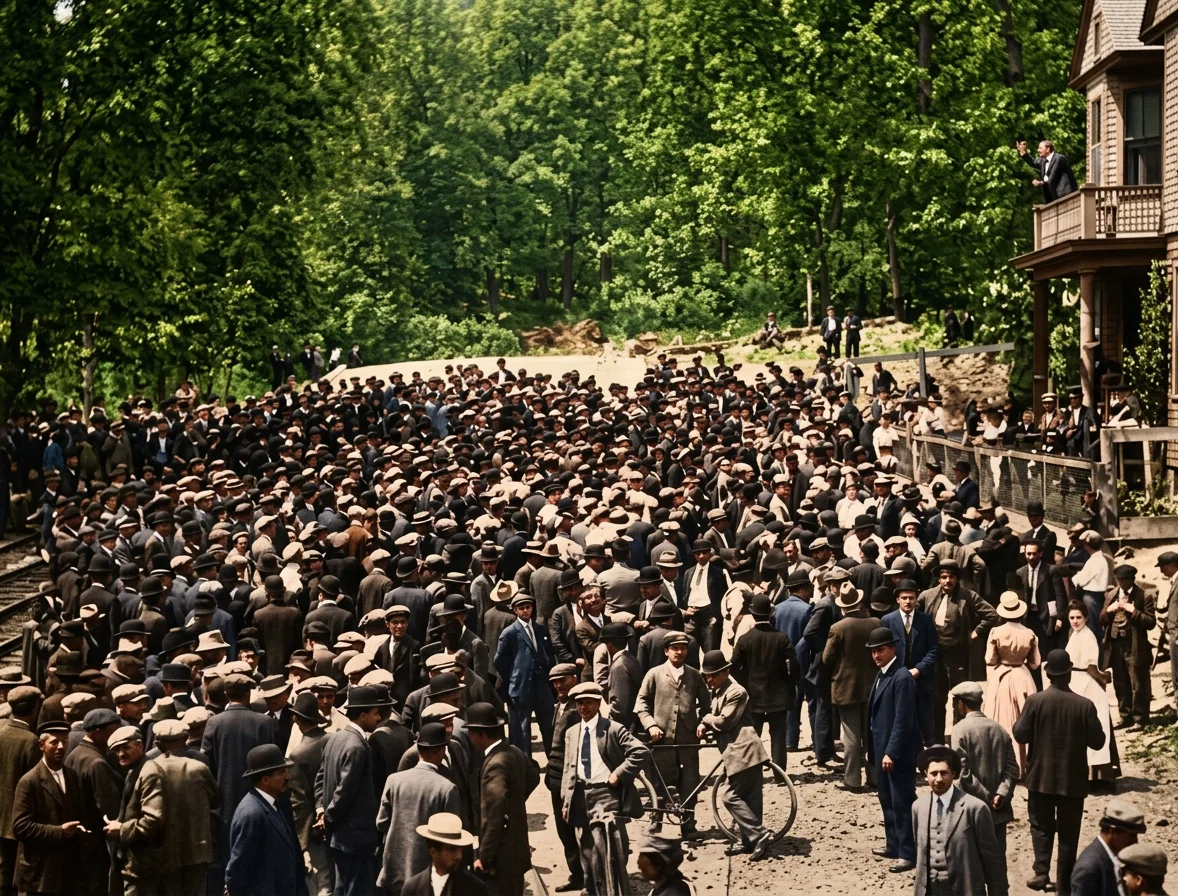
Photograph by Underwood & Underwood, N. Y.
“Now the I. W. W. is avowedly levying war on capitalist society, and so its tactics are neither justifiable nor unjustifiable; first, because the only law of war is to inflict the greatest possible harm by the least effort. . . . In the ultimate analysis, what the I. W. W. wants is the unconditional surrender of the capitalist class, and this would mean the social and economic demise of all the other classes whose existence is conditioned by the existence of capitalism. It follows that we can never expect anybody outside the militant working class to agree with such a fierce proposition. . . . The question that Syndicalism bravely confronts and lays down for discussion, is not one of right or justice, but one of force, taking the word in its broadest meaning. To quote the unrefuted axiom of Marx: ‘Between two irreconcilable conflicting interests, the only arbiter that can decide, is force.’”
“Verily, the law, like bourgeois morality, is no concern of ours; as our movement, which is essentially revolutionary and aims at the complete transformation of the economic foundations of society, must necessarily subvert its social, ethical, and juridical superstructure also.”
“The industrial revolution toward which the I. W. W. is steering the laboring classes is, therefore, not an economic question only, but it implies a complete and radical revolution of all the spiritual conceptions and forces now operating in capitalistic society. . . . Thus while we are not concerned with what the other classes consider right and wrong, on the other hand we create our own laws, our own moral values, and the strongest spirit of responsibility and interdependence ever known among men.”
“You will call this a fearsome creed, a sinister philosophy of force. So it is. Our ethics are the ethics of power, those of the absolute social and economic dictatorship of the proletariat, exactly as yours are those of the supreme mastery of plutocracy, or of the exclusive dominion of middle-class cowardice and imbecility. No, we do not believe in killing or bearing false testimony against you, our neighbor, nor do we want your ass, your ox, or your wife, but we do want your land, your machinery, your mill, your mine, your railroad, and your beloved thirty-six per cent—and we are going to take them back, as surely as you have stolen them from us. . . . We are going to do what we need and intend to do, simply because we have the power to do it.”
“Most Portentous Movement of the Times”
Not at all strange, is it, that the editor of the Independent, in the issue of January 9, 1913, was led to say that the rise of Syndicalism, or “industrial unionism,” is the most portentous movement of the times in the labor world? Its plan is ceaseless class warfare without regard to the humanitarian rules of war. “Its weapon is direct action, a euphemistic term which has been used to cover all sorts of violence.”
In the editor’s comment upon Mr. Giovannitti’s article in the Independent above referred to, he says: “Mr. Giovannitti throws down the gauntlet to civilization. He says that he and his associates are for war, and they acknowledge no standards, no principles other than the purposes of the proletariat.”
Syndicalists avow insistently that they have nothing in common with other classes of society, that they do not recognize the “public,” the “people,” the “nation,” Christendom, or humanity—they know only the working class, and doggedly maintain that outside of that class there is not, nor ever can be, any hope of salvation “in the great social hereafter.” Their leaders allege that the last and everlasting god, creator of all life and beauty and happiness, is—LABOR.
Surely the situation to-day is tense, and it is daily growing tenser. We are inevitably headed for trouble. Prophets of things mundane are announcing the oncoming of social bankruptcy. They insist that there is enough material of discontent already in solution to make a red revolution when the precipitation moment arrives. Mr. Bouck White, a social worker in New York City, says piquantly: “There is piling up to-day the vastest accumulation of vested rights that the world has ever seen; and there is moving toward it a lava stream of insurgency. Voices cry a head-on collision not far ahead.”