Representative Acts of Cruelty and Persecutions They Passed Through—Difficulties in Securing Their Privileges of Worship—Whole Sections of God's Word Memorized
By H. H. Hall
In a preceding article, Mr. Hall traced the history of the Waldenses in an unbroken line back to the days of the apostles. Others of his articles have told of their apostolic tenets, their intense missionary activities, and their well-organized and effective educational system in training their missionaries. One more article is to follow, on the subject of their return to their valleys after the persecutions and war described in this issue. Editor.
“All that will live godly in Christ Jesus shall suffer persecution,” said the apostle. That being one of the standards by which to judge the godliness of a people, the Waldenses certainly rank high. It does not fall within the province of these articles to list, even, the thirty-seven or more general edicts against them, many of which aimed at their total extermination, nor to speak of the continued persecutions to which they were subject for centuries. We will merely refer to a few representative acts of cruelty in Piedmont and southern France.
Atrocities in Southern France
We have already learned of the work of Waldo in translating, transcribing, and circulating the New Testament and gospel tracts; also of his expulsion, with his followers, from Lyons, France, in the latter part of the twelfth century. Like their worthy predecessors in the times of the apostles, they went everywhere preaching the Word. The people of the rich and fertile provinces of southern France, now known as Languedoc, Provence, and Dauphiné, were accepting their teachings with rejoicing, when the papal thunderbolts began to be heard. Listen:
“The Council of Tours, 1163, under Alexander III, stripped the heretics of their goods, forbade, under peril of excommunication, any to relieve them, and left them to perish without succor. The third General Council of Lateran, 1179, under Alexander III, enjoined princes to make war upon them, to take their possessions for a spoil, to reduce their persons to slavery, and to withhold from them Christian burial.”—Wylie's History of Protestantism, pages 39, 40.
In a later council, the property of the excommunicated was given over to those who carried out the sentence against them. Princes who failed to obey the council's command were to be excommunicated, their subjects released from their service, and their lands given to whoever had the power to seize them after first having purged them of heresy.
The Approach to Pra del Torre
These terrible commands and threats had their desired effect, and soon three great bodies of armed men, variously estimated at from fifty thousand to five hundred thousand, were gathered, and took up their march against the estate of Raymond VI, count of Toulouse, who, it was said, constantly carried a New Testament with him, and was suspected of being in sympathy with the followers of Waldo. The story of his forced submission, of his being publicly whipped, of his being dragged to the tomb of a friar who had been killed in his dominion, and of his final loss of all, is too long to tell here.
His nephew, Roger, viscount of Béziers, and his armed knights and people, decided to defend themselves. He therefore placed a number of his military men in charge of Béziers, and he with the remainder withdrew to Carcassonne. But Béziers was quickly taken, and its entire population of about sixty thousand were cut to pieces, and the city was burned to the ground. One author says, “Seven thousand dead bodies were found in the Magdeline (a leading church) alone.” After plundering the surrounding country, the army surrounded Carcassonne, which for a time was successfully defended by Roger and his brave knights. Finally the papal legate, Arnold, induced Roger and three hundred of his leading men to present themselves at his tent to consider terms of an honorable capitulation, swearing to respect their liberty. When they were once in his power, Arnold imprisoned them, with a hundred and fifty others who were captured in other ways, and shortly afterward burned four hundred of them alive. One author says Roger himself died shortly afterward, under circumstances indicating that he was poisoned.
The garrison escaped through an underground passage, and dispersed. For the account in detail, see pages 1–113 of Perrin's Waldenses, and pages 40–43 of Sismondi, History of the Crusades against the Albigenses, quoted on pages 43 and 44 of History of the Reformation, by Wylie. This occurred in 1200. In 1229 the Council of Toulouse completed the work of organizing the Inquisition, by the terms of which a Council of Inquisitors was appointed in every city. This followed up the work of exterminating the “heretics.”
It is worthy of mention that this same council prohibited “the laics from having the books of the Old and New Testament . . . translated into the vulgar tongue.” (Wylie's History of Protestantism, page 45.)
Condemned in a Church
May 22, 1303, in the church at Embrun, France, the names of two hundred thirty “heretics” were read, and after each were pronounced the fatal words, “Condemned to be burned alive.” Some eighty of these poor people were present, surrounded by a troop of soldiers; and the remainder, not having yet been apprehended, were in the Val Louise, a deep gorge or valley in the vicinity. How contrary to such a scene in such a place is the spirit of Him who said, “I came not to judge the world, but to save the world”!
In 1488, after attempting in vain to subjugate the valleys of the Piedmont, Albert Cataneo, the papal legate, crossed the mountains and descended upon Val Louise, whose inhabitants, being outnumbered twenty to one, fled to a great cavern in the side of Mount Pelvoux. Here their enemies followed, and heaping great quantities of wood in the cavern's mouth, set it on fire. Soon a cloud of smoke rolled in, filling every crevice, and smothering the entire population of over three thousand, including four hundred little children in their mothers' arms. No wonder the historian adds, “Never since that time has the Vandois church risen from its ashes in these blood-stained valleys.”
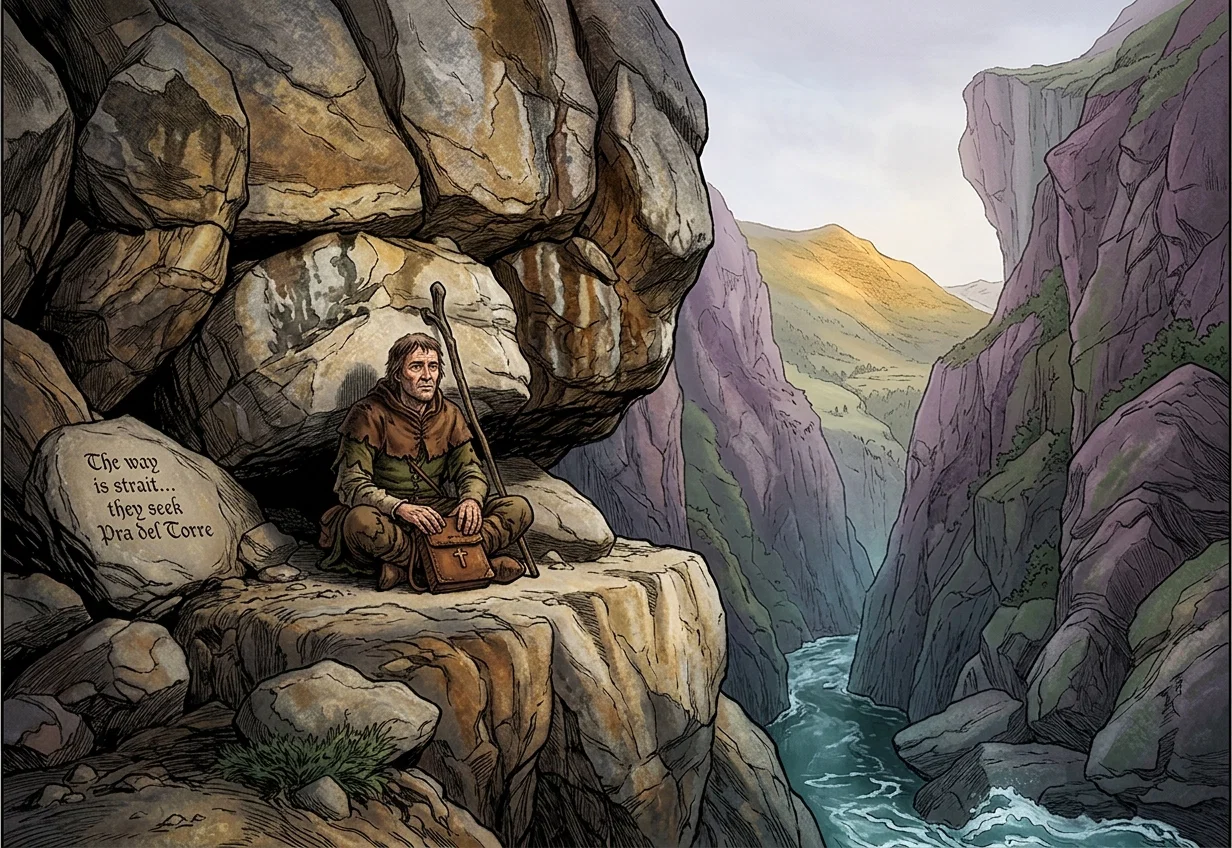
Though successful on the French side of the mountains, Cataneo was terribly checked on the Piedmont side. Here the Waldenses retreated to the Pra del Torre, their “Shiloh of the Valleys.” Cataneo finally found the narrow, dark chasm that formed the72only path to this citadel, and ordered his men to enter it.
Valley of Lucerna
“It seemed impossible for their prey to escape them. Assembled on this spot, the Waldensian people had but one neck, and the papal soldiers, so Cataneo believed, were to sever that neck at a blow. But God was watching over the Vaudois. He had said of the papal legate and his army, as of another tyrant of former days, ‘I will put My hook in thy nose, and My bridle in thy lips, and I will cause thee to return by the way by which thou camest.’ But by what agency was the advance of that host to be stayed? Will some mighty angel smite Cataneo's army, as he did Sennacherib's? No angel blockaded the pass. Will thunderbolts and hailstones be rained upon Cataneo's soldiers, as of old on Sisera's? The thunders slept, the hail fell not. Will earthquake and whirlwind discomfit them? No earthquake rocked the ground; no whirlwinds rent the mountains. The instrumentality now put in motion to shield the Vaudois from destruction was one of the lightest and frailest in all nature; yet no bars of adamant could have more effectually shut the pass, and brought the march of the host to an instant halt.
“A white cloud, no bigger than a man's hand, unobserved by the Piedmontese, but keenly watched by the Vaudois, was seen to gather on the mountain's summit, about the time the army would be entering the defile. That cloud grew rapidly bigger and blacker. It began to descend. It came rolling down the mountain's side, wave on wave, like an ocean tumbling out of heaven—a sea of murky vapor. It fell right into the chasm in which was the papal army, sealing it up, and filling it from top to bottom with a thick black fog. In a moment the host were in night; they were bewildered, stupefied, and could see neither before nor behind, could neither advance nor retreat. They halted in a state bordering on terror.
“The Waldenses interpreted this as an interposition of Providence in their behalf. It had given them the power of repelling the invader. Climbing the slopes of the Pra, and issuing from all their hiding-places in its environs, they spread themselves over the mountains, the paths of which were familiar to them, and while the host stood riveted beneath them, caught in the double toils of the defile and the mist, they tore up huge stones and rocks, and sent them thundering down into the ravine. The papal soldiers were crushed where they stood. Nor was this all. Some of the Waldenses boldly entered the chasm, sword in hand, and attacked them in front. Consternation seized the Piedmontese host. Panic impelled them to flee, but their effort to escape was more fatal than the sword of the Vaudois, or the rocks that, swift as arrows, came bounding down the mountain. They jostled one another; they threw each other down in the struggle; some were trodden to death; others were rolled over the precipice, and crushed on the rocks below, or drowned in the torrent, and so perished miserably.”—Wylie's History of the Waldenses, pages 47–49.
Their “Church in the Wilderness”
The sacrifices they made for the privilege of attending a divine service are both pitiful and inspiring. Let us read:
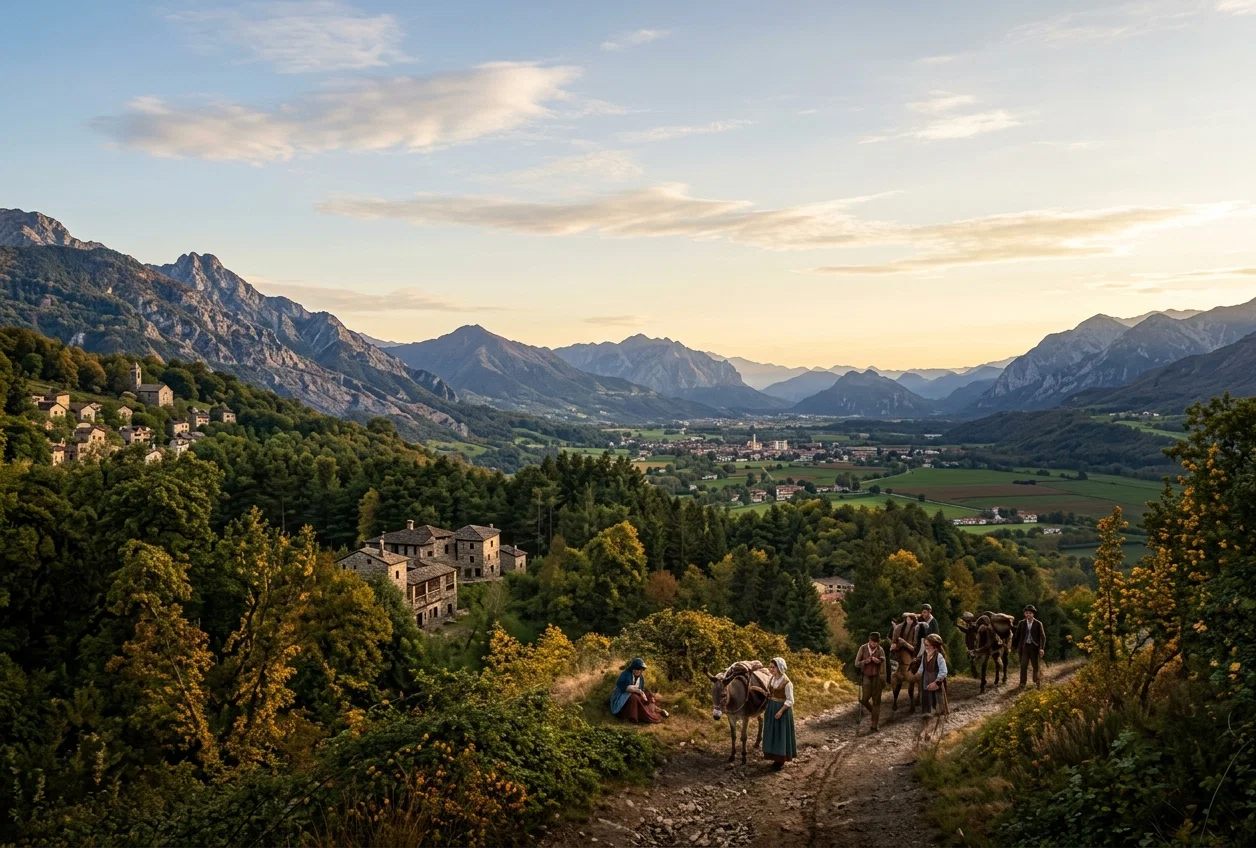
“Under the reign of Louis XV, the reformed religion being still interdicted, the Protestant churches of Dauphiny had their meetings for worship, in the wilderness. . . . When a meeting was to be held anywhere, the villagers might be seen descending separately and by different paths, their spades over their shoulders, as if they were going to the field, and then they met in some solitary retreat, where the psalm-books were drawn forth from their laborers' dresses. Entire families traveled great distances to be present. They left home in the evening, and traveled all night. At the outskirts of villages, the men took off their shoes, and walked barefooted along the silent street, lest the clatter of their iron-shod soles should betray their passing. The feet of the beast which bore the wife and children were wrapped in cloths, which prevented noise; and the caravan, fatigued but rejoicing, arrived with much emotion at the furtive rendezvous of prayer and edification. . . . Where, by the incessant confiscations of which they were the object, copies of the Bible had become too rare to suffice for the wants of all, societies of young people were formed, with the view of committing it to memory, and in this way saving themselves from the privation of it with which they were threatened. Each member of these pious associations was entrusted with the duty of carefully preserving in his recollection a certain number of chapters; and when the assembly of the wilderness met again, these new Levites, standing around the minister, with their faces towards the people, instead of the reading of the interdicted pages, recited in succession, and each in his turn, all the chapters of the book named by the pastor for common edification.”—Israel of the Alps, volume 1, pages 51, 52.
Horror in Provence, June 15, 1544
Francis I signed an edict suspending all proceedings against the Vaudois of Provence, southern France. But it was irregularly revoked, and D'Oppède marched against the cities of Mérindol, Cabrières, Lecoste, and others. At Cabrières the people retreated behind the walls of their town and defended themselves. D'Oppède wrote them a note saying that if they would open the gates he would do them no harm. They did so, and he entered with his army and demanded to see the principal men of the town. They came, eighteen in number, and history tells us the rest:
“‘Kill them all!’ cried D'Oppède, . . . and in a moment these dastardly and fanatical troops fell upon them and butchered them. . . . The heads of these unfortunate men were carried about on pikes. The passions of the soldiers were roused, the signal for massacre had been given. Some women, shut up in a barn, which was set on fire, sought to save themselves by leaping from its walls. They were received upon the points of partisans and sabres. Others had retired into a castle. ‘Their death! their blood!’ cried D'Oppède, and pointed out to his soldiers the way to their place of refuge. But how shall I describe the scene which took place in the church? It was the most horrible and sacrilegious scene of all, for it was there that a great number of the women and young girls of the place had taken refuge. . . . The advocate Guérin, who was present there, said in his deposition, ‘I think I saw four or five hundred poor souls of women and children killed in that church.’ . . . This legate also, having learned that twenty-five persons, the greater part of whom were mothers of families, were concealed in a cave towards Murs, although it was not within the boundary of the papal territories, marched thither with soldiers to destroy them. Arriving at the entrance of the cave, he gave orders for discharges of musketry, but no one came out. Thereupon he caused a great fire to be kindled in the mouth of the cave, and every living creature in it was stifled to death.”—Israel of the Alps, volume 1, pages 68, 69.
On account of the irregularity of this massacre, it was the subject of an investigation, in which it was found that 703 inhabited houses had been burned, and more than 3,000 people murdered.
The Martyrdom of a Colporteur
About 1542, punishment was inflicted upon a colporteur of Provence who had been surprised in the act of selling a Bible.
“All means were tried in order to make him abjure, but he had been too long familiar with the word of God to bow to the word of men. His steadfastness [that the evangelical colporteurs of our days seem to have inherited, and which they display in the midst of humiliating treatment sometimes experienced by them, where their predecessors would have incurred the penalty of death] did not forsake him in his last moments. Condemned to be burned alive at the place of public execution, he was chained to a post, to which the volume of the Holy Scriptures was also attached. ‘Ah!’ cried he, ‘how can I complain of my being put to death, when the word of God is burned along with me?’”—Israel of the Alps, volume 1, page 60.
A Martyr's Letter to His Wife
In 1555, Anthony Labories, with four others, was committed to the flames for his faith. He had married a young woman who had been born a Catholic but had been converted. Before being conducted to his execution, he wrote her a long letter, from which we quote the following:
“Anne, my beloved sister and most faithful spouse, you know how well we have loved one another, so long as it has pleased the Lord to leave us together; His peace has continually remained with us, and you have completely obeyed me in everything. I pray you, therefore, that you be always found such as you have been, and better, if it be possible, when I am no more. If your youth is alarmed at the world and poverty, I advise you to marry again, with another brother who equally fears God; and thenceforth think no more of me as having been your husband, but as a handful of ashes; for from this moment we are no longer united, except by the bond of that fraternal charity, in which I hope for your prayers so long as I am alive. When your father shall be apprised of my death, I doubt not but he will seek you to win you back to popery; but I entreat you, in the name of the Lord, to remain firm to your adherence to the truth. Trust in God, pray to Him, love Him, and serve Him, and He will not forsake you. Our little girl, as well as yourself, will be dear to Him; for He is the Protector of the widow and the Father of orphans. The example of Moses should suffice to assure you of this.”—Israel of the Alps, volume 1, pages 115, 116.743
Multiply this case by a score, a hundred, yes, by a thousand, and you catch a glimpse of the horrible cruelties and heart-breaking experiences this people endured. And yet, with the martyrs of old, they rejoiced “that they were counted worthy to suffer shame for His name.”
A Voice from a Subterranean Cell
In 1597 the father and brother of Felix Huguez, a Waldensian pastor, were seized and thrown into prison. The father died there some years later, but the son was finally released.
“One night, at the time when the universal silence of the sleeping earth rendered more perceptible the distant noises which communicated their vibrations to the sides of their dungeon, the two captives of Pragela (for his son was still with him) heard, through the walls of the prison, Christian hymns and psalms sung by unknown voices in the neighboring cell.”
“After some days of labor, the wall was pierced; and the Huguezes, father and son, entered into communication with their brethren in captivity. ‘For these nine years,’ said one of them, ‘I have lain buried before my time in this tomb; but I rejoice that God gives me strength to suffer so long for His gospel. The truth is so glorious! Salvation is so precious! My blessedness daily increases, and I confidently hope to continue thus, singing psalms and confessing the truth, to the very end of my life.’”—Israel of the Alps, volume 1, page 213.
The 1655 Massacre
One of the basest acts on record against the enemies of these oft-persecuted people was that of the marquis of Pianesse. He was defeated in several engagements, and therefore decided to use deception. He sent for the deputies from the various towns and valleys, and asked them to entertain certain regiments of soldiers to show their good faith. They accepted these soldiers, little dreaming that they had been directed to begin a universal massacre of the Waldenses, when the signal should be given at 4 A.M., April 24, 1655, from the castle of La Torre. The soldiers arose early from the beds that had been provided by the generosity of those whom they were soon to torture. The signal was heard—and we will ask Leger, who was an eye-witness, to tell the rest:
“Little children were torn from the arms of their mothers, dashed against the rocks, and cast carelessly away. The sick or the aged, both men and women, were either burned in their houses, or hacked in pieces; or mutilated, half-murdered, and flayed alive, they were exposed in a dying state to the heat of the sun, or to flames, or to ferocious beasts; others were tied, in a state of nakedness, into the form of balls, the head between the legs, and in this state were rolled down the precipice. Some of them, torn and bruised by the rocks from which they had rebounded, remained suspended from some projecting rock, or the branch of some tree, and still groaned forty-eight hours afterwards. . . . The universal destruction of the Vaudois houses by fire followed the massacre of their inhabitants. In many hamlets . . . not one single cottage remained standing, so that the beautiful valley of Lucerna then presented only the aspect of a burning furnace, where cries, which became more and more unfrequent, attested that a people had lived!”—Israel of the Alps, volume 1, pages 249, 250.
The Protestant world stood aghast at this enormity. The duke of Savoy tried to throw the blame on the French troops, which called forth the following sworn accusation and denial from the French commandant:
“I, the seignor Du Petitbourg, first captain of the regiment of Grancey, in command of the regiment, having been ordered by the prince Thomas to go to join the marquis of Pianesse, and to receive orders from him at La Tour. . . . I have been witness of many deeds of great violence and extreme cruelty, committed by the outlaws of Piedmont, and by the soldiers, on persons of every age, sex, and condition, whom I saw massacred, dismembered, hanged, burned, and violated; and of many frightful conflagrations. . . . I saw the order that every one must be killed. As for his (the marquis of Pianesse's) protesting that no one was ever touched except in battle, nor the least outrage committed against persons unable to bear arms, I maintain that this is not the case, and that I with my own eyes saw men murdered in cold blood, and women, aged men, and little children miserably put to death. . . . So that I positively affirm and protest before God that none of the cruelties above mentioned were executed by my orders; on the contrary, seeing that I could do nothing to prevent them, I was constrained to retire, and to renounce the command of the regiment, that I might not be present at such wicked actions. Done at Pignerol, this 27th of November, 1655. (Signed) Du Petitbourg.”—Israel of the Alps, volume 1, page 254.
It was of this unparalleled massacre that the poet Milton wrote:
“Avenge, O Lord, Thy slaughtered saints, whose bones
Lie scattered on the Alpine mountains cold;
E'en them, who kept Thy truth so pure of old,
When all our fathers worshiped stocks and stones,
Forget not: in Thy book record their groans,
Who were Thy sheep, and in their ancient fold
Slain by the bloody Piedmontese, that roll'd
Mother with infant down the rocks. Their moans
The vales redoubled to the hills, and they
To heaven. Their martyred blood and ashes sow
O'er all the Italian fields, where still doth sway
The triple tyrant; that from these may grow
An hundredfold, who, having learned Thy way,
Early may fly the Babylonian woe!”
The Extermination Edict of 1686
Only thirty-one years later the united forces of France and Piedmont, fully supplied with the necessary stores and implements of war, again entered the valley. Before following their campaign, let us turn aside and listen to the terms of the edict which they had vainly endeavored to have modified:
“The heresy . . . has found its way from the midst of the valley of Lucerna to the very heart of Piedmont. . . . Our ancestors have often attempted to extirpate it; but in consequence of the aid which the societies received from foreign countries, the sacred work of their restoration to the Church of Rome could not be accomplished; and as the principal reason which existed for tolerating them has recently disappeared—through the zeal and piety of the glorious monarch of France, who has brought back to the true faith the heretics bordering upon the Vaudois valleys—we think he would have cause to accuse us of ingratitude for his distinguished favors, which we still enjoy, if we were to allow the opportunity to escape of executing this important design, according to the intention which our glorious predecessors have always entertained. . . . For the preceding causes, and for other urgent reasons, we have, of our perfect authority, certain knowledge, good pleasure, and absolute power, decreed as follows:
“1. The Vaudois shall cease immediately and forever from all the exercises of their religion.
“2. They are prohibited from holding religious meetings, under pain of death and confiscation of goods.
“3. All their ancient privileges are abolished.
“4. All their places of worship, places of prayer, and edifices set apart for their worship shall be razed.
“5. All the pastors and schoolmasters of the valleys shall be obliged to embrace Catholicism, or to quit the country within the space of fifteen days, under pain of death and confiscation of goods.
“6. All the children born and to be born of Protestant parents, shall be compulsorily educated as Catholics.
“Consequently, the parents to whom a child shall be born are required, within eight days from its birth, to present it to the priest of their parish, under pain, for the mother, of being publicly beaten with rods, and for the father, of five years of the galleys.”
This edict is to be found entire in the archives of the Court of Accounts of Turin, Regio contorni, Finanze da 1678 in 1687, No. 165, fol. 224, second page, and is quoted in Israel of the Alps, volume 1, pages 427, 428.
Now let us return to the attacking army. They were defeated in the opening encounters, and so resorted to deception, which the simple Waldenses seemed unable to resist. Gabriel of Savoy himself wrote them:
“Do not hesitate to lay down your arms; and be assured that if you cast yourselves upon the clemency of his royal highness, he will pardon you, and that neither your persons nor those of your wives or children shall be touched.”—Israel of the Alps, volume 1, page 445.
After receiving a promise so specific and signed by a royal hand, the Waldenses opened their entrenchments and came forth without arms. And then—the old story of 1655 was enacted over and over again, with still more horrible variations. A French officer wrote under date of May 26, 1686, “All the valleys are exterminated, the people killed, hanged, or massacred.” One author says: “More than a thousand persons had been massacred, more than six thousand lay in prison, and two thousand children torn from their parents were immured in various popish establishments. All the Waldenses, dead or alive, had been declared guilty of high treason, and their property, of whatever description, confiscated to the state. Nothing seemed to remain for the valleys, but the silence of death and desolation.”
A carefully prepared table by Dr. Muston shows that 6,193 persons were killed or died in prison. We know that the population of the valleys was from twelve to fifteen thousand previous to this massacre, and that when the door of the prisons was finally opened only about three thousand skeletons walked out.
Surely the veteran and soon to be martyred apostle had a vision of this people when he wrote:
“They were stoned, they were sawn asunder, were tempted, were slain with the sword: they wandered about in sheepskins and goatskins; being destitute, afflicted, tormented; (of whom the world was not worthy;) they wandered in deserts, and in mountains, and in dens and caves of the earth.” Heb. 11: 37, 38.