The Cruelties of Superstitious Medical Practice — Barbarous Midwives — What Small Hospitals and Dispensaries Can Do to Relieve the Distress
By GEORGE F. ENOCH, A. B.
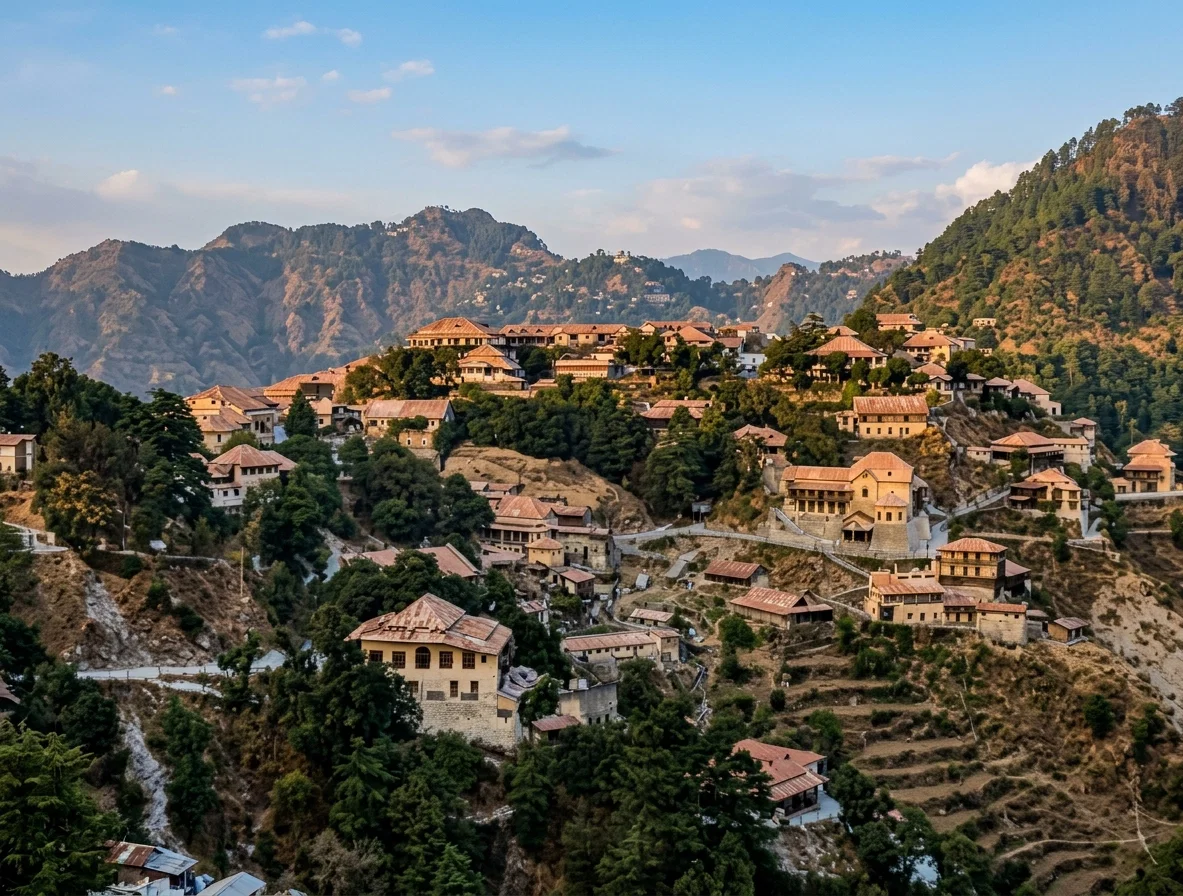
GENERAL VIEW OF THE VILLAGE OF MUSSOORIE, INDIA, NEAR WHICH ONE OF OUR MEDICAL MISSIONS IS LOCATED
The suffering of the heathen world is due to three conditions,—ignorance, superstition, and malpractice. Native medical practitioners in heathen lands are ignorant of the rudiments of medical knowledge. Their knowledge of anatomy is practically nil. They hold the crudest and most absurd theories concerning the internal organs.
In China, doctors classify themselves as “outside” or “inside” doctors, according to whether they deal with the surface or the internal mechanism. Even those who make the outside their specialty cause untold suffering through their ignorance. For example, an “outside” doctor has a sore to treat that is filled with pus. This pus must by all means be kept inside. So he puts on resinous plasters or a dab of tar; and if it suppurates and burrows its way out, he again covers it up to keep it in.
MEDICAL MISSION, MUSSOORIE
The “inside” doctor gives special attention to the internals, of which he knows nothing. He first learns the three hundred places on the body through which the skewer may be driven without killing the patient. If there is pain anywhere, he punches a hole with his needle to let the pain out, even though it may be in the eye, the abdomen, or the lungs.
The following is taken from a Chinese pharmacopeia: “Flies are of great use to man; for their heads, when pounded and used as a pomade, form an invaluable restorer for the hair. There is nothing better for that dangerous disease, lethargy, than to put fleas in the patient’s ear. . . . People have been known to put bedbugs in their beds that they might be more wakeful to contemplate divine things. One only, placed in the nose, has remarkable efficiency in the case of hysteria in females.” After reading this, any one who has had any considerable practical experience either in India or in China can say that if there is any value in these remedies, nature has been very kind to these countries, and bountifully supplied her dispensary for their benefit.
The bones of the tiger are prescribed for strength; and if one is too poor to afford the bones, he may use a tea made by steeping the tiger’s whiskers.
GODS, DEMONS, AND DISEASE
But dreadful as is the suffering that comes from ignorance, that which results from the superstition of the people is greater. The belief in demons is common to all non-Christian lands. In case of sickness, the question to be determined is not, What is the cause? but, Who is the cause? The answer is varied, running the whole gamut of gods, goddesses, and demons, and then coming to friends and neighbors.
The name for smallpox in Marathi, a language of western India, is devi, a goddess; and the particular name for vaccination means, “drawing out the goddess.” It is supposed that through the abrasion made to get the vaccine in, the goddess is able to escape.
THE DEMON SLIPPED UP ON YOU
These beliefs lead to witchcraft, charms, and spells. The demons get in by various ways. You have, for example, a pain in the back of the neck. Some demon has slipped up behind you, and with an invisible spirit club, hit you there, and thus gained entrance. Your problem is, how to get rid of him. You may have pneumonia or pleurisy, with the feeling of weight on the chest. It is caused by an invisible demon, or a host of them, who are seated there. An outsider protests that he cannot see anything, and the reply is, “You cannot see them, nor can I; but I can most certainly feel their weight, so I know they are there.”
BARBAROUS MIDWIVES
Dr. Williamson, in his little book, “For the Healing of the Nations,” tells the following story, which is repeated a thousand times in many homes. When the reader remembers that a little girl in India is supposed to be married before she is thirteen years old, and that there is a host of mothers between the ages of twelve and eighteen years, the story will be the more significant:
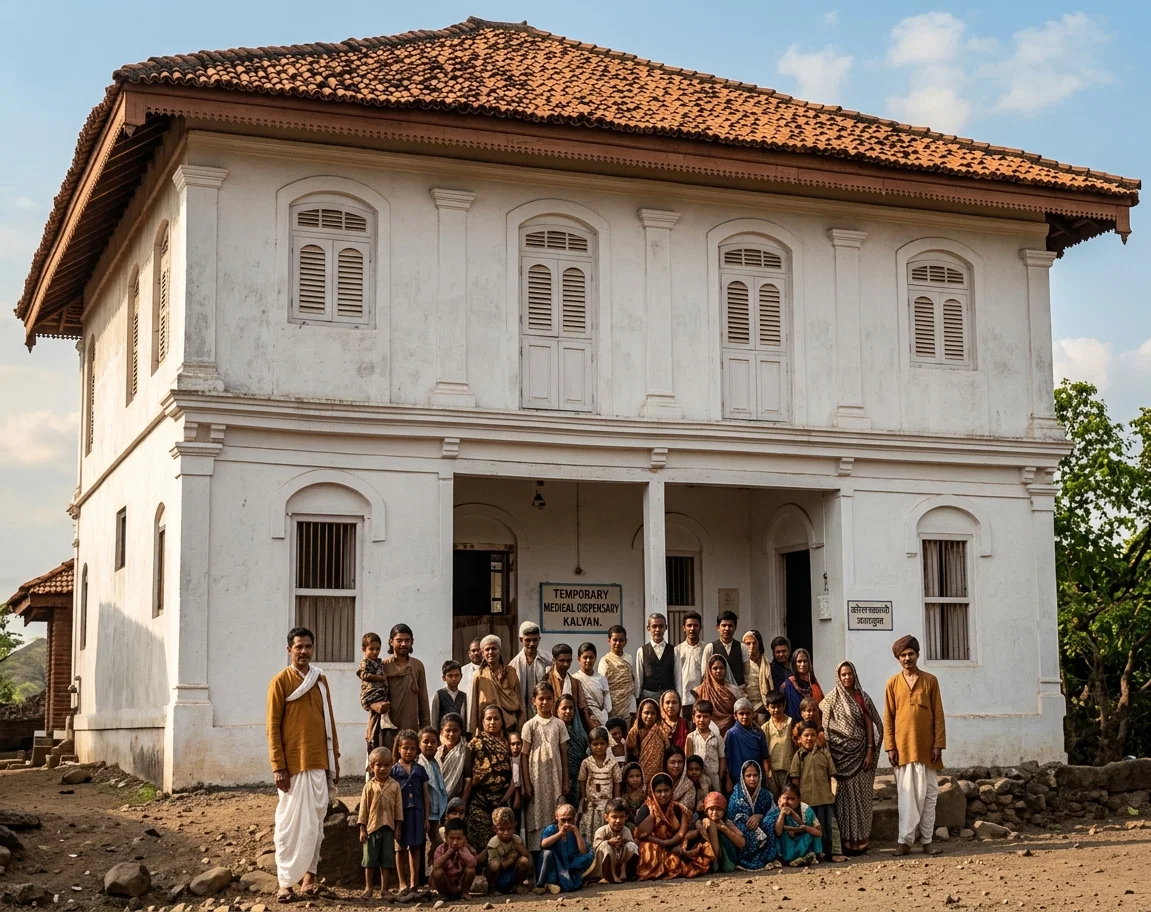
Temporary medical dispensary at Kalyan, India, in which over thirty thousand patients were treated in two years by Dr. Mrs. M. D. Wood and her associates.
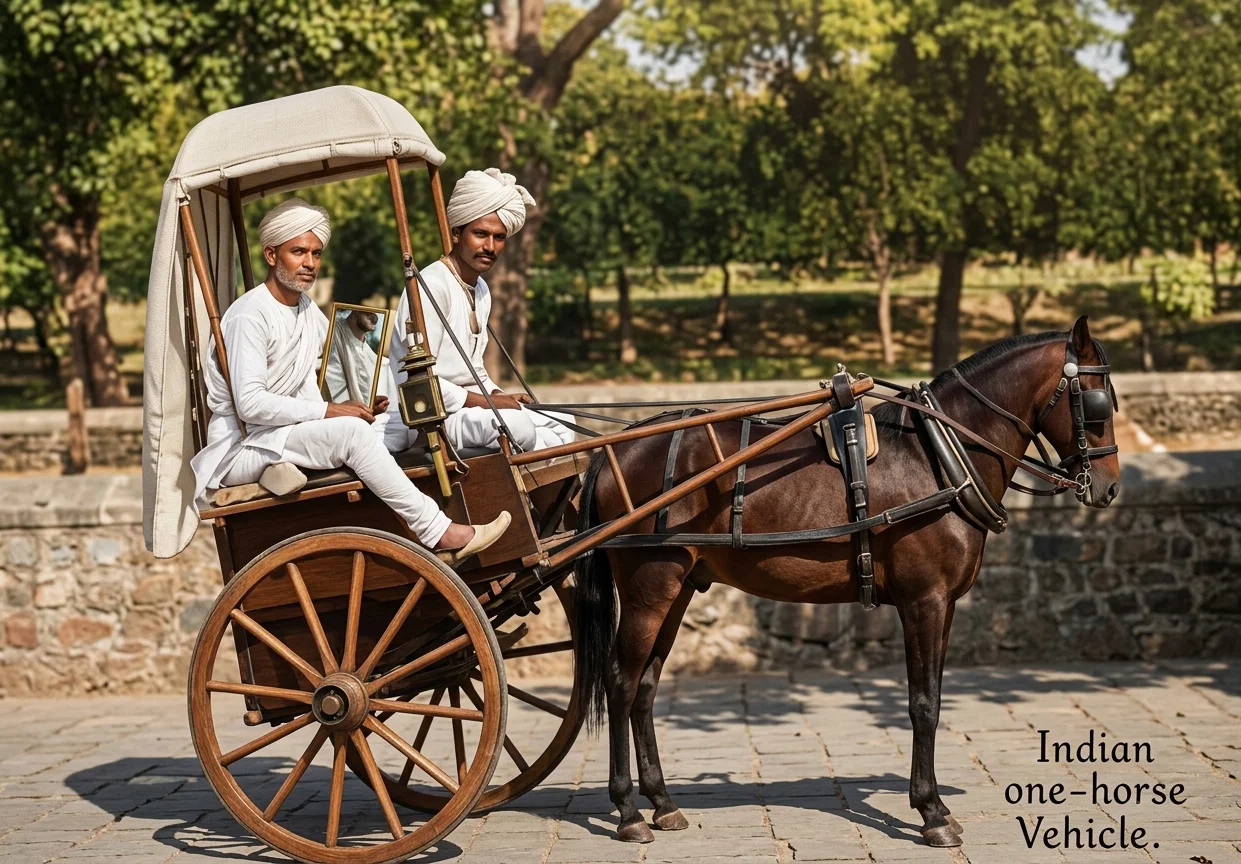
Indian one horse Vehicle.
“The doctor is called to the home of a high caste Hindu. A mother, and a child less than a week old, are lying unconscious, having survived the unspeakable barbarities of a native midwife, ignorant and immoral, among which might have been the placing of a board across the abdomen with assistants seated thereon, to assist tardy labor.
“Every step of her treatment has been laid down in their sacred book. For the first three days, she has been deprived of food and drink, and on the third, allowed one grain of rice. Her room has been prepared by placing her in the darkest and dirtiest of the house, with the most filthy rags, and a mud floor for her bed. A cow’s skull painted red, and an image of Sasthi, the goddess presiding over the destiny of women and children, are placed in a conspicuous position. These and a pot of smoldering charcoal are the only furniture. The charcoal is to expel the evil spirits hovering round.
“During her three weeks of uncleanness, neither father nor mother, husband nor sister, can come nigh her, leaving her to the care of the barber’s wife. On the fifth day, the filthy clothing is removed, and the room cleansed, and on the next is the worship of Sasthi, and that night Vidhata will write on the child’s forehead the main events of its life. The day has arrived; Sasthi has been worshiped; the woman has been given a cold bath; all necessary arrangements for Vidhata’s visit have been made; food consisting of coarse Graham flour and coarser sugar, kneaded together, has been prepared to be eaten raw by the famished mother; but alas, both mother and child are unconscious, and the foreign doctor is called to bring them back to life. These are thy gods, O India! These are Thy rivals, O Jehovah!”
But great as is the suffering due to ignorance and superstition, greatest of all is that resulting from malpractice. How any tender-hearted Christian can know these things and be unmoved, is more than one can tell. “The dark places of the earth are full of the habitations of cruelty.” Ps. 74:20. “The tender mercies of the wicked are cruel.” Prov. 12:10. Let us see how these statements of the Bible are verified:
BURN HOLES TO LET OUT DISEASE
In India and Arabia, the common method of dealing with disease is to let it out, by burning holes or branding with red-hot irons. Dr. Rosetta Hall gives this account of a visit to a Korean sick child: “The first thing the doctor did was to make a little pyramid of brownish powder on each breast of the child, and then set it on fire until it burned the tender skin. This was followed by the use of a large darning needle, which was thrust through each little foot, then the palms of the hands, the thumb joints, and through the lips into the jaw just beneath the nose.”
A missionary in India—a woman—relates a visit she paid to the home of a Mohammedan teacher where both wife and children were loved by father and mother. On the bed was a little child of three years in convulsions. “As we enter, a barber has just finished shaving the hair from the head, just over the place where the brain can be seen to pulsate in an infant’s head, and is called by the natives of India, ‘the door to the brain.’ A Mohammedan doctor lifts a red-hot piece of iron from the fire, and presses it to the exposed part, destroying the tissues to the skull; and to my cry of horror and dismay, the father in agony of sorrow answers, ‘Oh, Miss Sahib, for many days that door was open, and an evil spirit entered there, and must be destroyed, or our child will die.’”
Just one more side of this awful picture: In the polygamous households, behind the purdah, from which the poor women can never emerge, are innumerable jealousies. If in Christian lands stringent laws must be passed against such forms of malpractice as abortion and kindred566crimes, one can imagine what happens behind the mysterious purdah. Many times, the foreign doctor is besought for some poison to kill a rival, or injure or disfigure a pretty face. No one knows the awful scenes sometimes enacted there, where no human law can enter.
ONE AND ONE FOURTH DOCTORS IN CALIFORNIA
If there were only as few doctors in the state of California as there are in India or China, in proportion to the population, this state would have just one and one fourth doctors. Imagine how many suffer and die out of reach of any human help.
SMALL HOSPITALS AT STRATEGIC CENTERS
The work for the relief of the masses lying out in the villages of India must be done by small hospitals at strategic centers, and a large number of small dispensaries. We have been operating a number of these dispensaries for some time in different parts of India. A remarkably providential opening has recently been occupied by Dr. V. L. Mann and Brother F. Loasby in the Punjab. A long petition from a large number of villages was presented to our committee more than one year ago; and now these brethren are on the ground, and are opening one of the most promising fields that we have yet entered in India. The plan is to have a small hospital here that will head the system of dispensaries scattered over the land. The brightest and best native young people we have in India will be sent here for medical training, and then they will go back to the several divisions to work in the dispensaries.
To give the reader of the SIGNS a glimpse of what these dispensaries are doing, the writer will tell his personal experience. He went over to India seven years ago. Since then, work has been opened in four centers of western India,—in Lonavla, Bombay, Panwel, and Kalyan.
In February, 1913, Elder and Mrs. Wood joined us, and we opened a dispensary in Kalyan. Mrs. Wood has charge of the dispensary, assisted by Miss Elenora Reid. We had to begin the work with meager facilities, in a native house; but the suffering was great, and in spite of religious prejudices, the dispensary soon gained a foothold that has made it a permanent feature of the district. Elder A. G. Danielle recently inspected this work, and he said, “This is the most thoroughly organized and efficiently managed dispensary I have ever seen anywhere.”
The different diseases treated number forty-seven, ranging from simple ailments to cholera and leprosy. The dispensary report for the two years it has been in operation is as follows:
1913
1914
Total
Patients
11,376
16,421
27,797
Outside calls
934
978
1,912
Villages represented
72
85
Religious services held
253
272
525
Pages literature dist.
5,684
11,220
16,904
Cash receipts
$500.
$500.
$1,000
“WHERE THEY ARE KIND TO WOMEN”
What is said in previous paragraphs on the need of medical missions will help the reader to appreciate the immense amount of good that has been done by this work. When the workers are asked by the poor, suffering women why they have left comfortable homes to come across the sea, to do for them that which their own native friends will not do, the way is opened and the soil prepared to tell of the wonderful love of Jesus. This dispensary is becoming known as the place “where they are kind to women.”
We also have dispensaries that have been operating successfully for several years in Gopalgunj, East Bengal; Karmatar, Bengal; and Najibabad, United Provinces. Some dispensary work has been done at Nazareth, Tinnevelli; Tagadishpur, among the Santalis; at Panwel, near Bombay; and by Dr. Ollie Oberholzer Tornhissal in Burma.
Plants of this kind, where the medical and the evangelistic work are marching forward hand in hand, should be multiplied a hundredfold.
Just now is the time to work. A little later, it will be too late. The writer hopes to open a new station on his return from furlough, and is praying that a consecrated physician and nurses will join in the development of such a center in some needy corner of the vineyard, and that sufficient means will come in to equip and man such a dispensary.