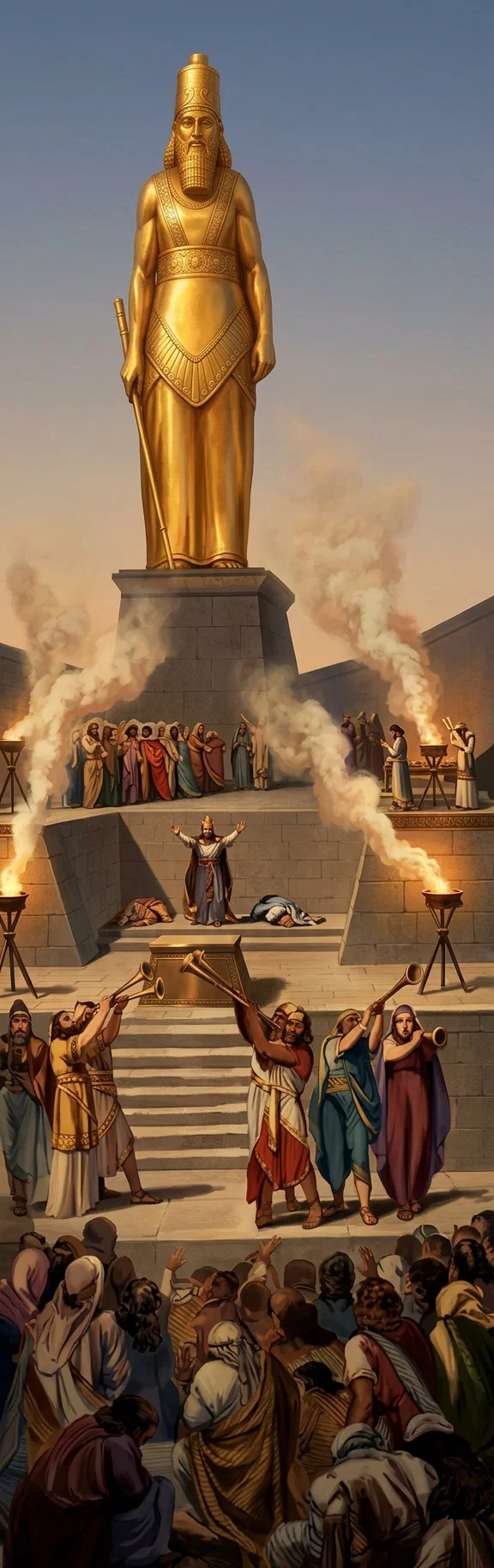
IN the third chapter of Daniel there is contained an account of Nebuchadnezzar's futile attempt to prove that God's revelation through the prophet Daniel was untrue. That is, he did not wish to admit that his kingdom would finally be overcome and another kingdom would supersede it.
Nebuchadnezzar was evidently pleased with the dream that God gave Daniel in reproduction of the dream that had been previously given to the king. But it appears, from the subsequent course he pursued, as recorded in the third chapter of Daniel, that he was not pleased with the interpretation of the dream as it related to his kingdom's being succeeded by another. And therefore the significant words of Daniel the prophet that undoubtedly impressed Nebuchadnezzar more than any other in the interpretation of the dream were as follows: "After thee [Nebuchadnezzar] shall arise another kingdom."
It is not difficult to understand why the proud, arrogant, and idolatrous king of Babylon proceeded to erect a golden image for his subjects to worship, believing, as he did, that his kingdom was never to be superseded by another. This image was to be the one grand patriotic demonstration by which he hoped to assure himself that his kingdom would be perpetuated, and thus show that the words of the Lord through Daniel, that his kingdom would be succeeded by another, were false. The thought of continued existence of his kingdom is evidently hinted at in the words of the Chaldeans as recorded in Dan. 3:9, when they said to Nebuchadnezzar, "O king, live forever."
The King's Tyrannical Decree
The king's command to his subjects to worship the golden image was a most positive and sweeping one. And the penalty to be inflicted upon those who dared to disregard his decree was also most terrible; for those who would not fall down and worship the image when they heard the music, should the same hour be cast into the burning fiery furnace.
There were three subjects in the realm who dared to refuse to obey the command of the king, and instead of falling prostrate at the king's decree, they stood erect when they were commanded to bow before the image. For their disobedience to the king's command, the furnace was heated seven times hotter, and these God-fearing men were cast into that seething fire; but the fire produced no effect upon them, and there was not even the smell of smoke upon their garments.
Why this wonderful deliverance from that awful fiery furnace?—It was due to the fact that Jesus was with them during that trying hour. How true the words of the poet who says, "Anywhere with Jesus I can safely go"!
Their Deliverance Because of Loyalty
It is truly said that the miraculous deliverance of those faithful Hebrew men, and the protecting care of Jesus Christ, the Arch- angel, was because of their refusal to bow down to the golden image. To bow to that image would have been a disobedience to the first and second commandments of the Decalogue, which forbid idolatrous worship. However, it should be remembered that another important element entered into their refusal to bow down to the golden image.
These noble and God-fearing men were associated with Daniel when they sought the God of heaven to reveal to him Nebuchadnezzar's dream and its interpretation. They had implicit faith in God, and believed that when they sought wisdom from above, He would impart it to them. When the Lord did reveal the things that they desired to know, it evidently brought to their hearts and minds an increased confidence in God, whom they were serving. And besides, it gave them great joy. These men, who had experienced such a remarkable answer to prayer, could never consent to bow down to the golden image. In doing so, they would tacitly have said that the remarkable experiences recorded in the first and second chapters of Daniel were a farce. Daniel and his three associates had fasted and earnestly prayed before they sought the Lord in a special manner to reveal the dream and its interpretation. These men had indeed been in the audience-chamber with their God; and for them to bow down to the golden image would have been doing wrong to the Spirit of God.
The Spirit to Perpetuate Kingdoms
The same spirit that controlled Nebuchadnezzar has continued to dominate the rulers to the present time. Recently a Christian missionary was arrested in Turkey for selling a tract explaining the second chapter of Daniel, which shows the final overthrow of all earthly kingdoms and the establishment of Christ's everlasting kingdom at His coming. To the authorities in Turkey, the suggestion that their government was ultimately to be overthrown by any other power was a serious proposition. Turkey is not the only government that is keenly jealous as to the idea that their kingdom shall ever be succeeded by any subsequent one. The thought that this world in its present state is to continue on indefinitely has strangely taken possession of the hearts of men, and any intimation concerning the termination of earthly empires and the world itself is spurned by the masses of people in these times. The great arch-deceiver of mankind realizes what a stronghold the hope of the permanency of an earthly kingdom has upon the hearts of men.
One of the great temptations that Satan brought to bear upon Jesus Christ was the promise of the earthly kingdom if He would pay him homage. Luke 4:5, 6 says: "And the devil, taking Him up into an high mountain, showed unto Him all the kingdoms of4the world in a moment of time. And the devil said unto Him, All this power will I give Thee, and the glory of them: for that is delivered unto me; and to whomsoever I will I give it." Jesus well knew what was "written," concerning earthly kingdoms. He understood that they were only transitory and soon to pass away, and therefore the enemy was unable to overcome Him by this almost overwhelming temptation.
The message, therefore, that should speedily be borne to both rulers and subjects at this time, is that all earthly kingdoms and their glory will soon pass away and become "as the chaff of the summer threshing-floor."
Earthly Kingdoms Temporary and Transitory
Men of God in every age, who have been under the influence of the Holy Spirit, have realized the temporary and transitory character of earthly kingdoms. We read of Moses, who was on the verge of becoming the king of Egypt, one of the greatest and wealthiest of earthly empires, that "by faith Moses, when he was come to years, refused to be called the son of Pharaoh's daughter; choosing rather to suffer affliction with the people of God, than to enjoy the pleasures of sin for a season; esteeming the reproach of Christ greater riches than the treasures in Egypt: for he had respect unto the recompense of the reward." Heb. 11:24-26. From this inspired statement it appears that Moses regarded all of his earthly prospects as only "pleasures . . . for a season," temporary, but had respect to the "recompense of the reward," which will be his inheritance in God's everlasting kingdom.
Likewise Abraham "looked for a city which hath foundations, whose builder and maker is God." Heb. 11:10. He realized that earthly cities were not enduring, but temporary and indeed without foundations. We have but to scan the history of the past to realize the significance of the words of the patriarch Abraham, when he said he looked for a city which would have foundations. Think of the proud and wicked cities of the plains—Sodom and Gomorrah—with only the Dead Sea to mark the place where they once stood. Think of Babylon, one of the greatest cities that ever existed, now a barren waste; and of Jerusalem and Pompeii. What is true of these cities, already indicated, will be true of the great and populous cities of modern times,—London, New York, Chicago, and other great cities of the world: for says the prophet Jeremiah, "I beheld, and, lo, the fruitful place was a wilderness, and all the cities thereof were broken down at the presence of the Lord, and by His fierce anger." Jer. 4:26. Men may try to sink the foundations of the great skyscrapers and other buildings deep in the earth, thinking that by so doing they will insure the permanency of these great structures, which they believe will be immune from the perils of earthquakes and tornadoes; but, alas, they will find that they are only temporary, and will be laid low by the judgments of God that will soon visit the inhabitants of this world.
The inspired apostle, in his exhortation to constant faith and godliness, shows that everything that can be shaken will be shaken, and that the only enduring thing will be God's everlasting kingdom. In Heb. 12:26-28 we read, "Whose [Christ's] voice then [at Sinai] shook the earth: but now He hath promised, saying, Yet once more I shake not the earth only, but also heaven." From this it will again be seen that the only kingdom that will never be removed is Christ's everlasting kingdom. The inspired apostle Peter has already outlined, in his second epistle, first chapter, verses 4-11, that if we will become partakers of Christ's divine nature, and add to our faith the heavenly graces which constitute a genuine Christian character, we will by that means have an entrance into His everlasting kingdom.