The Ottoman Empire

2%

Pacific Press Publishing Association · Mountain View, California · Jan 28, 1913

FromSigns of the Times, Vol. 40, No. 4.

Read the full edition

The Ottoman Empire

A Chronicle of Its History
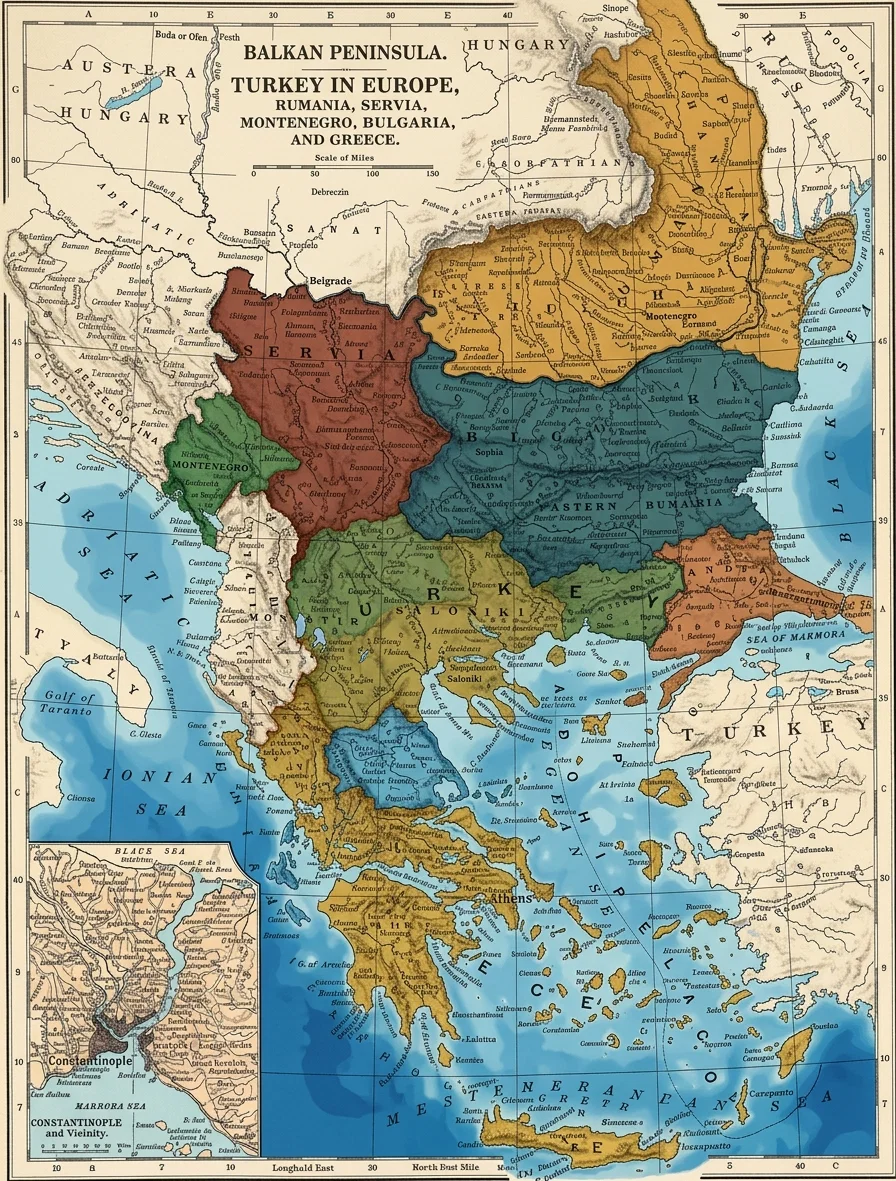
INASMUCH as there is a great interest now over the Eastern Question, as the outcome of the Balkan war is not yet decided, and may not be for some time, we have thought that it would be of interest to our readers to present a map of not only European Turkey but Asiatic Turkey as well, with a brief chronicle of the history of the Turkish Empire, simply stating the facts in order that these may be held in mind by those who are studying the question, and a good map to enable them to locate the boundaries of the new Turkey, if there be any new Turkey left in Europe after the allies and powers are through with her. Next week we will give a map of Asiatic Turkey.
The Ottoman Empire was founded by Osman, or Othman, from which the empire received its name, Ottoman. This founder lived between the years 1288 and 1326. The beginning of the nation was simply a tribe of Turks which had moved westward from their home in Iran in Asia.
Othman's son and successor, Orkhan (1326-1359), continued the strong, aggressive policy of his father. He was really the organizer of the kingdom. His capital was Brusa, the ancient capital of Bithynia. He gained a foothold in Europe in 1354 by taking the little peninsula of Gallipoli. He began an organization of his army by exacting a tribute of children from conquered Christian peoples. These he reared as Mohammedans and trained under rigid military discipline, and developed them into that tremendously powerful fighting machine, the Janizaries.
He was succeeded by Amurath I (1359-1389), under whom the Ottoman realm became a European as well as an Asiatic power. This king conquered Adrianople in 1361, and made it his capital.
Shortly after this, about all that was left of the Byzantine Empire was Thrace, Macedonia, and parts of Greece. Amurath greatly extended the Turkish dominions in Asia Minor, and in 1389 he broke the power of Servia in the battle of Kossovo. Servia at this time held considerable power eastward to the Black Sea, south of the Danube.
His son Bajazet I (1389-1402) succeeded him. He began his reign with the conquest of Bulgaria and a war against Wallachia, conquering a crusading army of Hungarians, Poles, and French under the command of Sigismund, king of Hungary, in 1396. Bajazet was taken captive in 1402 by Timur the Tartar, who swept over Asia Minor. In 1413 his youngest son became sultan, Amurath II, who reigned from 1421 to 1451. He extended the Turkish dominion over Macedonia, conquered a part of Greece, waged successful wars with the Hungarians, and sought to conquer the Albanians, but without much success. He gained a notable victory over the Hungarians under King Ladislaus and Hunyady in 1444. Mohammed II reigned from 1451 to 1481. Under his reign Constantinople was taken May 29, 1453, and the Byzantine or Eastern Empire of Rome came to an end.
An offshoot from the Greek Empire was that of Trebizond, and that was conquered in 1461. About the same time Morea, the southern peninsula of Greece, was conquered. The capital was transferred from Adrianople to Constantinople. History notes that at this time, cruel as they were in battle, the Turks allowed the Christian churches to maintain their organization in Constantinople. In 1456 Mohammed undertook to secure Belgrade, the key to Hungary, but Hunyady, the great Hungarian patriot, was victorious. A few years later Servia was incorporated into the Turkish Empire, and Bosnia was subjugated. In 1470 Euboea was wrested from the Venetians, and in 1475 the Tartar ruler of the Crimea became a vassal of the Ottoman sultan. Albania, which had maintained its independence so long under Scanderbeg, was at last subjugated.
An endeavor to seize Rhodes in 1480 was defeated. For a little while the Ottomans obtained a foothold in Italy. Mohammed II was succeeded by Bajazet II (1481-1512). Very little occurred during his reign, but under Selim I (1512-1520) great conquests were won by the Turkish Empire. He was successful in Persia, conquered Syria in 1516, annexed Egypt in 1517, and assumed the guardianship of the sanctuary of Mecca. Moldavia also became tributary to the Turkish Empire; Wallachia had previously submitted. Algeria fell under his power just at the close of the reign of Selim.
He was succeeded by Solyman the Magnificent (1520-1566). Under him the Turkish Empire reached the height of its power. Belgrade and Rhodes were taken respectively in the years 1521 and 1522. A victory was won over the army of Louis II of Hungary, in 1526, followed by a succession of campaigns against the house of Hapsburg in Austria. In 1529 they had gone so far west as to besiege Vienna. Hungary was then a Turkish province. In the great middle or Mediterranean Sea there was none to dispute them. Venice had been stripped of her possessions in the Morea and the Archipelago. Tripoli yielded in 1551. However, in 1565 a large Turkish force was beaten by the defenders of Malta.
Following Solyman came Selim II (1566-1574). He put forth a special effort to obtain the Island of Cyprus from the Venetians, which caused a league to be formed between Venice, Spain, and the pope, whose combined fleets defeated him in the battle of Lepanto, 1571. Nevertheless Cyprus was taken by the Turks. Yemen, the capital of which is Mecca, was subjugated in the reign of this sultan, and the Spaniards came were driven from Tunis, which yielded to Turkey. But the defeat at Lepanto was the beginning of the decline of the Turkish Empire. Men were led to believe that after all the Turkish fleet was not wholly irresistible. But she continued to win victories on land.
Under Amurath III (1574-1595), a successful war was waged with Persia in Armenia, followed by another with Austria which continued through the reign of Mohammed III (1595-1603), extending into the reign of Achmet I (1603-1617). Persia won a great victory over the Turks in 1605, even seizing the province of Bagdad, which was regained by Amurath IV (1623-1640).
In the meantime, the Venetians had been building up their fleets, and in 1656 appeared in the Dardanelles and defeated the Turkish fleet.
Turkey's greatest land defeat, however, really a decisive one in marking her decline, was in 1683, the chief figure of which was John Sobieski, king of Poland. That was the beginning of the end of Turkish power in Eastern Europe. After this crushing defeat Austria, Poland, and Venice waged aggressive warfare against the Ottoman Empire. The Turks were driven out of Hungary, the city of Buda which they had held for a century and a half was lost, John Sobieski overran Moldavia and Wallachia, and the Venetians successfully invaded the Morea.
In 1696 Peter the Great of Russia wrested Azov from them. The Turkish army was almost annihilated by Prince Eugene of Austria in 1697, and in the Peace of Karlowitz in 1699, Turkey was forced to give up all of Hungary between the Danube and the Theiss, to restore to Poland a great part of the Ukraine acquired in 1672, and to surrender the lower peninsula of Greece to the Venetians. Turkey waged a successful war in 1711, under Sultan Achmet III, against Peter the Great of Russia, who surrendered Azov. In 1715 they reconquered the Morea from the Venetians. The next year the struggle with Austria was renewed, with Austria victorious. In the Peace of Passarowitz in 1718, the Turks were compelled to cede a part of Servia with Belgrade, and parts of Bosnia and Wallachia to Austria, the Morea still remaining in their hands.
Russia took the aggressive in 1736, attacking the Ottoman Empire by seizing Azov and invading the Crimea, followed by the capture of Ochakov (1737), and a victorious advance into Bessarabia and Moldavia. Austria united with Russia in this in 1737, and the two together cooked up a scheme for the division of Turkey. This was foiled by the defeats, however, inflicted upon the Austrian armies by the Turks. In the Peace of Belgrade in 1739, Austria relinquished the Servian and Wallachian territories acquired in 1718, Russia concluded a peace in which she had made but a little gain.
In 1768 Turkey ventured upon a war with Russia, under Sultan Mustapha III, believing that her safety lay in checking Russia's advance; but the Russians marched victoriously through Moldavia and Wallachia, defeated the khan of the Crimea, won a victory in Bessarabia, and advanced into Bulgaria, where they were checked by the Turkish fortresses.
In 1770 the Russians burned the Turkish fleet at Tchesme. Peace was concluded in 1774, Turkey renouncing her suzerainty over the Crimea and other Tartar territories in the region of the Black Sea, and according to Russia a sort of protectorate over Moldavia and Wallachia, and the free navigation of the Turkish waters. What crippled Turkey in this war was the revolt of the Mameluke governor of Egypt.
Another war occurred with Russia in 1787. Austria profiting by this, seized the opportunity to enter Turkish territories, and fresh disasters befell the Turks. The Russian general Potemkin stormed Ochakov in 1788, and the allies won a great victory at Fokshani in 1789. Belgrade and Bender were captured in the same year, and Suvaroff besieged Ismail in 1790. Austria withdrew from the war, under pressure from Prussia, and the czar made peace with Sultan Selim III, in which the Dniester was made the boundary between the Russian and Turkish dominions.
France took Turkey in Egypt and Syria in 1798, but came no farther north than Acre. In 1801 the English drove the French from Egypt, and it was restored to Turkey.
In 1804 the oppressed Servians rose against the Turkish power. Internal troubles followed, largely from the growing power of the Janizaries.
In 1806 a war with Russia followed, and the country between the Dniester and the Pruth was ceded to Russia. Servia was again subdued, but the people rose again shortly after, and achieved a partial independence.
Greece threw off the Turkish yoke in 1821, and secured its independence through the intervention of the European powers in 1827 to 1829.
A revolt of the Janizaries occurred in 1825. This was met by Sultan Mahmud, and the next year thousands of the famous fighting organization were slain.
In 1828 and 1829 Russia again waged war against Turkey, advancing as far as Adrianople. Russia was also successful in Armenia.
In the Peace of Adrianople of 1829, Turkey surrendered to Russia the northeastern coastland of the Black Sea, and transferred to that power her suzerainty over the tribes of the Caucasus, while Russia was accorded a protectorate over Wallachia and Moldavia.
In 1831 internal war between the sultan and the Turkish viceroy, Mehemet Ali of Egypt, occurred. Mehemet would probably have succeeded in conquering the Ottoman Empire had it not been for the intervention of the powers, England, Russia, Austria, and Prussia. Efforts had been made more or less since Selim III to reform Turkey internally, but these were not very successful.
In 1853 Russia's attitude brought on another war with Turkey, the results of which would probably have been disastrous to the Ottoman Empire if England and France and Sardinia had not joined together to humble Russia. This resulted in the well-known Crimean war. In 1855 Sebastopol fell.
A treaty of Paris (1856) restored to Turkey the command of both sides of the lower Danube, excluding the czar from his assumed protectorate over the principalities of Wallachia and Moldavia, and closed the Black Sea against all ships of war. The two provinces above named secured almost complete independence, and were united into the principality of Rumania. The Porte coming into the family of European nations, made a proclamation of equal civil rights to all races and creeds in the Turkish dominions, but this was soon followed by a massacre of Christians in the Lebanon and at Damascus, which provoked again western intervention in 1860.
While it was thought that the treaty of Paris had settled for all time the Eastern Question, Russia reopened it again in 1871. When Germany and France were at war, Russia declared that she felt herself no longer bound by the provisions of that treaty which forbade her to have a fleet in the Black Sea. Russia's action was sanctioned by a London Conference. In 1866 to 1868 Turkey had great difficulty in suppressing an insurrection in Crete, and in 1875 the government repudiated a part of its obligations, the entire debt amounting to nearly $600,000,000.
A revolution broke out in Herzegovina in 1875, stirred up no doubt by Russian emissaries. In 1876 a fearful massacre of Christians and Bulgarians took place. Abd-ul-Aziz the sultan was deposed. His nephew, Amurath V, was placed on the throne, but reigned only three months, and was deposed as an imbecile; and his brother, Abd-ul-Hamid II succeeded to the throne.
Servia and Montenegro declared war against the sultan in 1876, but Servia was utterly defeated, in spite of Russian help. The European powers met at Constantinople, endeavoring to help matters, and a Turkish parliamentary constitution was adopted, a mere blind, however, on the part of Abd-ul-Hamid. Russia declared war again, under the pretense of enforcing the demands made by the powers in 1877, the Turks fighting bravely to defend themselves, but yielding in 1878 when the Russians were almost before the walls of Constantinople. The powers again intervened, the treaty of San Stefano was signed on March 3 of that year, and the whole Eastern Question was adjusted at what is called the Congress at Berlin, Russia being forced to content herself with a much less radical disruption of the Turkish Empire in Europe than she had endeavored to bring about.
In 1883 Great Britain took practical control of Egypt, altho it is still nominally a Turkish dependency.
September, 1885, the prince of Bulgaria proclaimed the annexation of Eastern Rumelia, and the Turkish government recognized the action.
In 1895 and 1896 there were massacres of thousands of Armenian Christians, which the local officials of the Ottoman government seemed to acquiesce in, and the protests of Europe had little effect on Abd-ul-Hamid. War between Greece and Turkey broke out in 1897, but Greece was soon conquered and was compelled to pay an indemnity of $18,000,000 to the Ottoman government. Crete was practically lost to Turkey by the powers taking charge of it,—Great Britain, Russia, France, and Italy, in 1898.
In 1908 the Turkish provinces of Bosnia and Herzegovina were formally annexed by Austria. In response to Turkey's protest, the assumption of $12,500,000 of the Ottoman debt was accepted by Turkey.
In 1909 the independence of Bulgaria was recognized by the Porte. For this Russia assumed $9,000,000 of the Ottoman national debt.
In 1908 the Young Turk revolution broke out. Those at the head of it evidently designed to give Turkey a much better and more stable and modern government, but it has been with great difficulty that they have existed. The old prejudices of years are not overcome by constitutions, and the Young Turk cabinet was really overthrown in July of last year.
In September, 1911, the Turko-Italian war broke out over Italy's seizure of Tripoli. As a result of trouble in the Balkans, and having no navy to meet the Italian sea forces, Tripoli was yielded to Italy, Italy assuming $400,000 annually of the payment of the Ottoman public debt, in compensation for the loss of revenue from Tripoli.
In October of last year Bulgaria, Servia, Montenegro, and Greece, allied together and began war against Turkey, and that war has continued up to the present time, altho at this writing there is a meeting of peace delegates in London to endeavor to settle it. Nearly all of European Turkey has been conquered by the allies. Turkey wishes to retain Adrianople, her ancient capital. The allies demand that Adrianople shall be given up. If this is accomplished, it will leave Turkey the barest strip of land along the borders of the Sea of Marmora and the Straits of Dardanelles, including the peninsula of Gallipoli. At last advices Rumania was threatening Bulgaria, giving the Turk hope that she might retain Adrianople, but on the other hand, the inhabitants of Adrianople and the Turkish army that holds it, are on the verge of starvation, and can hold out but a few days more, it is said.
This recital of mere facts, showing the increase and decline of the Turkish Empire, we have taken largely from that excellent work, “The International Encyclopedia.” It will help our readers to form something of a just basis of the Turkish Empire in the past and present. That power which God suffered to enter Christendom as a scourge to an apostate church certainly did her work, so far as the scourge was concerned, but the lesson seemed to have been poorly learned on the part of those who were so severely punished. Next week we will give a map of Turkey's possessions in Asia, and somewhat of the resources of the empire in that continent.