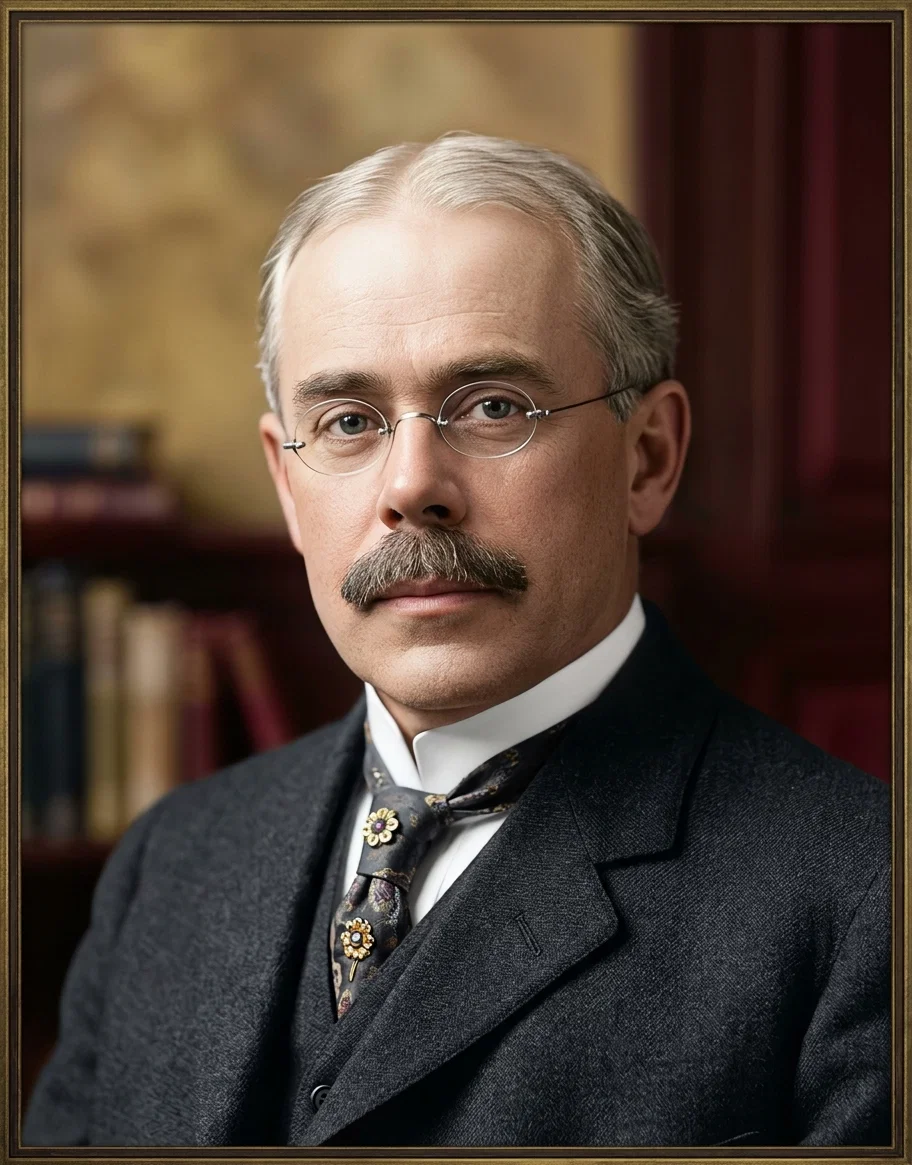
Dr. Shailer Mathews, newly elected president of the Federal Council of Churches, Convention of 1912
“Hotel La Salle,” Chicago, where many of the important meetings were held
Dr. Chas. S. Macfarland, secretary of the Federal Council of Churches, Convention of 1912
Dr. Peter Ainslee, who presented a report on Sunday Observance, Convention of 1912
The second quadrennial meeting of the Federal Council of the Churches of Christ in America convened in the city of Chicago, December 4-9, 1912. There were delegates in attendance from all sections of the United States and the Dominion of Canada. The sessions of the council were held chiefly in the La Salle Hotel, one of the most popular hotels in the city. One could but contrast the grand and gorgeous entertainment with which the distinguished delegates of the council were greeted, with the humble and self-sacrificing experiences through which Jesus and His disciples passed. The council was not largely attended by the citizens of Chicago, with the exception of the evening services, which were held in the prominent halls and theaters in the city.
One of the items of business which was of chief importance to the council was the election of officers for another quadrennial period. The Rev. Bishop E. R. Hendrix, D.D., LL.D., who has served as the president of the council for the past quadrennial period, was succeeded by Dean Shailer Mathews, of Chicago, whose election was received with great enthusiasm by the delegates. His inaugural address in which he clearly outlined the principles for which the council stands, was well received. The progress of this movement during the past quadrennial period, is very aptly expressed in an editorial which appeared in the Chicago “Evening Post,” December 7, which in speaking of the efforts of this great council toward the idea of coöperation says, “The length of the step they have taken is not very great.”
In listening to the addresses and discussions of the various phases of the work of the council, one could not but observe how each speaker sought to assure the delegates of the council of the unity which they claim to possess regardless of the different beliefs concerning some of the great fundamental doctrines of Protestantism. The frequent assurance that they were united in the work of coöperation, regardless of the denominational differences, was in itself a suggestion that the unity of coöperation was not as perfect as it might be. Imagine a husband and wife constantly assuring each other that they were united as one in marriage, and therefore are coöperating in the battle of life. The fact of such an assurance in words from either, would be at least a suggestion that would generate doubts as to the felicity of the union that they profess to be enjoying.
True unity depends upon faith in the unchanging and infallible Word of God. Without any desire to be captious, all who are acquainted with the utterances of some of the distinguished members of the Federal Council of the Churches of Christ in America, must know that skepticism and disbelief in the Word of God prevail to an alarming extent.
I herewith quote some utterances which were recently made by Bishop William F. McDowell, dean of the bishops of the Methodist Episcopal Church, who declared at a conference of that body in Evanston, Illinois, “that under the light of modern research many of the Bible stories need no longer be taken as literal.” He further declared that “he would not undertake to entertain the patriarch Jacob before he locked up the family silverware and retained an attorney to see that the ancient saint did not take too great an advantage of him.”
Dr. Charles M. Stuart, president of the Garret Biblical Institute, on the same occasion said, “Criticism has changed public opinion about many matters—once deemed primary, now seem to be of subsidiary importance.” He said: “It is not now thought to be necessary to one’s salvation that he shall believe the world to have been created in six days of twenty-four hours each, or that woman was created from the rib of man, or that the Deluge was universal, or that the waters of the Red Sea separated at the word of Moses. One may still have fellowship with God, and surmise that the Pentateuch was not written by Moses, that the Levitical legislation was post-exilian, that the book of Isaiah is of composite authorship, that the book of Daniel is a story to illustrate how God keeps watch over His own, that the book of Job is a dramatic putting of the problem of evil in the world, and that Jonah is an allegory setting forth the universality of God’s love.” He went on saying: “We may even go further than that. We may admit that the Bible, as we have it, is a book derived from secondary sources; that the autographs of the evangelists and apostles have been irrevocably lost, that there are omissions and interpolations, glosses and misreadings numerous enough to be discouraging, that genealogies and chronologies are hopelessly confused, and that there are discrepancies of statement about matters of fact which are not to be reconciled.”11
The great corner-stone of Protestantism, when it was launched in the sixteenth century, was the Bible and the Bible alone. A rejection of the Word of God must inevitably result in a departure from Protestantism; and this is precisely one of the fruits which was borne at the recent quadrennial Council of the Federal Churches of Christ in America. A resolution was unanimously adopted by the council to strike out the word “Protestant” from their literature, and substitute the word “Believer” in its place. This sort of action is the logical result of an organization that is seeking for a unity which is not in accord with the Word of God. They regard as non-essentials many of the great fundamental doctrines of the Bible, in order that some sort of resemblance of unity may exist. Protestantism was conceived when there was burning in the souls of men a great undying love for the unadulterated truth. Tradition and the enforcing of the same upon the conscience of man by civil magistrates, held sway so long that the only alternative left was that of protesting by those noble Reformers.
The resolution to eliminate the word “Protestant” from the literature of the Federal Council of the Churches of Christ in America, is a long step in the direction of paving the way for the Roman Catholic Church, at not a far distant date, to constitute a large part of this federal movement. In this connection, it will be interesting to note the significant words of Cardinal Gibbons, who is recognized as the greatest Catholic in the United States, in a recent magazine article in which he expressed his faith in the ultimate union of all Christendom. He also stated that “dissension is the chief cause of persecution” and that “it delays the complete triumph of Christianity over the heart and souls of men. The federation of churches, as we have it in many places, is a long step in the right direction for a more compact wall in Christendom.”
The sentiment voiced in the foregoing words of the cardinal would seem to breathe forth a spirit of Christian unity, but in the light of other claims of his church, the Catholic idea of Christian unity should be carefully weighed. The cardinal has well said that the dissensions have been the chief cause of persecution. He might have voiced it in another way, which would have truly expressed the idea of the Catholic Church more clearly, and that is, that the great persecutions of the past might not have existed if no one had dissented from the teachings of the Roman Catholic Church. It will also be understood, as this program is carried out, what significance there is to the cardinal’s statement that the churches have taken a long step in the right direction for a more compact wall in Christendom. The step which the climax of the church movement will ultimately reach, will be for the so-called Protestant churches of Christ in America to unite with the mother, or “Roman Catholic Church.”
The following words from an authoritative work entitled “The Full Catechism of the Catholic Religion” make it clearly certain that there will be no compromise on the part of the Catholic Church, when she ultimately assumes the leadership of the great inter-church federation movement. On page 45, this work says:
“Every one is obliged under pain of eternal damnation, to become a member of the Catholic Church, to believe her doctrine, to use her means of grace, and to submit to her authority. Hence, the Catholic Church is justly called the only saving church. To despise her is to despise Christ; namely, His doctrine, His means of grace, and His power; to separate from her is the same as to separate from Christ, and to forfeit eternal salvation. . . . Whosoever is separated from the Catholic Church, however commendable in his own opinion his life may be, he shall for this very reason, that he is at the same time separated from the unity of Christ, not see life, but the wrath of God abideth on him.”
Photo by Paul Thompson
In the face of these arrogant claims, what other place could this church occupy, if united in this movement, than the leadership of the Federal Council of the Churches of Christ in America.
Another resolution which was adopted by the Federal Council of the Churches of Christ in America, was to provide that the public schools should be closed for half a day each week, so that the churches may have an opportunity to impart to the students a religious education; and where public sentiment does not warrant such a closing, the duty of the churches is to see that the pupils have at least one hour’s instruction after school. Should such a plan as this become effective, what reasonable protest could be made against the public funds being appropriated to the Roman Catholic Church, for the support of their parochial schools? The moment that this government should ever enter upon a program to have religious instruction become a part of the public school system, just so soon the people of this country will be plunged into endless controversies and difficulties, which is the inevitable fruit when there is the union between civil and religious matters. U. S. Grant wisely said: “Leave the matter of religion to the family altar, the church, and the private school supported by private contribution. Keep the state and church forever separated.”
Perhaps one of the most important things for which the council stands, is that of compulsory Sunday observance. This was again emphasized during their present council, and is crystallized in the following resolutions:
1. That all Christians shall seek to do their utmost in the observance of this day by themselves abstaining from anything that savors of desecration, such as sports, travel, and buying, and urge upon the government and employers the need of rest for the laboring man. This day has been taken from him, and the church can in no better way prove its interest in him than untiringly seeking to restore to the laboring man his day of rest.
2. That we earnestly urge coöperation with all associations looking to the observance of the Lord’s day and also urge, if not a union, a close coöperation of all associations working to this end.
3. That we heartily endorse a half holiday of one of the six days of the week, preferably Saturday as tending to give better observance to Sunday.
4. That all ministers be requested to preach on this subject on the last Sunday in March. Last year 20,000 sermons were preached alone in England on Lord’s Day Sunday relative to the observance of this day.
5. That we earnestly recommend to state and local Federations of Churches the importance of not only guarding against the repeal or weakening of the laws we now have providing for Sunday rest, but of placing on our statute-books laws securing one day in seven as a rest day for all classes of working men and the securing to every community a more complete protection against all Sunday practices that tend to demoralize society or weaken the forces that make for virtue and righteousness. As a means to this end we heartily coöperate with the Social Service Commission of the Council in its nation-wide campaign for One Day in Seven for the workers.
The fifth resolution unmistakably outlines the council’s policy on the question of Sunday legislation in recommending the importance to the state and local federations of churches to not only guard against the repeal or weakening the laws we now have providing for Sunday rest, but that of securing other laws in behalf of the Sunday institution.
Undoubtedly, the feature that received the most attention during this council was that relating to the church and social service. Their new declaration of faith is a strong contrast to the old style declarations of their creed. The president of the council stated that he thought it read very similar to the platform of the Progressive Party; and the Rev. Walter Rauschenbusch, of Rochester, New York, said of their new declaration of faith, that if the inner truth were known, both the Progressive political platform and their declarations of faith were the outgrowth of the same influence working in the hearts of the people. He further added that when political parties of great corporations themselves have taken up social service problems, it is high time for the church to do so. It is very evident in the last analysis that this movement will assume the character of a gigantic church trust.
One of the prominent delegates at the organization of this movement in New York City, in November, 1905, said:
“I trust that one of the practical results of this conference will be the organization of a force that lawbreakers and lawmakers will respect and heed, when great questions of morals are involved. Our gospel is the fulfillment of the law. It is our profession in the name of our Supreme King and seeking the good of mankind to ask rulers to respect the code of our kingdom. Rulers may ignore sects, but they will respect the church. This federation will compel an audience, and it will speak with power if it will put aside its differences and make its agreements its arguments.”
In view of this unchristian and un-American movement, it is high time that every true Protestant should not fail in giving the trumpet a certain sound, by warning the people of the dangers that threaten both the church and the state.