A. L. KING

6%

Signs Publishing Co. · Melbourne, Victoria · Jun 21, 1920

FromAustraliasian Signs of the Times, Vol. 35, No. 25.

Read the full edition

A. L. KING

How Sunday Supplanted the Sabbath—No. 1

A. L. KING

A QUESTION that is securing world-wide prominence, and bids fair to become the greatest religious question of the day, is that of the Sabbath and Sunday. It is a striking fact that although the Bible applies the title of Sabbath to the seventh day and the seventh day alone, yet Sunday, the first day of the week, has come to be very generally observed as the Sabbath day. How came this about? By what process did the “day of the sun,” the first day of the week, come to supplant that sacred seventh day, which at creation God rested upon and blessed and sanctified, and which He later proclaimed with His own voice amidst an unparalleled display of divine majesty and power? This question this series of articles will essay to answer.
As we read and re-read the Sacred Oracles, certain facts stand out in increasingly bold relief. Never once in the Scriptures is Sunday (the first day of the week) called the Sabbath, nor man ever enjoined to keep it. In not one text are we told of the change of the Sabbath from the seventh day to Sunday. Never once is labour on Sunday declared to be sinful, or anything else, for that matter, that would be right and proper on Monday or Thursday or any other of the ordinary week-days. Nor can a case be shown where Christ ever mentioned the first day of the week during His life on earth. Clearly and consistently, the Old Testament and the New reserve the title of Sabbath for the seventh day alone, the day corresponding to our Saturday, the day the Jews still keep. In scriptural language, Sunday is “the first day of the week,” and one of “the six working days.” Eze. 46:1.

Significant Scriptural Silence

This striking silence of the Scriptures concerning any Sunday sacredness at once divests Sunday of any Sabbatic holiness or other sacred attributes that man has imputed to it. Naked and bare, it stands out in its true and original character as one of the six working days. Surely, had God ever wished man to keep Sunday sacred, would He not have plainly told us so in His Holy Word? With those awe-inspiring scenes of Sinai rising before us, when earth was shaken and nature convulsed at the Divine presence, and the Deity spoke His will in awful and commanding majesty—with all the dread admonitions in the Scriptures ringing in our ears to do exactly what the Lord has bidden us, to beware of adding to what He has written or taking away anything from its force,—is it not natural and right to expect that clear and express instructions would have been given us had the Lord designed to change the Sabbath from Saturday to Sunday? “Surely the Lord God will do nothing, but He revealeth His secret unto His servants the prophets.” Amos 3:7. “If it were not so,” said Christ on one occasion, “I would have told you” (John 14:1), thus giving tangible expression to the divine practice of informing His people fully on points of faith and duty. For the Sabbath, baptism, (immersion), the Lord’s supper, etc., we have plain and express instruction; but for the Sunday-Sabbath none whatever. That Sunday lacks divine ordination and authority should be sufficient for us. This background of divine silence is sufficient to indicate that the Sunday-Sabbath is the work of some alien hand.

The Position in a Nutshell

But some naturally wish to know how the change was brought about. In brief, Sunday, the day the heathen venerated as “the day of the sun,” began with the spread of apostasy to creep into the Church in the second century. It was then only a working and recreation day, those Christians who observed it merely holding a meeting in the early morning and then returning to their ordinary labours and recreations. Proof of this will be adduced in these articles. Sunday crept in gradually, and it took centuries for the change to be accomplished fully.
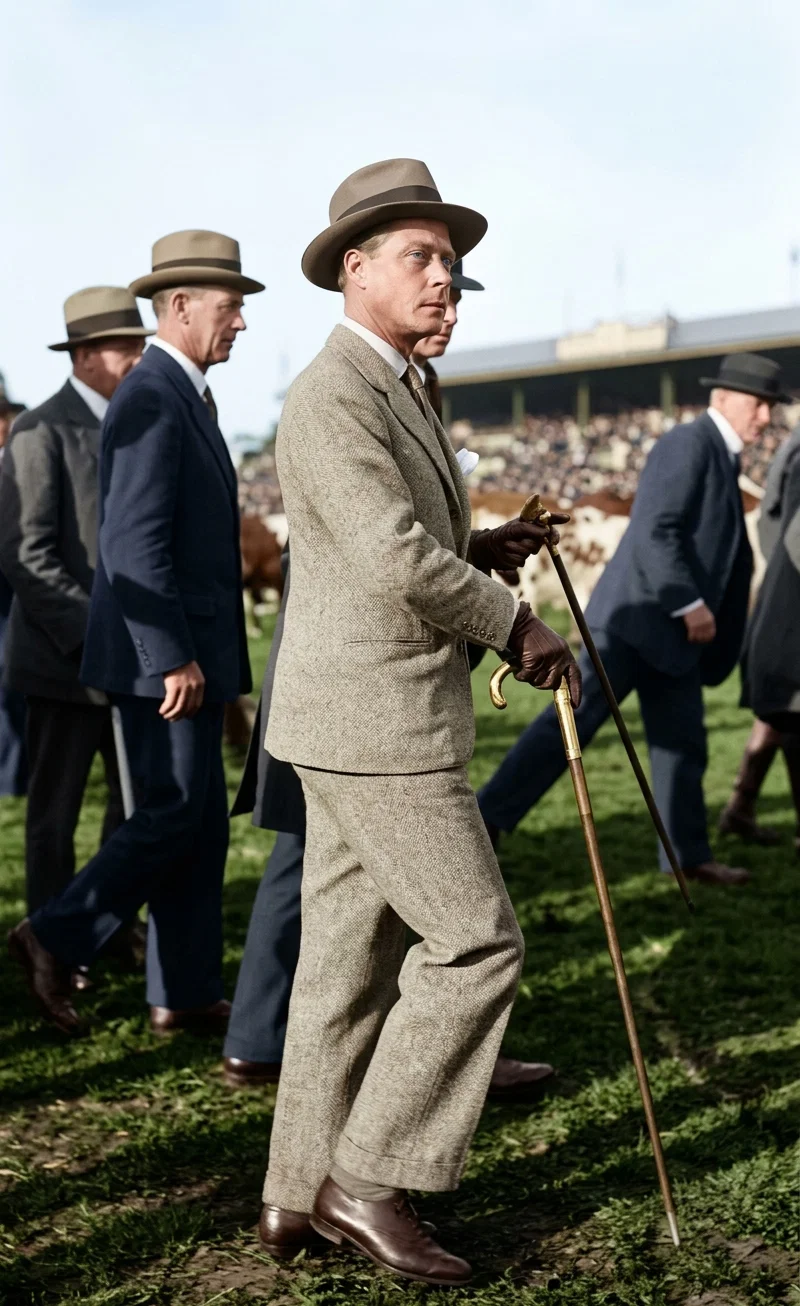
Pathe Photo. THE PRINCE WATCHING THE CATTLE PARADE AT THE ROYAL SHOW IN MELBOURNE
The Book of Acts shows that the apostlesas well as the Jewish and Gentile believers observed the seventh-day Sabbath. See Acts 13:14, 42-44; etc. No fewer than eighty-four Sabbath meetings are recorded in the Book of Acts. And history witnesses to the fact that the true Sabbath was observed widely for many centuries after Bible times, proof of which will be adduced later. As the proverbial camel that first thrust its head into its master’s tent, advancing by degrees its whole body till it stood completely within, and as a climax turned its owner out, so Sunday crept in gradually, first as a recreation day, or holiday, and then a day to memorialise the resurrection, till at length it shared equal honours with the Sabbath, and finally the Sunday-Sabbath was generally enforced and the true Sabbath suppressed except among Christians in isolated parts. That in brief is the story of the change. Let us now consider with more detail some of the phases of and steps in the exaltation of Sunday.

When and How Sunday Came to Be Called “Lord’s Day”

To-day Sunday is frequently called the Lord’s day. For this there is no scriptural authority. Sometimes Rev. 1:10 is cited, but with no force whatever. This text reads, “I was in the Spirit on the Lord’s day.” To say that this day was Sunday, however, is merely to assume what has to be proved. The only day ever claimed by Jehovah as His own particular day is the Sabbath, the seventh day. “The seventh day is the Sabbath of the Lord thy God” (Ex. 20:10); while in Isaiah the Sabbath is called “My holy day” (Isa. 58:13, 14), and Christ declared Himself to be Lord of the Sabbath day. The Lord’s day of Scripture is therefore indisputably the Sabbath. It is well to remember, too, that John wrote his Gospel subsequent to the Revelation, and in his Gospel he never calls Sunday the Lord’s day, but always and consistently by its secular name, “the first day of the week.” Were the Lord’s day the new name for Sunday, the latter would surely have been so termed in the Gospel of John.
Sometimes garbled versions of a statement of Ignatius of Antioch and one from the work “Didache” are adduced to show that Sunday was called the Lord’s day at the close of the first century of our era. But to do this, words have to be put into the original that are not there, a method which cannot commend itself to any honest mind. The fact remains and is impregnable, that the very first instance that can be found of the appellation of “Lord’s day” being applied to Sunday, is that of the Latin Church Father Tertullian, in A.D. 200. But Tertullian is perfectly frank about the lack of scriptural authority for Sunday. What small measure of Sunday observance there was, he associates with offerings for the dead and the use of the sign of the cross on the forehead, and then adds: “If for these and other such rules, you insist upon having positive Scripture injunction, you will find none.”—De Corona, sections 3 and 4.
In the fourth century, Sylvester, who wasBishop of Rome when the heathen Roman emperor Constantine was nominally converted to Christianity (A.D. 323), subsequently officially gave Sunday the title of Lord’s day. My authority for this is the second edition of the “Magdeburg Centuries” edited by Lucium (Cent. 4). The “Magdeburg Centuries” was the first general history of the Church written from the Protestant viewpoint, and is termed by the “Encyclopædia Britannica” “a remarkable monument to the scholarship of its authors.”
Prior to A.D. 386 all legal documents used the heathen designation “day of the sun,” or Sunday. But owing to the religious agitation on the part of various Catholic clerics the designation “Lord’s day” was substituted. As a consequence of this agitation, in the Roman countries, where the Latin Church was predominant, the term adopted for Sunday was Dominicum, which is Domenica in the Italian, Domingo in the Spanish and Portuguese, and Dimanche in the French. The Teutonic races, however, retained the ancient name Sunday, as in the German Sonntag and the Scandinavian Söndag; while in the Slavonic, Sunday is called Voskresinje, “resurrection day.”
The next article will furnish proof that when Sunday began to creep into the Christian Church and for nearly two centuries afterwards, it was only a working and recreation day.