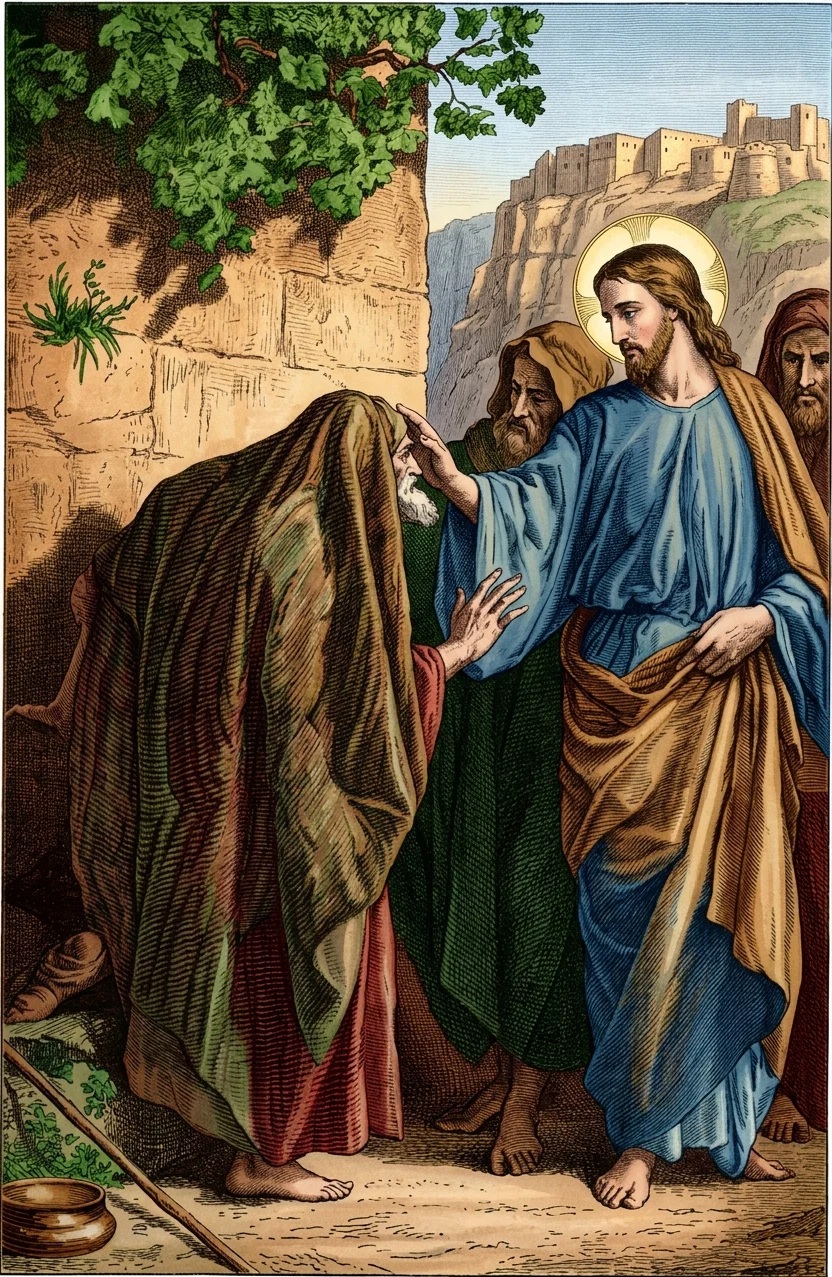
THE dread disease leprosy abounded in Eastern lands, and still abounds. It is one of the most fearful diseases, and in its worst forms is incurable, so far as the skill or power of man can go. It comes from a Hebrew word which means “a smiting,” referring more to its fearful and hopeless result than to its beginning, for it begins slowly and insidiously. It does not after its appearance at first seem to affect the general health, and the only inconvenience is a slight itching when the skin is heated. It is common to both sexes, and to all ages, and to all ranks of society.
There are three kinds mentioned in the Scriptures, the first of which did not render one unclean. The other two did. If on examination by the priest the person was found to be affected by the “smiting,” he was immediately declared unclean, separated from the cities and people; the hair of his head was to go loose, and he was to cover his upper lip; and when he saw people approaching him, he was to cry, “Unclean! Unclean!” Most mournful and despairing it must have sounded to victim and beholders.
Our description of the disease comes from its later developments and phases, and is called scientifically, elephantiasis, from the thickening of the skin, making it to appear like the skin of the elephant: the face becomes frightfully deformed, the forehead is traversed by deep lines, and covered with numerous tubercles; the eyebrows become bald, swelled, furrowed by oblique lines; the eyelashes fall out; the eyes assume a fixed and staring look; the lips are enormously thickened and shining; the beard falls out; the chin and ears are enlarged and beset with tubercles; the nose frightfully enlarged and deformed; the voice hoarse and nasal; and the breath intolerably fetid. Sometimes it is years before these tubercles ulcerate. The extremities are affected in the same way as the face. The sensibility of the skin is greatly impaired, and often entirely lost. Joints of toes and fingers ulcerate and fall off, one after the other, and insupportable fetor exhales from the whole body. And these conditions continue for years, but the sufferings are rarely equal to the external deformity and appearance. Sometimes the patient becomes morose and melancholy, and shuns the sight of the healthy, knowing what an object of disgust he must be, and life becomes a loathsome burden. Sometimes he falls into a state of apathy, and cares for nothing going on around him save to secure the food that he needs.
What a picture this is of sin, which destroys its victim and at the same time destroys his sensibility, which literally eats him up; yet at the same time he does not recognize that he is being devoured by it. Utterly incurable by men; so also is sin, and he who becomes affected by its dreadful germs, must go on in the living death to the end. Even so “sin when it is finished,” however fair it may be in the beginning, “bringeth forth death.”
Similar to this description must have been the spectacle which greeted our Lord on one of His tours through Galilee. Nay, He may have been greeted by many more. The instances given are typical. We can easily picture to ourselves the eagerness of the poor victim, to whose ears had come the news of the wonderful Healer, who had, as he drew nigh to the great Physician, forgotten his cry of “Unclean.” We can see the crowd surrounding our Lord press back in horror from the revolting object as he approached. They wonder why the great Prophet does not wave him back, why He Himself does not flee with the crowd, lest He be contaminated. But He does not, He can not thus deny His mission—He came to seek and to save the lost.
The leper presses closer, yet doubting—not the Master’s power, but—His willingness. He kneels before our Lord, and from the agony of his longing soul, cries, “Lord, if Thou wilt, Thou canst make me clean.” He had met slightings and rebuffs and repulsings, and even cursing, as one smitten of God, until it seemed that all humanity were against him; and doubts arise in his mind as to whether this mighty, compassionate4Healer does not stand with them. Jesus, he believes, could heal him,—would He?
Jesus knew the heart of the poor leper, knew that under the treatment he had received the heart would harden and grow doubtful. But not the appearance, not the standing, not the worth of the leper appealed to the heart of the Master, but the pitiful need of the poor victim. He wished to assure the poor man that God did not forget him, that He is very pitiful and of tender mercy; and therefore when Jesus spoke He touched him. It was no casual touch; the words were no ordinary words. “I will, be thou clean,” were wonderful words of life, pregnant with creative power. The touch was filled with healing, as well as sympathy. Creative power coursed through arteries and organs. Bone and skin responded to it, and the man who was literally rotting away became whole again, and his flesh like that of a little child.
This is the lesson to us. As children of earth, we are all smitten with the leprosy of sin. The fearful disease, leprosy, they say, is not contagious, but it is hereditary; and so it is with sin. We have inherited it. We need not take it from our fellow beings around us, but we are born sinners. The fearful disease is upon us, whether we will or not. It may not be seen to-day, there may be the mildest symptoms of it to-morrow. We may almost deny that we have it, nevertheless it is there; and as we yield to its spirit, it becomes more and more manifest how potent of evil is its power. It affects heart and mind and disposition, and to the soul that yields to the longing for righteousness which God’s Spirit would implant in every soul, it brings despair. Yet there is healing, and there is just as complete healing to the poor sinner as there was to the leper that met Jesus in the way. The Master has come down to earth, and does come down, to show His sympathy with the poor sinner. He does not separate Himself from that sinner by a cordon of saints, or angels, or priests. He pleads with the poor, leprous sinner, “Come unto Me;” approach Him just as the leper did. Forget all other souls, all their regard for us for ill or good—forget all things else but the sinner and the Cleanser from sin, and go to Jesus. Say to Him, as did the leper, nay, with more confidence than did the leper, “Lord, make me clean.” He has willed to do this,—“This is the will of God, even your sanctification,” and He pleads with you to come. “Let the wicked forsake his way, and the unrighteous man his thoughts: and let him return unto the Lord, and He will have mercy upon him; and to our God, for He will abundantly pardon.” He declares: “Tho your sins be as scarlet, they shall be as white as snow; tho they be red like crimson, they shall be as wool.” “Himself took our infirmities, and bare our sicknesses.” He knows the sufferings of poor, sinful humanity. He has the potent remedy for them all. And all these miracles are written that in Him we may have hope, and by simple, childlike faith grasp the great life to heal. He is not only able, He is willing, and not only willing, but anxious, to cleanse and heal all the sins of humanity, and to save to His eternal kingdom. Let us carry with us the lesson of hope in our hearts always.