He is coming as the King of the Golden Age in fulfilment of divine promises and prophetic visions. At time’s death-line He comes, heralded by Heaven’s angelic messengers and in all the majesty and glory of the celestial realm.
KINGS many and lords many have ruled over men. But among these, few have been rightful masters of the possessions they claimed, or ruled as God designed they should rule. Self has too often stood behind the sceptre and justice has been forgotten. But the time is near when He shall rule—“whose right it is.” “He shall be great, and shall be called the Son of the Highest; and the Lord God shall give unto Him the throne of His father David; . . . and of His kingdom there shall be no end.”
More illustrious than Augustus Cæsar, more just and kind than Cyrus the Great; with a dominion wider than that of Charlemagne, and with more subjects than Alexander, He shall rule from sea to sea in that kingdom over which the sun shall no more go down.
A World’s Crisis
GREATEST of all historic events, the second coming of Christ rightfully takes its place on the last and most eventful page of human history. It is the world’s crisis hour, and forms the dividing line between time and eternity. Round it there cluster all the great prophecies in the Book of God, and from it the “Year of the Redeemed” will measure—the long, glad year that measures with the life of God.
The first prediction, that concerning the first advent, was made by Jehovah Himself in the promise: “The Seed of the woman shall bruise the serpent’s head.” Gen. 3:15. And “when the fulness of the time was come, God sent forth His Son, made of a woman.” Gal. 4:4. True, Eve misunderstood that promise, and when Cain was born declared, “I have gotten the Man Jehovah,” but her misunderstanding did not change or hinder God’s plan.
Christ came as the Seed of the woman. Had He come as the Seed of Adam, or at another time, He would have been but a human substitute, and not the Christ of God.
The first prediction concerning the second advent was given to the first prophet among men—the first man who walked with God—“Enoch, the seventh from Adam.” One of the inspired writers has preserved his prophecy: “Behold, the Lord cometh with ten thousands of His saints.” Jude 14.
These two greatest events in Bible history naturally claim the attention of all Bible writers, and round them most of the prophecies and all of the promises centre. Adam the first man—the man who lost all—heard both these predictions, for the first was given in Eden, and the other by Enoch who was contemporary with Adam for more than 300 years. So, then, the first man who lost all heard promise of the second man who regains all.
Not a New Doctrine
THE gospel of the second coming of Christ is not a new doctrine, neither is it a modern fad. Since the prophetic tongue first began to speak in the name of the Lord this great theme has claimed the unquestioned attention of the prophetic mind.
The Book of Job, probably the first Biblical composition, tells of a living Redeemer standing on the earth in the “latter day.” Job 19:25–27. David, the king and shepherd of Israel, tells of the great voice, the fire, and the whirlwind that will accompany His coming. Ps. 50:3, 4. Isaiah, the royal prophet, writes of the redeemed waiting for the “salvation” which the Lord’s coming must bring. Isa. 25:9. Daniel, the “greatly beloved” among the prophets, pictures the “One like the Son of man” receiving the kingdom over which He is to reign forever. Dan. 8:13, 14. Ezekiel tells of Israel’s kingdom being overturned until “He come whose right it is” (Eze. 21:27); while the New Testament is flooded with promises, predictions, and warnings that cluster round this beacon of hope.
The Divine Purpose in His Coming
Fulfilling a Promise
WITH man a promise or a pledge should be a sacred thing. But it must be much more so with God. Jehovah “cannot lie,” while Christ is termed the “faithful and true Witness.” Therefore all promises made must be fulfilled. Just before His departure Christ gave the promise to the disciples: “I will come again.” John 14:3. This is a definite pledge, and He must come again in its positive fulfilment, as failure to do this would prove Him to be an unfaithful witness. But the One who knew no sin could not thus speak falsely. He must come again in answer to His own promise.
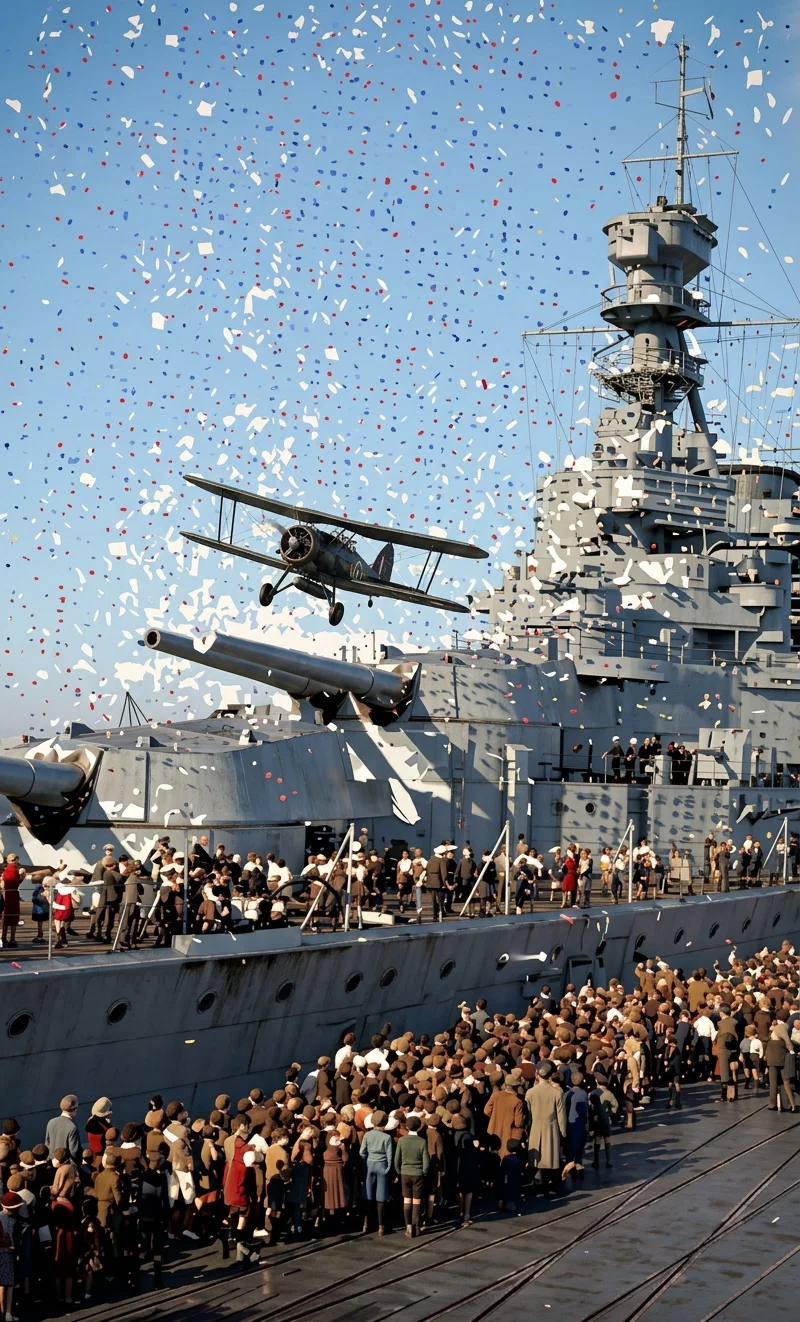
CHILDREN'S DAY ON THE “RENOWN”
A War-engine of our day fulfilling prophecy
To Complete Salvation
BUT Christ came first as a Saviour from sin. He must come again as a Saviour from the consequences of sin—“without sin unto salvation.” Heb. 9:28. All sin may be forgiven, but tears, pain, sorrow, and death still follow the child of mortality. When salvation is finally completed all these things will be removed forever. Of that time it is written, “God shall wipe away all tears, . . . neither can they die any more.” Rev. 21:4.
To Bring Rewards
JUDGMENT decisions are now pending in the court of heaven, and when they are determined rewards must be given. But rewards cannot be given to the righteous till Christ comes. Their bestowal is definitely linked with His appearing. “Behold, I come quickly; and My reward is with Me, to give every man according as his work shall be.” Rev. 22:12. Rewards have not yet been given. Christ must deliver them in person, for this is the right of the King.
To Waken the Loved Ones
THE resurrection, with all its hallowed memories, depends very definitely on the second coming of Christ. The dead are to “hear His voice and come forth.” The resurrection trumpet and the voice of Michael—the One like God—are both to be heard simultaneously: “For the Lord Himself shall descend from heaven with a shout, with the voice of the Archangel, and with the trump of God: and the dead in Christ shall rise first.” I Thess. 4:16.
How we long to behold the veiled faces; how we long to hear the voice that was hushed; how we long to clasp hands with the loved of memory’s vision. But love in the transport of all its sweetest anticipations must wait till the Lord Himself shall descend from heaven. Beyond His coming death has no power over the redeemed: “Because I live ye shall live also.”
A Personal Appearing
MAN must have a personal Saviour from sin, and just as surely must he have a personal Saviour from the consequences of sin. A myth or shadow cannot save from sin; it must be a reality or there can be no real salvation. Hence the second advent must be just as real and personal as the first coming. The Christ of history, man’s Saviour from sin, was the greatest personal reality that history has known. The B.C. and A.D. of historic reckoning recognises Him as such, and to and from His coming men and kingdoms, the world over, are willing to date their eras and ages.
Just as the recognition of His coming and a faith in His atonement for sin may rescue from sin and the power of sin now, so His coming again must rescue from all that sin has done, and guarantee against all tears and pain. On this side of that event we feel the darkness and the sorrow. Beyond it there bursts forth the eternal fountain of every joy. But it must be a personal coming, for the record reads: “This same Jesus.” Acts 1:11. A personal Saviour coming again! So real that “every eye shall see Him”; so real that He will be the “same Jesus”; so real that the unholy will call for the rocks and mountains to hide them from the revelation; so real that in His holy presence the redeemed of earth shall forget to sorrow, and they shall weep no more!
Blessed reality,—fitting landmark for the termination of all human uncertainty and trial, and fitting milestone to mark the beginning of the long glad years of the long eternity of peace!
Preceding Demonstration
NO great crisis has ever come, and no great epoch has appeared in human history, without some demonstration, special signs, and a warning message preceding it. Noah preached of the Deluge overthrow for 120 years. For many years the building of that huge ark testified to the faith of its builder, and to the certainty of the coming destruction.
Sodom and Gomorrah must go down because of their corruption. But first angel messengers carry a warning, and then Lot is seen departing from the doomed city before the thunderbolt of ruin fell.
Jerusalem, having filled the cup of her iniquity, must be sold into the hand of the fierce Roman to go down in fire and blood. But long before that fateful event, prophetic voices had pleaded with her people, and warnings had floated over valley and temple and hill. Even the voice of the Son of God was heard in tearful lamentation declaring: “Your house is left unto you desolate.” Strange sights appeared in the heavens, and a strange form walked her walls and streets crying night and day: “Woe, woe, woe, to Jerusalem!”
Remember, too, that Noah’s Deluge came upon “a vast population” in that antediluvian age. The fire of Sodom fell upon the luxurious, sensual, and crowded cities of the plain. The destruction of Jerusalem fell upon a nation and obliterated all their national boundaries. But the coming crisis will be a world event, and Jehovah could not allow this to fall without proportionate and appropriate signs, and a warning message. It is written: “Surely the Lord God will do nothing, but He revealeth His secret unto His servants the prophets.”423
Signs—Where and What?
THE ark was a sign to the antediluvian world. The two angels appearing at even should have been a sign to the people of Sodom; while to the people of Jerusalem the Roman armies surrounding their city should have told in thunder-tones that the time had come to escape.
But what signs are to tell of Christ’s coming and where will they appear? Jehovah has already anticipated our question and the answer is given: “There shall be signs in the sun, and in the moon, and in the stars,” while there will be seen “upon the earth distress of nations, with perplexity; the sea and the waves roaring; men’s hearts failing them for fear.” Luke 21:25, 26.
The Darkened Sun
MAN has written upon the earth, tunnelled the everlasting hills, sent his wireless through the atmosphere, and flashed his heliographs from mountain to mountain. But he has not been able to disarrange the stars or shadow the sun. All he can do with the sun is to look at it through a darkened glass. What, then, if the Creator, willing to teach man a lesson, and to make its elaboration more perfect, should darken the sun and in that way write over it and upon it His memoranda of coming events?
Man cannot reach the stars. He can neither retard nor accelerate their movements. He can only gaze and wonder at the stability of their multitude. What then, if the Creator, willing to preach man a sermon, should loosen these immortalities of light and cast them earthward as a fig tree would cast its unripe and unwilling fruit to the ground? Would not man remember these things?
Yet it is even so. The sun has been darkened and the stars, like unripe figs, have been made to forget their stability: “In those days, after that tribulation, the sun shall be darkened, and the moon shall not give her light, and the stars of heaven shall fall.” Mark 13:24.
The “days of tribulation” here referred to must evidently be the last and greatest of the tribulations that have fallen upon the Church of God. John of the Revelation gives its measure as “a thousand two hundred and threescore days.” Rev. 12:6. These prophetic days would represent years, and in them we have the 1260 years of papal usurpation and persecution, commencing in A.D. 538, when by virtue of Justinian’s decree the Papacy assumed control of all the churches, with the civil power to do its bidding. The “days” ended in 1798, when Pope Pius VI was taken prisoner and the “deadly wound” was given to that power.
The persecution terminated about 1776, the order of Jesuits having been abolished by Pope Clement XIV, in 1773. Here there remained twenty-two years of the specified time, and by these years the days were shortened so that all the righteous might not be destroyed. Matt. 24:22. Hence it is seen that the darkening of the sun, to which Christ referred, must be found in these twenty-two years coming after that persecution.
Thus writes the historian in 1883:—
One of the most noted instances of the obscuration of the sun from meteorological causes was the famous dark day in New England, May 19, 1780. The gloom was most intense in New Hampshire and Maine. It was necessary to light the candles in the houses throughout New England. The Connecticut Legislature adjourned on account of the darkness.
The famous “Dry Fog” of 1783, when through the whole of Europe the light of the sun was partially shut out by a bluish haze for many days, gave rise to more scientific discussion and theorising than all the other dark days together.—“American Cyclopædia,” page 823.
Just before making these statements, the writer has referred to several minor obscurations of the sun, but only to leave these two obscurations—one in the West and one in the East—more prominent by the contrast.
Again we quote:—
A dark day occurred in New England, May 19, 1780, during the session of the Connecticut Legislature at Hartford, which occasioned a proposition to adjourn.—“People’s Cyclopedia,” Vol. 1, page 532.
Under the term “Dark Days,” the “New International Encyclopædia,” Vol. 6, page 502, states:—
In New England the term is specifically applied to May 19, 1780, also known as “Black Friday.”
After speaking of several solar eclipses and obscurations, Wm. S. Walsh, author of “Handbook of Curious Information,” writes on page 275:— If we come nearer to our own time, to May 19, 1780, history and tradition assert the occurrence of a remarkable day prevailing over New England, and, to some extent, in some other places. Darkness came on between 10 and 11 a.m. and continued until midnight, growing gradually denser and denser, even till 11 at night. Candles and lamps were lighted for the people to see to dine and to perform work about the house. These became requisite before 12 a.m. In the evening so dense was it that farmers could scarcely, even with the aid of a lantern, grope their way to the barn to take care of the cattle. The birds returned to their roosts at 11 a.m., and the day was converted into night.
Many authors and historians could be quoted in continued testimony of the facts here mentioned. Not a few of them refer to the darkness as being of a “supernatural character,” and several state that the full moon, as it rose in the darkness, had the appearance of blood. The whole scene corresponds perfectly with the prophetic description of the event; the time is also correct, for it came “in those days” but “after that tribulation.”
Pathe Photo.
THE “IRON-HORSE” WHICH BORE THE PRINCE
ACROSS VICTORIA
The Falling Stars
AMONG the many signs given by Christ as premonitory of the second advent we find the “falling of the stars.” Matt. 24:29.
Prophecy has been true to its great Author. After centuries of waiting the falling stars have appeared, with both their promise and their warning.
In the year following the termination of papal rule, when Pope Pius VI was taken prisoner in 1798—the year when he died in captivity, “an exile from his country and his friends,”—there appeared a most remarkable shower of falling stars. The phenomenon is thus referred to by Thomas Milner, M.A.:—
The first grand phenomenon of a meteoric shower which attracted attention in modern times was witnessed by the Moravian missionaries at their settlements in Greenland. For several hours the hemisphere presented a magnificent and astonishing spectacle, that of fiery particles, thick as hail, crowding the concave of the sky, as though some magazine of combustion in celestial space was discharging its contents towards the earth. This was observed over a wide extent of territory. . . . Humboldt speaks of it: “Toward the morning of November 13, 1799, we witnessed a most extraordinary scene of shooting meteors. Thousands of bodies and shooting stars succeeded each other during four hours. . . . There was not a space in the firmament equal in extent to three diameters of the moon that was not filled every instant with bodies of falling stars.” . . . This shower of asteroids appears to have been visible, more or less, over an area of several thousand miles, from Greenland to the equator, and from the lonely deserts of South America to Weimar in Germany.—“Gallery of Nature,” page 138.
Another shower, the most awe-inspiring ever witnessed by the eyes of man, fell in 1833. Of it the same author writes:—
We now come to by far the most splendid display on record. . . . The chief scene of the exhibition was included within the limits of the longitude 61° in the Atlantic Ocean and that of 100° in Central Mexico, and from the North American lakes to the West Indies. Over this wide area an appearance presented itself, far surpassing in grandeur the most imposing artificial fireworks . . . . In many districts the masses of the population were terror-struck, and the more enlightened were awed at contemplating so vivid a picture of the apocalyptic image—that of the stars falling to earth even as a fig tree casteth her untimely figs when she is shaken of a mighty wind.—“Gallery of Nature,” page 140.
Again, in 1866, over England, in the Eastern Hemisphere, the same phenomenon was witnessed. Galleman thus writes of that shower: “In 1866, the November meteors attracted an unusual degree of attention on account of the wonderful display they presented on the morning of November 13 in that year.”—“The Heavens,” page 169. Lockyer speaks of this display as “the exquisitely beautiful star-shower.”—“Elementary Lessons in Astronomy,” page 131.
From a supposition that falling stars were merely a natural phenomenon, and occurred once in each thirty-three years, the astronomers of the world made great preparations to view the expected shower of 1899. But, lo! it did not appear, and their expectations failed.
But God has borne witness, and the stars have three times told their story since the darkening of the sun in 1780. Yet men will not believe. Nevertheless, Jehovah has not left Himself without witnesses. He has made the earthquake His preacher, the darkened sun His messenger, and the falling stars have twice over and again uttered the proclamation, “He is coming.” Why, then, will not the heart of man believe?
The Many Signs of His Coming
ONLY to the careless and unbelieving will Christ appear unexpectedly. Only to the man who shuts his eyes and persistently refuses to see the evidence of His coming will He “come as a thief.”
With a kindness unexampled and a patience that is wonderful Jehovah has outlined, over and over again, the course of events leading up to that supreme event. With great plainness He has foretold the conditions that would obtain in the social, political, religious, and financial world. So the nations are without excuse.
In addition to all that should touch national life, Jehovah has sent to many classes of men special warnings and signs telling of the approaching crisis that must finally fix the human destiny. It would almost seem that no class among men had been forgotten or overlooked.
Scientists and educationalists may read their message in Dan. 12:4. But this is the age of all that is rapid in movement, scientific in character, and skilled in knowledge. But it is also the “time of the end.” The demonstration of “running to and fro” is too evident even for enquiry.
The great army of engineers and traffic men have a special page with its “iron-horse” of the last period running like the lightning. Its cars are jostling one against another. It is the day of the “thunderbolt,” the “eclipse,” and the lightning express, but it is also the “day of His preparation.” Nahum 2:2–5.
For the mariners and the sea voyagers Christ points to tidal waves and ocean disturbances as the immediate evidence of the coming of the Son of man. Luke 21:25–27.
Indeed, all classes may know, if they will, concerning this greatest of all events—an event that must thrill heaven and earth with its grandeur and overwhelming splendour.
But for all that Jehovah has done in order that men may be prepared for this great finality of history, millions and tens of millions will be wakened from their dreams of pleasure and self-seeking only to find that “the harvest is past and the summer ended,” yet they are not saved.
But to those who are prepared for His glorious appearing it will be an event of joy unspeakable. “Lo, this is our God, we have waited for Him,” will be the glad declaration. Isa. 25:9.
Sometime, just when I cannot tell,
Some dawning after night of pain,
Amid the glory yet unseen,
My absent Lord will come again.
Sometime, I cannot tell just how,
When earth’s deep shading brings the night,
His hand will lift my tired feet
To walk the glory-streets of light.
Sometime, I cannot tell just why,
His power will fashion into grace
The fading form this life has given,
That I may rise and see His face.
Sometime, and though I cannot see
The transformation love has planned,
I wait for His “sometime,” and toil on
The “little while” at His command.