The Witnessing of God: The Basis of Our Confidence
By Editor
By the Editor
III. His Work Witnessing to His Word
The beautiful and instructive 19th Psalm opens with the mind-expanding and heart-stirring words: “The heavens declare the glory of God; and the firmament showeth His handiwork. Day unto day uttereth speech, and night unto night showeth knowledge. . . . Their line is gone out through all the earth, and their words to the end of the world.” All the heavens bear witness of the greatness and glory of God.
One of the sublimest passages of the Holy Scriptures is that which meets us at the very beginning, like an inscription on a noble archway, inviting the reverent, thoughtful mind to enter the unexplored regions of divine accomplishment:
“In the beginning God created the heavens and the earth.”
There is no apology with the statement, no modification of the direct thought that God created, that the earth and the heavens came into existence by His own inherent power. They are a witness of His word. It is the great, creative God to whom we are invited to give attention, who is the Author of the Book.
The mighty agency in this work is His Holy Spirit; for we read immediately, of the continued work of God upon the earth, that “the Spirit of God moved upon the face of the waters.”
Concerning the work of the Creation the psalmist sings: “By the word of Jehovah were the heavens made, and all the host of them by the breath of His mouth. . . . For He spake, and it was done; He commanded, and it stood fast.” Ps. 33: 6-9.
The old Idumean patriarch grasped the same living fact. “By His Spirit the heavens are garnished,” or adorned, beautified, made resplendent; and then the thought springs, Spirit-winged, to the greatness of God’s creation: “Lo, these are but the outskirts of His ways: and how small a whisper do we hear of Him! But the thunder of His power who can understand?” Job 26: 13, 14.
It is thus that God repeatedly sets Himself forth in His word as Creator, that the dying and despairing children of men may have hope in His power.
We are well aware that evolution has, in its hypotheses, set aside the story of the creative Word, and with it the basic power of the gospel—nay, more, the hypotheses of evolution accepted, the Bible as God’s word must go, and that which has been the hope of the helpless and of the despairing and the needy through all the centuries fails.
But God has met this attack upon His word by a witness to the Word in His works. In other words, the Spirit of might that moved upon the face of that primal deep, that brought cosmos out of chaos, also inspired and foretold facts concerning that creation utterly concealed from any knowledge that men possessed at that time, or subsequently, till the later days of Christianity.
The Planet Earth
Take, for instance, the belief held for so many centuries, that the earth was stationary in the universe, upheld by various fanciful things. To have said that it was a swiftly moving body in space, upheld or supported on its course without visible means, would have been counted not only error but heresy; yet the oldest book of the Bible had, nearly sixteen centuries before Christ, declared that God “hangeth the earth upon nothing.” Job 26: 7. But few dispute it now, and scientists feel that what was at first a hypothesis is now demonstrated; yet God told it long ago, and His inspired word testifies concurrently with His Spirit-wrought works, and the two witnesses are not collusive.
The Empty Place
Space is infinite. Think as broadly and as intensely and as persistently as we may, we can not comprehend infinity.6
Who can comprehend the distance even from the earth to the sun—92,800,000 miles? Prof. E. L. Larkin says: “No great minds before Galileo knew anything about even the rudimentary problems of space. They could not, because they had no telescope armed with instruments of precision.” The thinking star-students of that day did not dream, probably, that the tremendous sun Sirius, which like a flashing diamond burns in our southern sky, the brightest to us of all stars, was fifty-two trillion miles away. If we were to use the distance between the earth and our sun for our measuring-rod, we should have to lay it down 582,000 times. Astronomers estimate that the great suns Vega, Polaris (North Star), Arcturus, Aldebaran, are twice as far, at least; while others are ten, fifteen, or twenty times the distance; and should we stand on Arcturus and look onward with the same helps to penetrate space we now have, we would see as much beyond. Kopteyn estimates that light, traveling at the rate of 186,380 miles to the second, would require 60,000 years to plummet the star-depths; which is to say, we are lost in the immeasurable void. In this unsounded sea, “here and there only some projecting reef throws a star-gemmed point within touch of the astronomer’s sounding-line.” Charles Nordman, by a new method, Serviss tells us, has hooked such a crag, Delta Librae, and the length of the line is two quadrillion miles, about forty times the staggering distance to Sirius. All this is peopled space, and the infinite lies beyond.
Is the creation of God as infinite as space? Some have held that it is, others that the infinite abyss is not yet peopled. Job declares that God “stretcheth out the north over the empty place.” Just recently advanced astronomy has been finding out something about the north. The telescope has not yet penetrated to the space beyond. The eye of man at the great refractor tires after a little, and the vision becomes dim and uncertain. But the eye of the camera does not grow weary. The longer it steadily gazes into the star-depths of night, the more it sees, if there are stars to be seen. In the north a plate exposed for a certain time reveals a certain number of stars. The time is increased, and a few more are added; and this is repeated elsewhere in the heavens, but in the north a limit has been reached. The power of the telescopic camera and the time of the exposure have been increased, and no new point of light appears on the plate. The limit is reached; beyond is void space waiting for the creative power of God to fill it with marshaled armies of suns and planets.
“He Stretcheth Out the North Over the Empty Place”
How did Job know? He did not know, but God did know, and His Spirit that “garnished the heavens” spoke the word to the generation in which we live, that we might know that the God who foretells is the God who creates. The Holy Spirit confirms the text by declaring: “Lo, these are but the outskirts of His ways: and how small a whisper do we hear of Him! But the thunder of His power who can understand!” What must that mighty creation be, if those trillions of miles from the border line of the north are still but in the outskirts of His creation!
Here are the two concurring witnesses,— the works of God created in that far-off beginning, limited of necessity because infinite space can never be filled; and the Word coming centuries later, telling us, contrary to all human contemporary knowledge—when it was given—that this limit is reached in the north, that there are the outskirts of His ways, so far distant that the most powerful telephotography is required to reach it.
Centuries of ignorance have intervened since that Word was written. Man did not learn the truth of the inspired declaration concerning the creative fact till these days. The witness is complete. There can be no collusion between such witnesses. Their testimony is absolute.
[This topic will be continued in our next.]
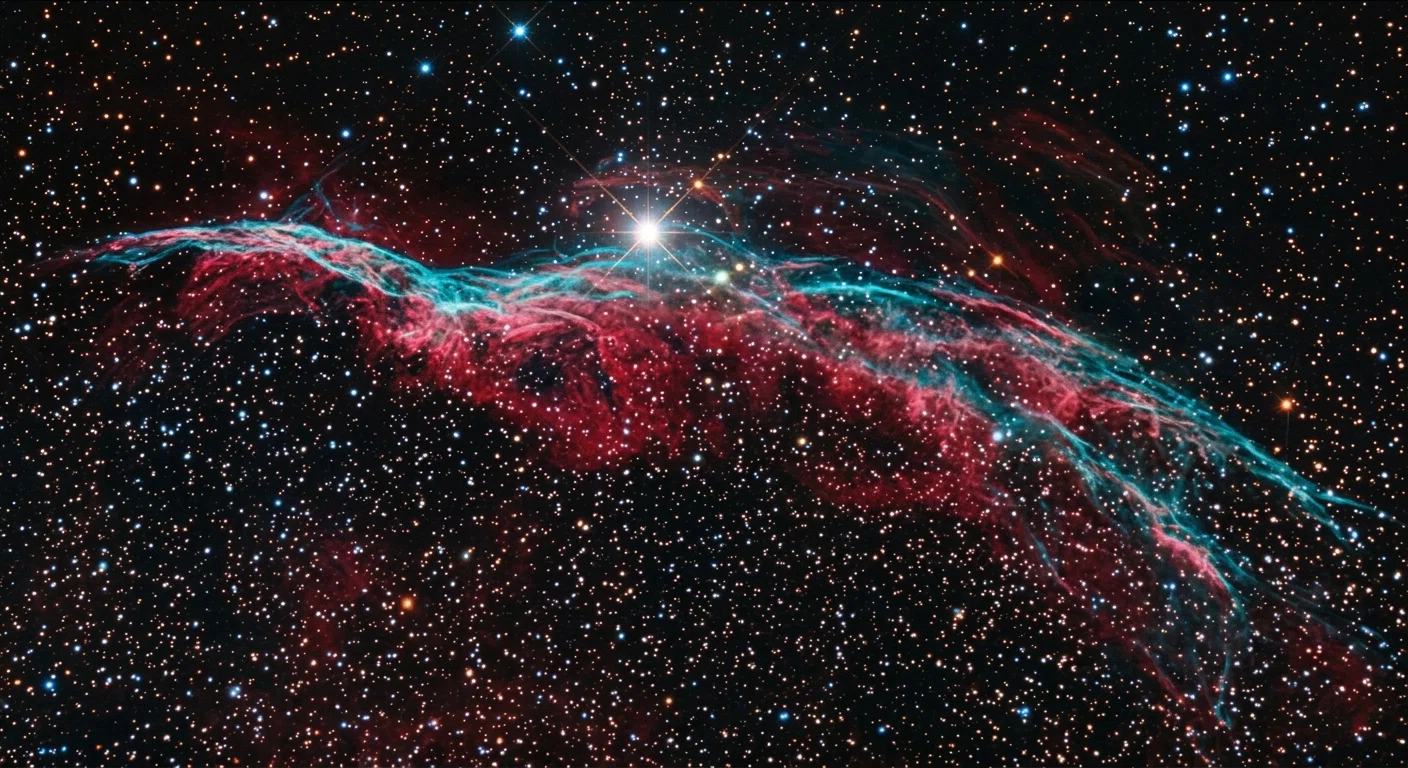
A view in Cygnus taken at the big Yerkes Observatory. Each dot represents one of the mighty suns brought into the vision of the camera through the powerful telescope. We asked a reverent and world-known astronomer to give us some appropriate facts to place under this cut; and he said, “This illustrates one of the amazing structures of the universe, but the explanation is beyond astronomers.” Truly the heavens declare the glory of God, and the firmament does most profoundly show His handiwork.
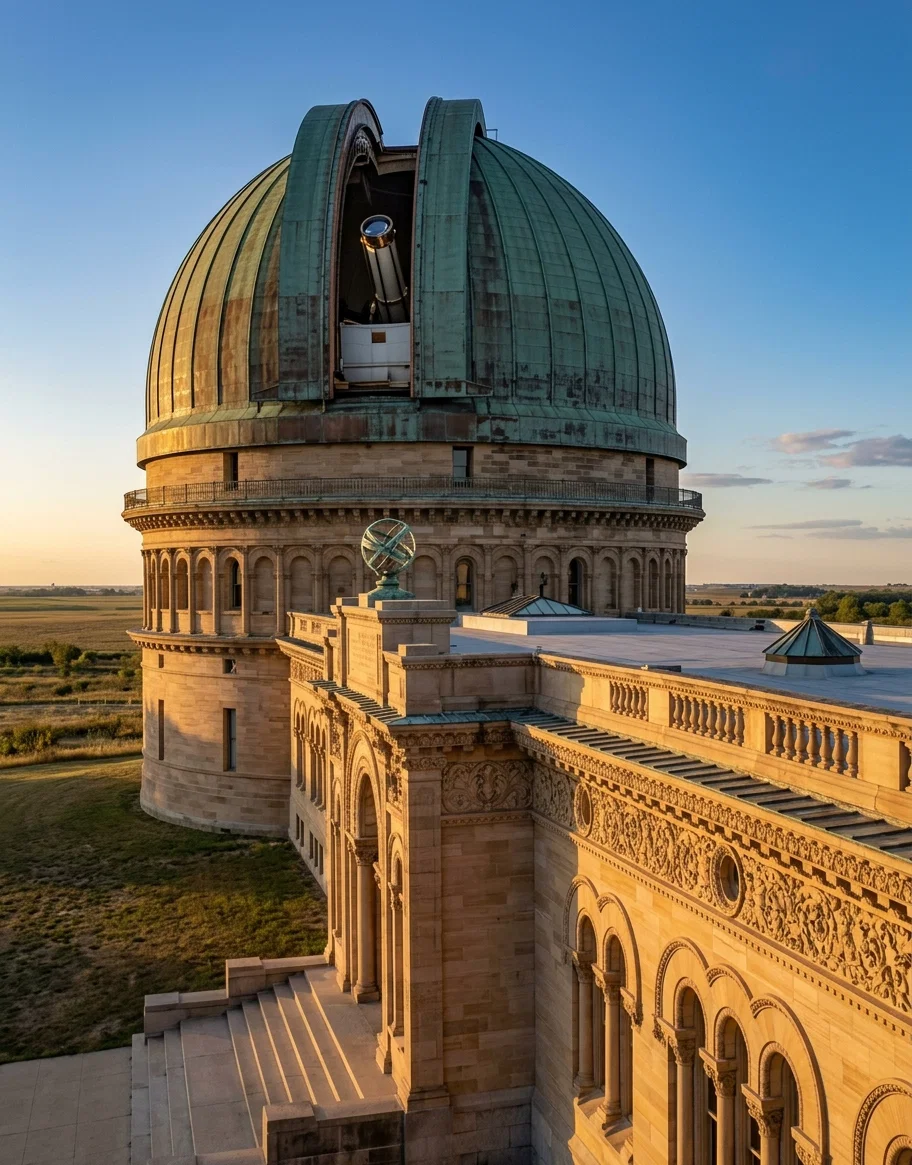
Dome of the great Yerkes Observatory, showing the end of the telescope