God the Revealer

4%

Pacific Press Publishing Association · Mountain View, California · May 27, 1913

FromSigns of the Times, Vol. 40, No. 21.

Read the full edition

God the Revealer

By K. C. Russell
“Thou, O king, sawest, and behold a great image”

A Great Prophecy

THE most condensed and comprehensive outline of the world’s history that has ever been written is recorded in the book of Daniel. The author of this remarkable prophecy is none other than Jesus Christ, the Saviour of men; for we read, in 1 Peter 1: 10, 11, that the Spirit of Christ was in the prophets; and in 2 Peter 1: 21, that “the prophecy came not in old time by the will of man: but holy men of God spake as they were moved by the Holy Ghost.”
It should furthermore be remembered that the Author of this book has commanded all not only to read this book, but also to understand it. See Matt. 24: 15. A book with the sublime authorship that this has, should command the attention of every thoughtful person, especially those who love the Lord.
The second chapter of Daniel contains a most remarkable and graphic illustration demonstrating that God is a Revealer of the future events of this world’s history. It is this fact that forever places the seal of divinity and infallibility upon this wonderful prophecy.

A King Perplexed

In the first verses of this chapter we are told that Nebuchadnezzar, the king of Babylon, had a dream, and that he called the professedly wise men of his realm to interpret it, for they claimed great skill in revealing mysteries. But upon learning that the king wished the dream told, as well as the interpretation, they were greatly perplexed, and said to the king that the gods only could do such a thing, whose dwelling was not with flesh. The king was greatly enraged at the wise men because of their failure to reveal the dream and to interpret it. He reasoned that if they possessed a knowledge of the future, they could with equal ease reproduce his dream. Because of their refusal to reproduce and interpret his dream, the king commanded that they be slain and their property destroyed.

Daniel Involved

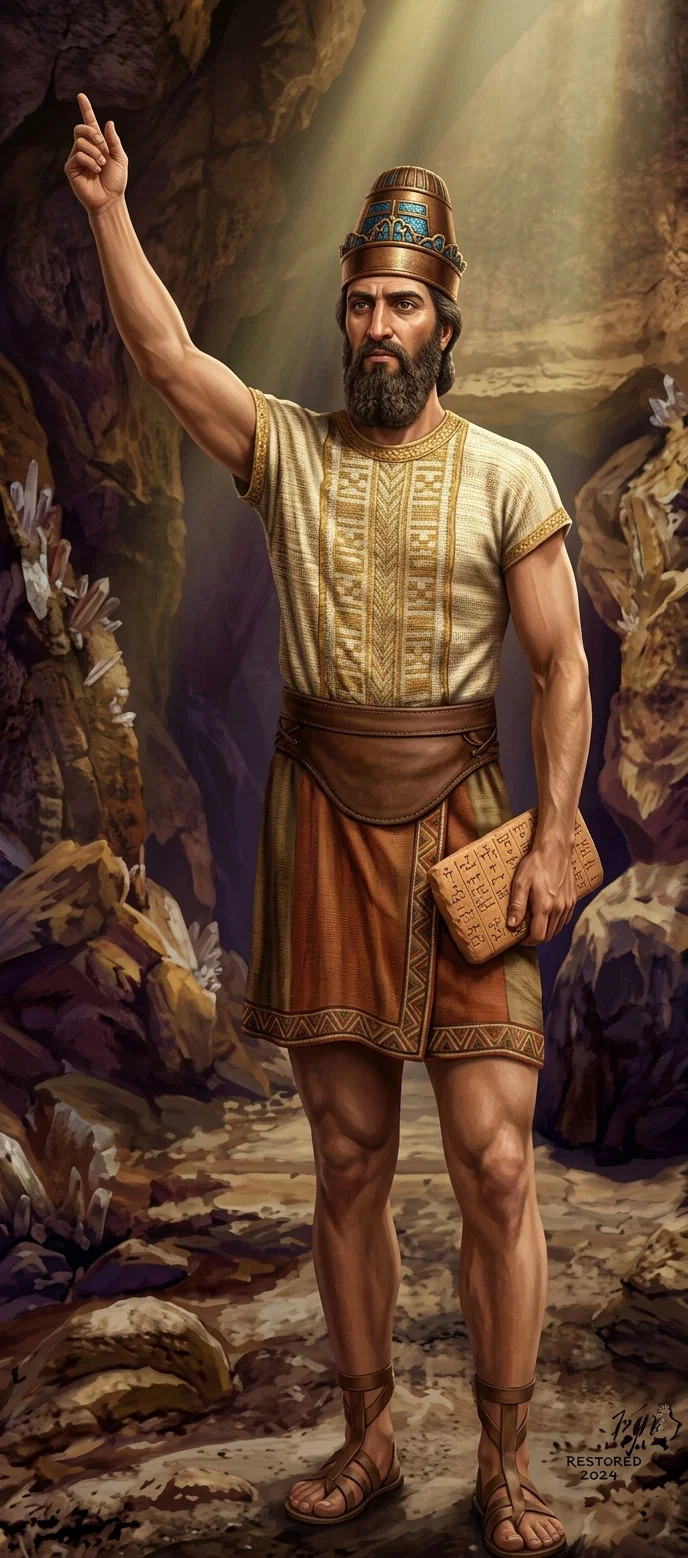
It was at this juncture that the great Revealer, through His servant Daniel, appeared upon the scene of action. Daniel informed the king that he would attempt to do what the great and wise men had failed in accomplishing; but he required time, in order that he and his three companions, Hananiah, Mishael, and Azariah, might unite in seeking the Lord for wisdom concerning the matter. See Dan. 2: 16-18, inclusive. This request of the king by Daniel showed his reliance upon God as the Revealer, and not upon any wisdom that he possessed independent of the Lord.
It is interesting to observe how Daniel and his three companions united in seeking wisdom from God concerning the matter. This method is in sweet accord with the Saviour’s words in Matt. 18: 19, 20, which are as follows: “I say unto you, That if two of you shall agree on earth as touching anything that they shall ask, it shall be done for them of My Father which is in heaven. For where two or three are gathered together in My name, there am I in the midst of them.” The result of this united prayer is beautifully expressed in the following forceful words: “Then was the secret revealed unto Daniel in a night vision. Then Daniel blessed the God of heaven. . . . He revealeth the deep and secret things: He knoweth what is in the darkness, and the light dwelleth with Him.” He further added, in verse twenty-eight, that the dream was for the purpose of revealing “what shall be in the latter days.”

What the King Dreamed

The dream is as follows: “Thou, O king, sawest, and behold a great image. This great image, whose brightness was excellent, stood before thee; and the form thereof was terrible. This image’s head was of fine gold, his breast and his arms of silver, his belly and his thighs of brass, his legs of iron, his feet part of iron and part of clay. Thou sawest till that a stone was cut out without hands, which smote the image upon his feet that were of iron and clay, and brake them to pieces. Then was the iron, the clay, the brass, the silver, and the gold, broken to pieces together, and became like the chaff of the summer threshing-floors; and the wind carried them away, that no place was found for them: and the stone that smote the image became a great mountain, and filled the whole earth.”

What the Dream Meant

The interpretation of this remarkable dream is as simple and to the point as the dream itself. It begins with these words, addressed to Nebuchadnezzar: “Thou, O king, art a king of kings: for the God of heaven hath given thee a kingdom, power, and strength, and glory. And wheresoever the children of men dwell, the beasts of the field and the fowls of the heaven hath He given into thine hand, and hath made thee ruler over them all. Thou art this head of gold.”
From this language it is easy to understand what is represented by the head of gold of the great image. How clearly it represents the first universal kingdom in the world’s history—Babylon! It is significant that this is symbolized by the head of gold, because, as the historian says, “It was the golden kingdom of a golden age.”
When one considers the wealth and glory of the Babylonian kingdom as compared with the three succeeding universal empires, it is easy to understand why the God of heaven has symbolized Babylon with the head of gold. The capital of the kingdom, the city of Babylon, will never be excelled in grandeur and glory by any earthly city. It was sixty miles in circumference, with a wall about it three hundred fifty feet in height and eighty-seven feet thick. It was laid out in a perfect square, with fifty streets running at right angles. There were also walls on either side of the river Euphrates, that ran through the city, and twenty-five brass gates on either side of the river. History teaches that the city of Babylon contained enough food stored within its walls to feed the subjects of the kingdom for twenty years in case of a siege. The tower of Belus, in the center of the city, represented a vast amount of wealth in its costly construction. Space will not permit us to say more regarding the glory of this once grand and magnificent metropolis of the proud monarchy of Babylon. Suffice it to say that the head of gold does in a most signal way represent the kingdom of Babylon, the first universal empire.

Succeeding Powers

The prophet continued his interpretation of Nebuchadnezzar’s dream by saying that another kingdom shall succeed the one over which he was reigning. In the year 538 B.C., at the time Belshazzar was the king of Babylon, the Medo-Persians overcame the first kingdom, and thus Babylon was succeeded by another universal empire. It will be noted that this second universal kingdom, Medo-Persia, was symbolized by the breast and arms of silver; and as silver is inferior to gold, so the Medo-Persian kingdom was inferior to Babylon in splendor and glory. However, by virtue of the fact that it overcame the Babylonian kingdom, it is evident that it excelled it in strength and power; but not even in these until Babylon had become weakened by the vices of luxury.
In his further interpretation of the dream, the prophet says that succeeding the Medo-Persian kingdom “another third kingdom of brass” should arise. No evidence is required to prove that the third universal kingdom was that of Grecia. It came upon the stage of action in 331 B.C.
The prophecy proceeds as follows: “And the fourth kingdom shall be strong as iron,” which very clearly symbolizes the iron monarchy of Rome, which surpassed in strength and power all the preceding universal kingdoms, for iron is stronger than gold, silver, and brass. In a most remarkable manner the prophet outlines the divided state of the Roman Empire by the mixture of the iron and the clay. It is a fact well known in history that between the years 351 and 476 the kingdom of Rome was divided into just ten parts, as follows: the Alemanni, the Ostrogoths, the Visigoths, the Franks, the Vandals, the Suevi, the Burgundians, the Heruli, the Anglo-Saxons, and the Lombards. Most of these horns, or powers, are still in existence, and the kingdom remains divided until the end of time.
The reader will recognize from the foregoing, the modern names of the kingdoms, which are familiar to all; namely, the Franks, the French; the Anglo-Saxon, the English; etc.
The great climax in the interpretation of this dream by Daniel is the establishment of the fifth universal empire, which is clearly expressed in the language of the prophet recorded in Dan. 2: 44: “And in the days of these kings shall the God of heaven set up a kingdom, which shall never be destroyed: and the kingdom shall not be left to other people, but it shall break in pieces and consume all these kingdoms, and it shall stand forever.” This fifth universal kingdom, which is yet to be established, is symbolized by the stone that was cut out of the mountain without hands, which is to destroy all of the earthly kingdoms that exist, and it will remain forever.
For over 1,400 years we have been living in the divided state of the Roman Empire, in which the prophet says this universal kingdom will be set up. Certainly the time must be near at hand when this fifth universal kingdom will be ushered in. When one stops to review how every detail of this prophecy relating to the four universal empires has been so accurately fulfilled to the very letter, how can he doubt the establishment upon this earth of the fifth kingdom which has been so clearly foretold in this remarkable prophecy? Is it not high time that all should seek to become inhabitants of this fifth universal kingdom? And in order to do so, we must let the principles of this kingdom now enter our hearts and change our lives so that we may become fit subjects for it.