Go and Sin No More

5%

Pacific Press Publishing Association · Mountain View, California · Sep 29, 1909

FromSigns of the Times, Vol. 36, No. 38.

Read the full edition

“Go and Sin No More”

By the Editor
“Let him that is without sin among you cast the first stone.”
THESE are words to a sinner by the Friend of sinners, the One most reviled by sinners, whose name is greatly profaned by sinners, who has been most maligned, denied, and blasphemed by sinners,—Jesus of Nazareth. Yet is He their greatest Friend. Others spurn them when they come to them; He never spurned them. Others hold hard and bitter thoughts against the low and degraded; He pardoned and healed all those whose hearts asked pardon and healing. The great, learned, and pious teachers of His day counted the poor and sinful accursed and without hope; He blessed them and kindled hope where erstwhile reigned dark despair.
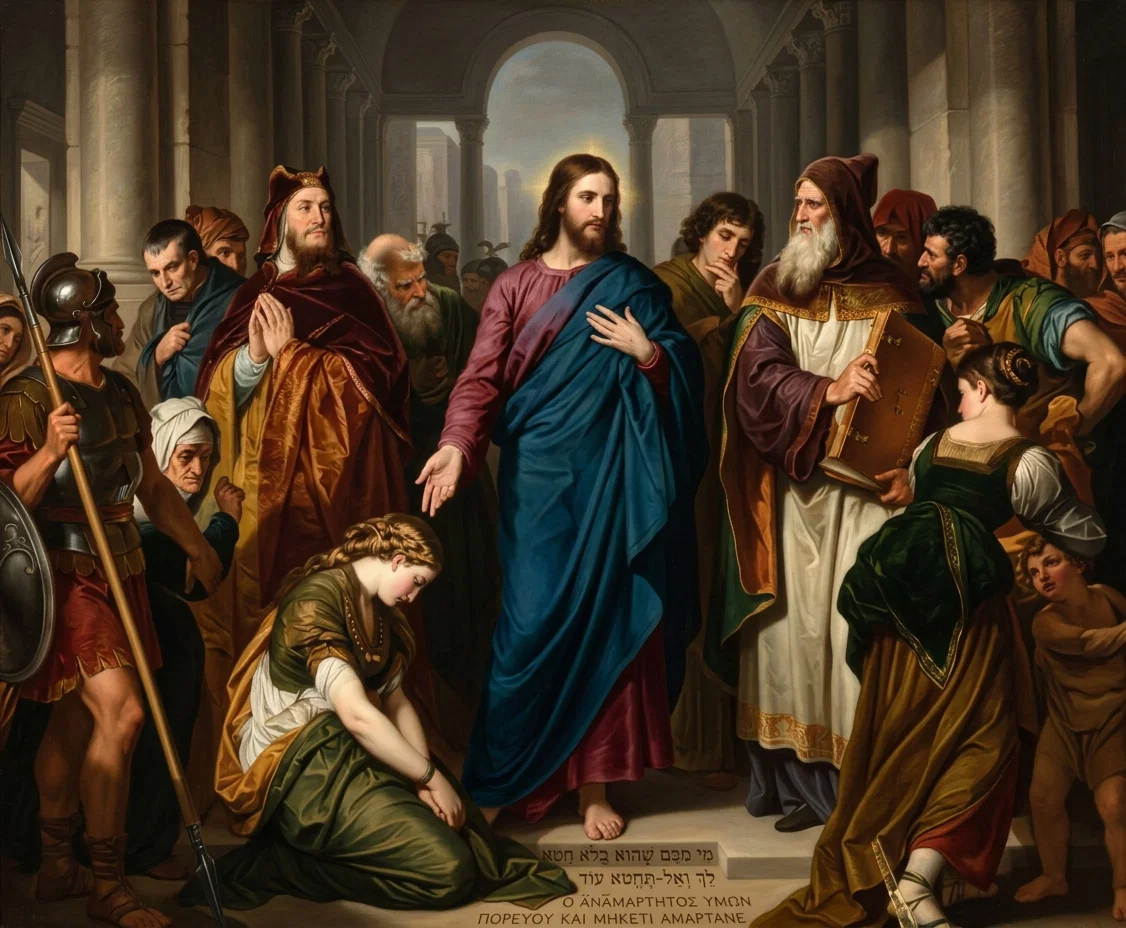
The instance which gave rise to the above-quoted words is recorded in John 8:3-11. It is a record of one of the traps set by the Jews to catch Jesus, but, as always, the outcome redounded to His glory. The scene was in Jerusalem, probably within the temple courts. The record is as follows:
**“And the scribes and Pharisees brought unto Him a woman taken in adultery; and when they had set her in the midst, they say unto Him, Master, this woman was taken in adultery, in the very act. Now Moses in the law commanded us, that such should be stoned; but what sayest Thou? This they said, tempting Him, that they might have to accuse Him. But Jesus stooped down, and with His finger wrote on the ground, as tho He heard them not. So when they continued asking Him, He lifted up Himself, and said unto them, He that is without sin among you, let him first cast a stone at her. And again He stooped down, and wrote on the ground.
“And they which heard it, being convicted by their own conscience, went out one by one, beginning at the eldest, even unto the last; and Jesus was left alone, and the woman standing in the midst. When Jesus had lifted up Himself, and saw none but the woman, He said unto her, Woman, where are those thine accusers? hath no man condemned thee? She said, No man, Lord. And Jesus said unto her, Neither do I condemn thee; GO, AND SIN NO MORE.”
The device of the enemies of our Lord seemed to be a perfect one. How could He free the woman without excusing sin or setting Himself against a civil law of the theocracy, given through Moses? Or if Jesus said, “Let her be stoned,” they could then accuse Him before the Romans as one who usurped authority, and an enemy ofCesar. It seemed to them that Jesus must in His reply set Himself against either Moses or Cesar. In the one case He would lose prestige as a religious teacher with the people, and in the other, they would through the Romans silence Him as one stirring up sedition.
Our Lord reads their thoughts. His pure eyes saw in them, cherished in heart and stamped on feature, the same sins and worse, of which they had accused the woman. And, stooping down, He wrote on the sand at His feet their sins, beginning with the oldest before Him. In their eagerness to trap Him, they did not notice at first what He was writing. They thought that He was indifferent to their plea; and they became insistent in their demands. The Master stood erect, and it needs no imagination to picture the look that swept the countenances of His interlocutors, and His deeper gaze that looked beyond the surface, piercing the innermost recesses of their hearts. With solemn tone and measured accent He responds: “He that is without sin among you, let him first cast a stone at her: And again He stooped down, and wrote on the ground.”
They heard His reply. They doubtless looked to the writing in the sand, and read in condemning letters their own hearts’ iniquities. No more is needed. Convicted of their own sins, fearful perhaps that they would be published to the world, not ashamed to sin, but ashamed to confess, they pass out, from the oldest to the last, till Jesus was left alone with the only sinner uncondemned.

“Hath No Man Condemned Thee?”

Jesus looks up, and finds Himself alone with the woman. He asks, “Where are those thine accusers? hath no man condemned thee? She said, No man, Lord.” How could they, in the light of eternal truth and righteousness, blazing the light deep down into the darkened chambers of their own vile hearts, and revealing sins, the wickedness of which the poor adulteress perhaps had never dreamed? How can men in the present blessed light of God’s Word, revealing, probing, searching the hearts of all, go on with unsparing condemnation of their fellows? How can professed Pharisees of to-day place themselves on the throne, and assume to condemn all who do not follow their interpretation of law or pronounce the shibboleth of their clan? How can professedly Christian society, among whose recognized leaders are rakes and debauchees, crowned by earth tho some may be, sit in judgment on the poor women, some of whom are ruined by the male prostitutes whose positions or wealth make them welcome to the same society? Would to God such could see, in the presence of the pure Jesus, their own hearts. They, as did their prototypes of old, would go out “convicted by their own consciences.”

“Neither Do I Condemn Thee”

This is the message of Jesus to the poor, humbled sinner at His feet. It is not the business of Christianity to condemn men or women. This does not mean that Christ excused the sin. Doubtless the woman’s sin had never seemed so heinous to her in all her life before as when she was bowed in the presence of Jesus. By not one word did Christ lessen the enormity of the sin. He knew as no other knew its terrible results. He was voluntarily bearing its fearful results for others’ sake, that He might save others. He knew that He could not frighten nor compel into a better life the penitent one before Him. She already knew the sin; what she needed to know was the Father’s mercy, hidden by the rigorous exactions of selfish Pharisaism. “Neither do I condemn thee;” thy sins are forgiven. Does this touch your heart? Would you be released from such a life? As God has the greatness in mercy to forgive, so He has the greatness of strength to sustain. “Go, and sin no more.” Blessed, soothing words to every contrite heart, now as well as then. O soul, bound in sin, the Master, the Lord of heaven and earth, speaks to thee, however scribes or Pharisees may condemn! You may be an adulteress, an outcast, a drunkard, a thief, a blasphemer; “Jesus Christ came into the world to save sinners.”
This is the work of Christianity. “For the Son of Man is come to seek and to save that which was lost.” “For the Son of Man is not come to destroy men’s lives, but to save them.” It is the lost sheep, torn, bruised, hungry, seemingly worthless, for which the shepherd ventures life and safety. It is the lost piece of silver that the church is to hunt. It is the sinner that needs the saving, the hungry that needs to be fed, the naked that needs to be clothed, the sick that needs a physician. And to reach these—these “lower classes,” men call them, but not less precious in God’s sight—who knows a better way than Jesus Christ followed? It was not by legislation that He led men back to the commands of God; it was not by compulsion or coercion that He labored; it was love, outgiving, winning love. Every attempt to reform the world or man by human legislation has resulted in evil and only evil. Every outflowing of love in sacrifice has won and bound some soul to God.

God’s Mercy and Power

How gloriously shines out the first, even toward the self-righteous, condemning Pharisees! He could have told their sins orally in public; but He did not. He could have told each man’s sins under each man’s name; but He left conscience to do the work. He might have written the sins in the rock of the temple, even as He graved the law in the rock; but He wrote them upon the sand, to show them how easy He could obliterate them. The only writing He did when on earth with human finger was to write men’s sins in sand; but on the hearts of men by divine love He engraved and implanted His law. And then He is all powerful. When He said to the impotent man, “Arise, take up thy bed and walk,” there was power in the word to enable the man to obey. So when He said to the adulteress, and to each and all, “Go, and sin no more,” there is power in the word to keep from sin.
“There’s a wideness in God’s mercy, like the wideness of the sea;\nThere’s a kindness in His justice, which is more that liberty.\nThere is welcome for the sinner, and more graces for the good;\nThere is mercy with the Saviour; there is healing in His blood.\nFor the love of God is broader than the measure of man’s mind,\nAnd the heart of the Eternal is most wonderfully kind.\nIf our love were but more simple, we should take Him at His word,\nAnd our lives would be all sunshine in the sweetness of our Lord.”