IN May 20, I left the mission for a visit to our out stations, intending also to extend my trip among the Angoni tribes of Central Nyasaland. I spent Sabbath and Sunday at our Monekera out station, where we have three village schools and about twenty baptized members. As at sunset I came up the hill on which the little grass church stands, I heard the songs of the worshipers assembled for their opening Sabbath service. Malinki and Provera have charge of the work at this place. Provera is chief over eight small villages, and Malinki is our head teacher. A few weeks before, a man had been murdered in one of these villages. Malinki and Provera with many others had been called before the magistrate as witnesses in the case, so there was much excitement over the matter, which had resulted in the hanging of the murderer. I took the opportunity to impress on these people the evils of beer-drinking and polygamy, which cause much of the trouble among natives here.
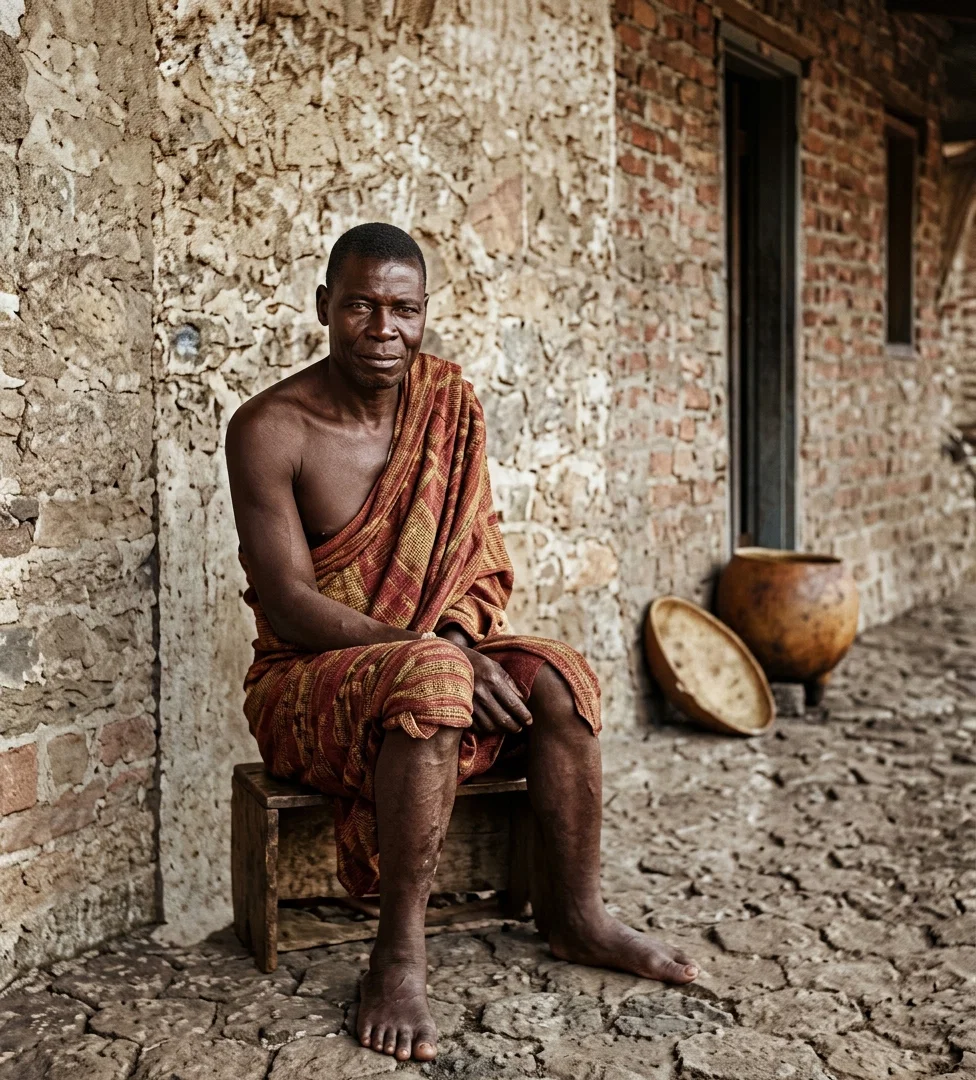
Angoni Chief, Nyasaland. Front of J. C. Rogers's House
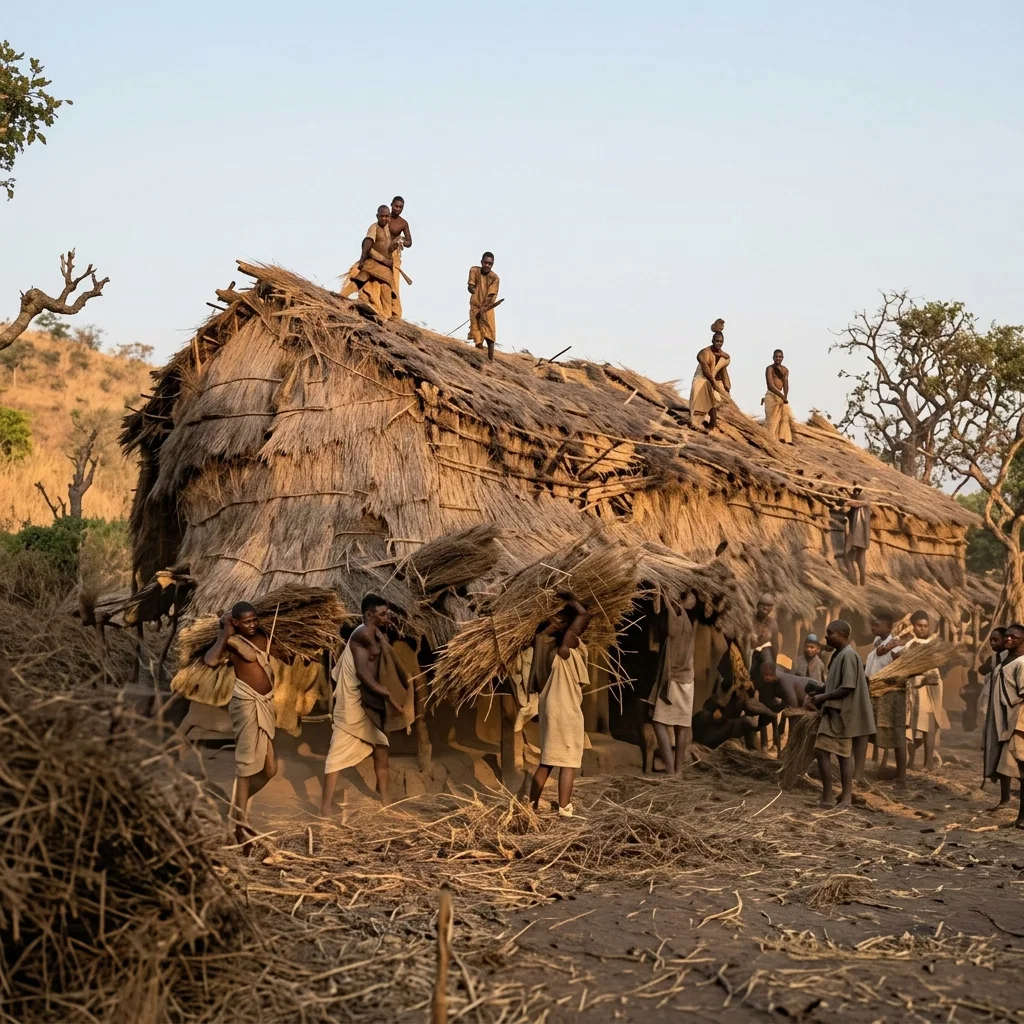
Tearing Down Old Grass Building, Nyasaland
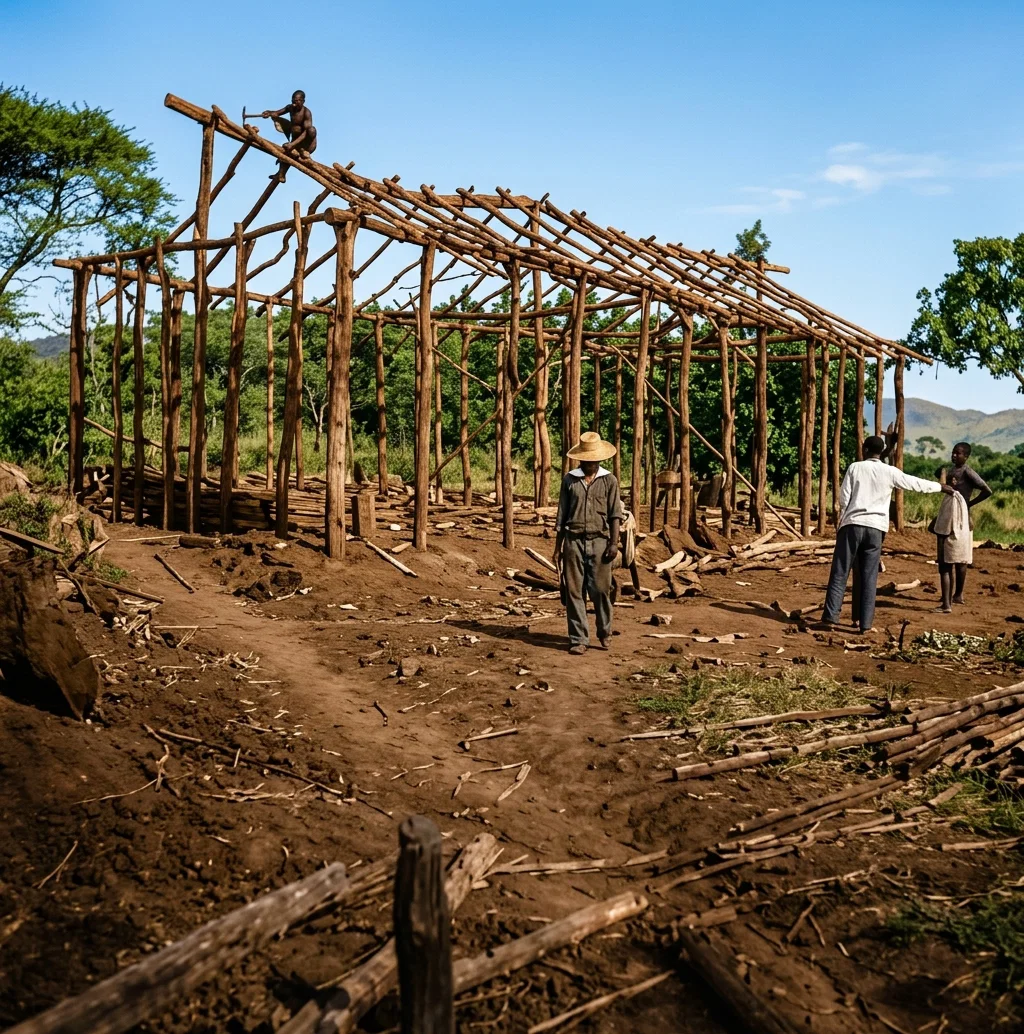
The Frame of the Old Grass Building
With seven men to carry food, bed, blankets, etc., I then proceeded by bicycle to our Matandane out station fifty miles away. As this station is in the mountains and the roads are bad, I had to walk about half the distance. I found Brother and Sister Konigmacher well, and the station looking much better than when they took charge of the place six months before. They have had a good school, and enrolled fifty-two pupils. During the coming year we hope to open two or three schools in the villages near Matandane, and in this way extend our work right up to the Portuguese border. Brother Konigmacher will spend some time during the school vacation visiting among the villages.
After leaving Matandane it was my plan to visit the stations of the Zambezi Industrial Mission and the Dutch Reform Church Mission, while also visiting the villages of the Angoni tribes, from which many of our schoolboys, teachers, and church-members come. My first stops were at two stations of the former mission. Here I found the missionaries and many hired natives busily engaged in gathering the coffee crop, which is the principal industry of this mission.
There was no school at either of these stations, owing I suppose to the urgency of the industrial work, tho many village schools were running under the superintendence of the missionaries. These missions have no boarding-schools, only having a church and day-school for pupils who live in near-by villages. Besides they have a central training-school for teachers. I also visited this training-school, which has about forty teachers in training.
Near these stations I found the home of Peter Nyambo, a native who was two years in our London training-school, and who is now teaching in our Malamulo school. I spent a day and night in this group of villages, having a good chance to learn the home conditions of our natives. Their huts are made mostly of grass, some plastered with mud over the grass inside and outside. As a rule these natives desert one village after three or four years, and build another. Peter’s father was among the descendants of the Zulus who raided much of the country south of the Zambezi, crossing the river northward about 1825. He told me that he was old enough to herd cattle at the time the Zulus crossed the Zambezi. From this fact I suppose he is now about ninety years old. The people of some of these Angoni villages are talking of moving near to our Matandane station. At present there is no school near them, and they want their children in school. It would not be wise for us to place a school where they now are, as this is territory of another mission.
On my return I took another road, which brought me to Zomba, the seat of the colonial government. Here I had the first opportunity of meeting the governor, Sir Alfred Sharpe. I was glad of the opportunity to personally pay my respects to him, and also to represent the cause in whatever way might be offered. After conversing with him, he showed the kindly feeling of the government toward our work by calling my attention to the government grant in aid of native education, in which our mission might share equally with other missions.
After a four weeks’ trip, covering about six hundred miles, I was glad to get back to the mission again. We are now busy preparing for a four weeks’ teachers’ school before the opening of the next school year, August 1. We hope to have twenty or more native teachers present, and shall try to give them the best preparation possible. We have difficulties which we hope will be removed in time. One of the most serious is our lack of books in the native language. One little tract of twelve Bible readings is all that we have of present truth. So we are obliged to depend upon other sources for all school-books. Some of our own books must be translated into this language. May the Lord give time and strength for this work!
Joel C. Rogers.
Malamulo Mission, Cholo, Nyasaland.
June 27, 1909.
LATER.—Twenty-seven native teachers and assistants will work in thirteen schools, in which about 600 will be enrolled.