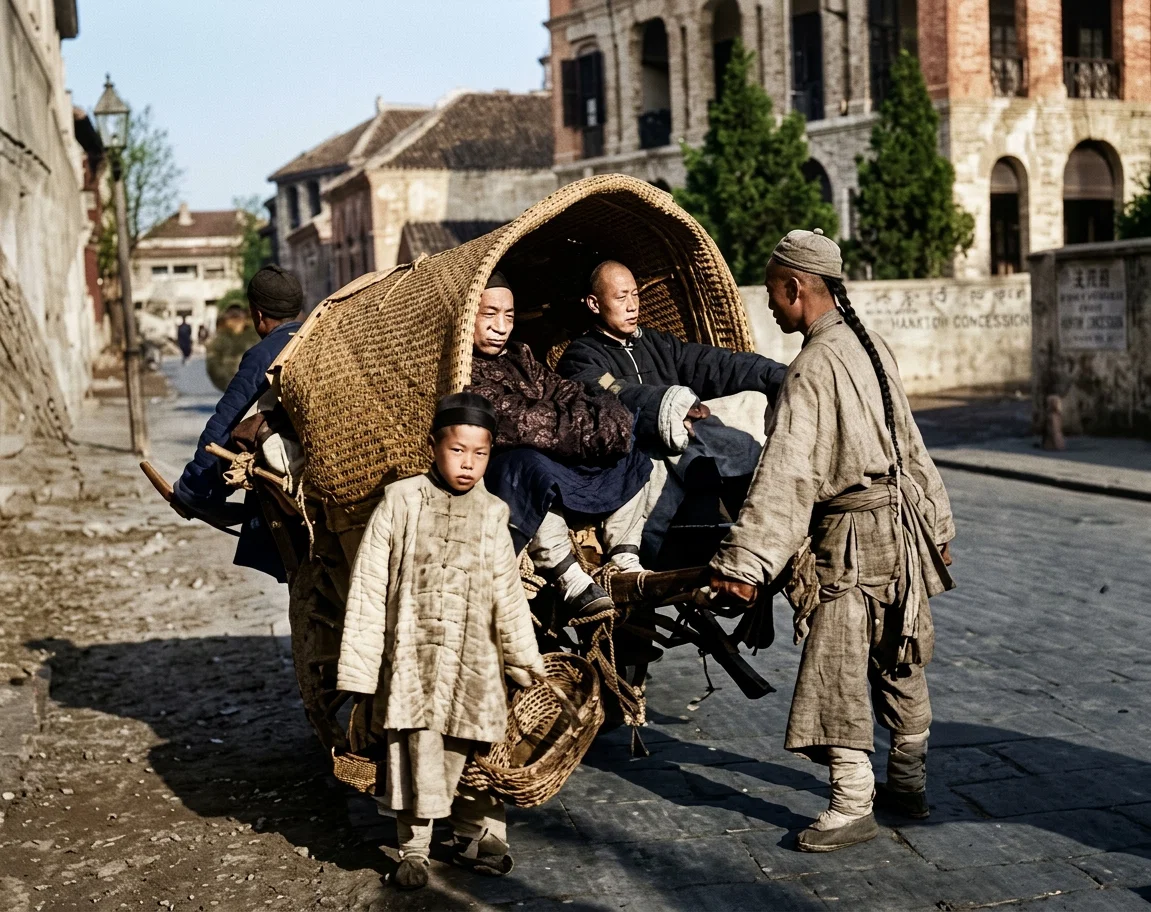
It is said that there is no other civilized country of the world where the means of communication are so difficult as in China.
In Central and Southern China, where the country is largely mountainous, the only highways are foot-paths that seldom exceed five feet in width. These hardly admit of any conveyance other than the wheelbarrow and sedan-chair. In the plains of the North the roads widen out enough to allow rough carts to travel on them, tho frequently they appear merely as beaten paths through the fields. In other places, through long years of travel, they are found to be sunk so deep between high walls of yellow earth that the travelers are unobserved by any one more than a few rods distant.
Aside from these ordinary roads, the Chinese Government has constructed a system of courier roads, called in the Chinese “Great Public Horse Roads,” which connect Pekin with the most remote regions of the empire. These take an approximately straight course, often being cut into the steep sides of mountains or run through them by means of tunnels. In the plains these roads have a width of from twenty to thirty yards and are paved. At intervals of every three miles a signal tower is erected, and along the entire route are to be found inns, relay-posts, and companies of soldiers. The repair of these roads is entirely neglected and the government is now considering the idea of abolishing this courier service altogether, and having the official despatches transmitted through the post-office.
In her four river systems, China has ten thousand miles of navigable waterways. These are well utilized by the Chinese, many thousands of whom have no other home than the house-boat. The Grand Canal, which is about one thousand miles in length, is also of much value. Considerable portions of it are now in such condition that it is barely navigable, but the government is now planning to make extensive repairs and reopen it for commerce. In recent years many steam-launch and steamship lines have been established, and have been a most valuable factor in the development of China.
Chinese Wheelbarrow. Country Travelers Entering Foreign Concession at Hankow
The first telegraph line was established in 1884 and connected Pekin with Shanghai. Since then many other lines have been put in operation, by which Pekin is connected with all provincial capitals and important commercial centers, making in all nearly forty thousand miles of wire. China is in communication with the outside world by the overland Siberian telegraph line, and by two submarine cables,—one running to Japan and the United States, the other to Europe by way of the Indian Ocean and the Mediterranean.
As the Chinese characters can not be transmitted by wire, the following ingenious device is used. Each character has its number. The operators have type with the character on one end and the corresponding number on the other. When the message is to be sent the operator arranges the type according to the characters to be used, then turns it over and sends the numbers. At the other end of the line the numbers are received and the type arranged accordingly; then the type is turned and the message is read in Chinese characters.
In 1876 China’s pioneer railway was constructed by an English corporation and connected Shanghai with Woosung, a distance of twelve miles. As the government had given no regular permission, and as there was much opposition by the Chinese, the line was compelled to suspend operations. The next year the property was purchased by the Chinese Government, the rails and sleepers were torn up, and the whole thing, together with the engines and cars, was shipped to the Island of Formosa. This procedure quieted all railway enterprise in this section of China for about twenty years.
In North China a railway connecting the Kaiping coal mines with Tientsin was opened in 1888, and nine years later it was completed as far as Pekin. This railway has now been extended in Manchuria, and with other lines connects with the Siberian Railway. By the investment of Russian, Japanese, and Chinese capital, the Dependency of Manchuria has been provided with more and better railway facilities than any section of China proper.
In Shantung, a province of Eastern China, two hundred and seventy-four miles of railway has been constructed by a German corporation, and it is expected that other lines will soon be added to this system.
The Pekin-Hankow Railway, built by the Belgians and French, was opened to traffic in the autumn of 1905. It is seven hundred sixty miles in length, and spans the Yellow River by a bridge that has for its foundation nothing but the sand bottom of the river. Notwithstanding the many doubts that have been entertained regarding this structure, it has thus far stood the test.
The Hankow-Canton line, which with the Pekin-Hankow Railway would form a trunk line through the heart of China proper from north to south, was undertaken several years ago. The control of this proposed railroad has passed through various hands, but it is now hoped that the present Chinese company, with German capital, will succeed in completing the work.
Along the lower Yangtze a well-built road, two hundred miles in length, connecting Shanghai and Nanking, has recently been put in operation. It is now proposed to push on with this railway nine hundred miles further into western China.
Without question, the most important railway now under construction in China is13one which is to connect the cities of North China with those of the lower Yangtze. It will make the distance between Pekin and Shanghai eight hundred seventy-five miles to be traveled in forty-eight hours. German and British enterprise combine in the construction, and it is hoped that this line will be open to traffic by the autumn of 1911.
These are but a few of the more important railways that have been built, or that it is hoped will soon be built in China. Including Manchuria, there is now nearly four thousand miles of road in operation, and almost as much more under construction. The French are making substantial progress in the Southwest, and it is hoped that ere long there will be railway connection between China, Burma, and India. Altho very difficult because of the canyon-cleft country, still the project is feasible, and various routes have already been suggested.
Nearly two thousand years ago, the Saviour made the explicit promise, “And this Gospel of the kingdom shall be preached in all the world for a witness unto all nations, and then shall the end come.” In all ages when the Lord has had a great work to be accomplished, He has likewise had His agencies at work to prepare the way. To-day the tokens of the soon coming of Christ to this world are unmistakable; but before the dawn of that glad morn there is a message to be carried to “every nation, kindred, tongue, and people.” Therefore we confidently believe that this great movement in the development of communications and facilities for travel in this ancient yet densely populated empire is a part of God’s program in the opening of China to the Gospel of salvation.
Shall we not make greater efforts in the future than we have in the past to keep pace with the unfolding providences of God? Who will consecrate himself this day for service in this mighty mission field? Who will give freely and willingly of his means to assist in supporting workers, to establish mission stations, and to publish and circulate Gospel-filled literature in the land of ancient Sinim? And finally, pray, and pray earnestly for this work, for the workers, and for China’s millions.