Spiritualism in China

6%

Pacific Press Publishing Association · Mountain View, California · Nov 3, 1909

FromSigns of the Times, Vol. 36, No. 43.

Read the full edition

Spiritualism in China

Boys in the China mission field, as elsewhere, are sometimes marred by deep sorrows. And yet the latter are but channels to lead the soul to a deeper faith in God, less reliance on self; and moreover, to give the worker with God new insights into Chinese life hitherto unknown. Thus are opened up new fields for sympathy and prayer. Such is the case of a petty official at Changsha, of whom at one time much was expected.
His mother, a widow, is notorious for her frequent paroxysms of anger. This led her two sons cowardly to put away their wives for the sake of peace. Confucius never inculcated the Edenic teaching, “Therefore shall a man leave . . . his mother, and shall cleave unto his wife.” Hence it is not surprising to find his followers think these two sons able exponents of “filial piety.” But later the elder son’s wife fell very sick. The ordinary Chinese treatment proved unavailing, and as she grew much worse, her husband was induced, as a last resort, to seek one who had “a familiar spirit,” and obtained a satanic written prescription. This was also ineffective, and the poor woman’s unhappy married life ended. In spite of many exhortations to abstain from such a course of action, this man began to study the spirit writings for himself. As a result he has now become a most popular spirit medium. At times, what purports to be his deceased father’s spirit attends the seances, and writes most uncomplimentary and condemnatory messages for the widow mother. Nevertheless, the son still walks in fear and dread of her violent temper.
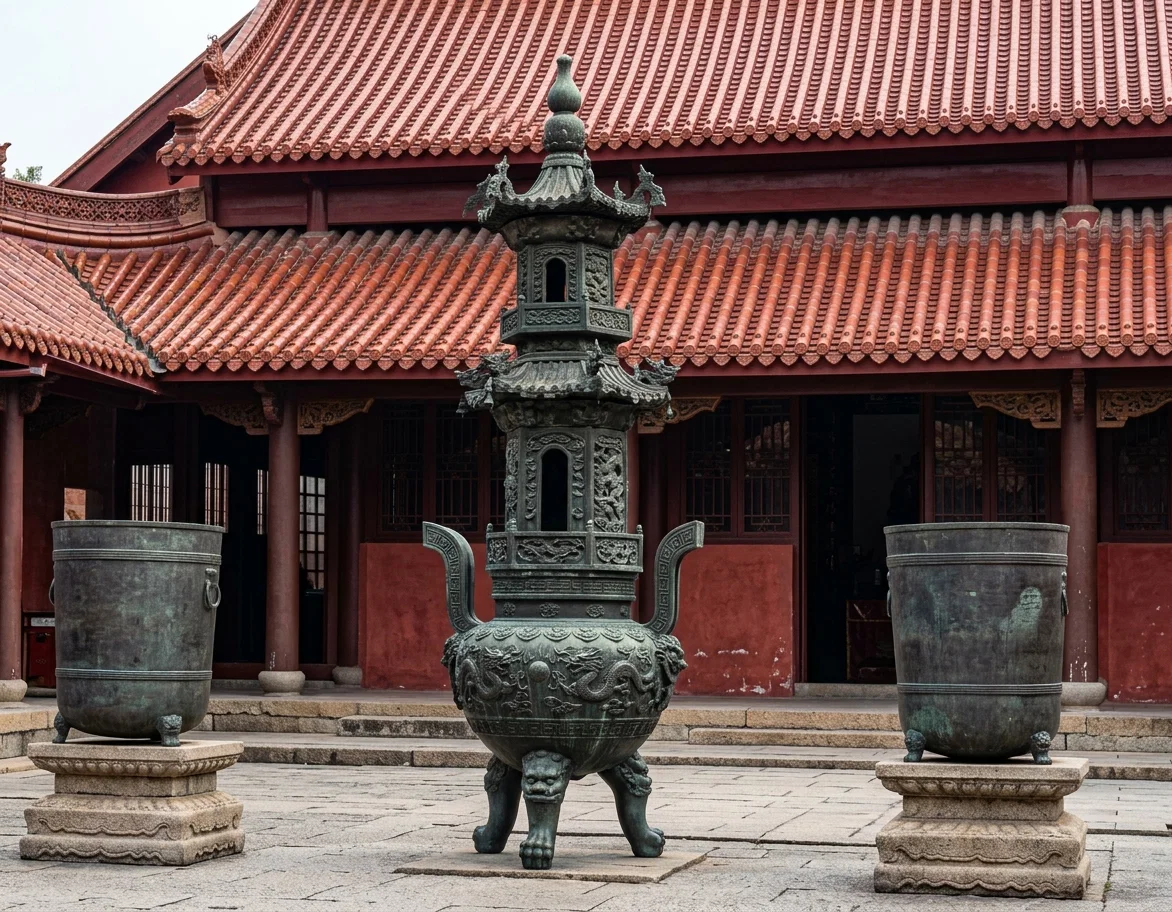
Incense Urn in Temple Court
Yochow, from Tung Ting Lake, Province of Hunan. The Temple is the high building above the white cross.
In China, where ancestral worship “makes dead men into gods, and its gods are only dead men,” these spiritualistic seances have been held for centuries. But in these latter days they have become more prominent at this center, as have those on the other shores of the Pacific Ocean. The seances are held about midnight, and at intervals of a few days. The medium presents his questions orally, but the replies are always made in writing. For this purpose a good supply of ink is prepared beforehand, and a Chinese pen-brush is tied to the single end of a forked peach-branch. Inasmuch as the satanic messages are in the high classical language, the mediums, of necessity, are confined to the literati, whose sage, Confucius, advised that “to respect spiritual beings, but to keep aloof from them, may be called wisdom.”
To summon the spirit, the medium prostrates himself before a shrine, before which have been burned incense, candles, crackers, and the other paraphernalia used in idolatry; certain formularies are recited in a loud voice. The two forked ends of the peach-branch are then held by the medium and another person. After some time has elapsed, a violent agitation of the peach-branch, thus held in readiness, signifies that a spirit has arrived. At times the medium is levitated. On being questioned as to his identity, the satanic messenger uses the peach-branch pen and writes his supposed name in beautiful Chinese characters. If, however, he is not the one whose services are required, he is requested to go and call up this special visitant.
A famous spirit writer in this district purports to be one Lay Tongpin, a scholar who died centuries ago. As the tutelary deity (?) of the Tung Ting Lake, in North Hunan, he has a large temple at Yochow, on the north side of the lake. There are probably few boatmen who would venture the passage of the lake without some pretense to sacrifice toward this temple. A picture is given of an urn in this temple courtyard.
Other strange phenomena are witnessed in this city. In a certain house of three rooms, the middle one being empty, a mosquito curtain was completely burned up as it was hanging over a bed in one of the occupied rooms. Almost immediately after the first one was burned, a like thing happened in the other occupied room. In each case nothing else was damaged at all, even though the mattresses on both beds were composed of loose straw. The poor inmates, who aver they saw a red something go out of the window after the fire, were terrified and have moved out of the house.
In another case, one man was killed outright, and others severely injured, by a house falling in. It was discovered that one of the central wooden pillars, measuring more than a foot in circumference, had snapped asunder like a dry twig. “Surely a spirit visited that house,” was the general opinion.
Since writing the above, I have just returned from a visit to a small temple with a single idol. This idol has suddenly become renowned for its healing virtues. Its origin is unknown, beyond the fact that it was washed down to Changsha during the great flood about four years ago. Some months ago it was stolen, but after a little disturbance was recovered and reinstated in its present position. Altho the river is in flood, causing the shrine to be an island, it does not deter the long stream of worshipers of all ranks and stations in life who are seeking healing for themselves or friends. Each person carries a little bunch of crackers, candles, paper money, incense sticks, etc., to offer at the shrine. The edifice being so small, firecrackers are covered up to prevent injury to the prostrate worshipers. Those arriving late seemed almost to begrudge the time taken by those first at the shrine. The sulphur fumes, smoke, and heat of a sultry morning, added to the sadness of the whole scene, caused me to seek the open air and cry to God for the light of truth to penetrate into these dark hearts.
Well spoke Jeremiah of death’s being “the land of the enemy.” From the cradle to grave, this whole nation of a fourth of the world’s population, “through fear of death” are “all their lifetime subject to bondage.” They are afraid to die themselves, and more afraid of those dead already.
“Christ was unwilling that Chinese should suffer; And thus of flesh and blood took part the same, That through death He might destroy Satan’s death power, Liberate Chinese who feared demon names. Perishing, perishing! Hark how they call us: Bring us your Saviour, O tell us of Him! We are so weary, so heavily laden, And with long weeping our eyes have grown dim.”
PERCIVAL J. LAIRD.
Note.—Just as these few facts were ready for the post, the spirit medium above mentioned happened along. He handed me one of the seance bulletins which are widely circulated at Changsha. He was completely taken aback to find that, without the slightest attempt at compromise, we could agree as to the genuineness of these seances. But I emphatically denied that the spirits of dead men can be present; for “the dead know not anything.” Eccl. 9:5. This opened up the way for a Bible reading on life only in Christ. Pray for us in this dark field, and also that the time will soon come when we may havetruth-filled literature to educate these poor people away from these soul-destroying delusions of Satan.
P. J. L.
Changsha, Hunan, China.