“For all have sinned, and come short of the glory of God.” Rom. 3:23.
2. What is the sure result of sin?
“Sin, when it is finished, bringeth forth death.” James 1:15.
“The soul that sinneth, it shall die.” Eze. 18:4, 20.
3. Yet for what does mankind, good or bad, continually long?
“What shall it profit a man, if he shall gain the whole world, and lose his own soul [life]?” Mark 8:36.
NOTE.—The above is the true diagnosis of man’s case. Proud man does not like to believe it. It is not flattering to the strong, the wise, the proud. They would rather believe, “I am, and there is none else beside me.” They prefer to believe that man did not fall; that he is not a sinner; that he is not subject to death, but rather a child of nature on his upward way. Yet all of life, all relationships of life, all man’s best consciousness of himself, go to show that he is a sinner, one who has “missed the mark,” and therefore he has come short of the glory, or goodness (Ex. 33:18, 19), of God. “In the way of righteousness is life; and in the pathway thereof there is no death.” Prov. 12:28. God can not die, because He is absolute righteousness. Man does die, ever dies, because he is a sinner. Why not, then, accept of God’s diagnosis of our case, when there is so much in our own experience to confirm it! Man’s longing for life, man’s fear of death, are the evidences of his instincts, whatever his theories, that man is a sinner and subject to death. Satan declared what is everywhere obvious, when he said, “Yea, all that a man hath will he give for his life.” Job 2:4.
4. Can not our brother, or friends, or great men, help us?
“None of them can by any means redeem his brother, nor give to God a ransom for him.” Ps. 49:7.
5. In whom alone can man be saved?
“Neither is there salvation in any other; for there is none other name under heaven given among men [save that of Jesus Christ], whereby we must be saved.” Acts 4:12.7
6. Whom does He undertake to save?
“This is a faithful saying, and worthy of all acceptation, that Christ Jesus came into the world to save sinners.” 1 Tim. 1:15.
7. How early was His sacrifice?
“Redeemed . . . with the precious blood of Christ, as of a lamb without blemish and without spot: who verily was foreordained before the foundation of the world, but was manifest in these last times for you.” 1 Peter 1:18–20.
“The Lamb slain from the foundation of the world.” Rev. 13:8.
8. Why did God thus give His Son?
“For God so loved the world, that He gave His only-begotten Son, that whosoever believeth in Him should not perish, but have everlasting life.” John 3:16.
9. What part had the Son in this giving?
“Who gave Himself for us, that He might redeem us from all iniquity, and purify unto Himself a peculiar people, zealous of good works.” Titus 2:14.
10. What was the worth of this offering?
“For He [the Father] hath made Him [the Son] to be sin for us, who [the Son] knew no sin; that we [the sinners] might be made the righteousness of God in Him.” 2 Cor. 5:21.
“He was wounded for our transgressions, He was bruised for our iniquities: the chastisement of our peace was upon Him; and with His stripes we are healed.” Isa. 53:5.
11. How may the sinner avail himself of the benefits of Christ’s sacrifice?
“Testifying both to the Jews, and also to the Greeks, repentance toward God, and faith toward our Lord Jesus Christ.” Acts 20:21.
“I acknowledge my sin unto Thee, and mine iniquity have I not hid, I said, I will confess my transgressions unto the Lord; and Thou forgavest the iniquity of my sin.” Ps. 32:5.
12. How did men formerly show faith in Christ’s offering?
“And Abel, he also brought of the firstlings of his flock and of the fat thereof. And the Lord had respect unto Abel and to his offering.” Gen. 4:5.
“By faith Abel offered unto God a more excellent sacrifice than Cain, by which he obtained witness that he was righteous, God testifying of his gifts: and by it he being dead yet speaketh.” Heb. 11:4.
13. What was there in Abel’s offering which recognized sin and the sacrifice of the Son of God for the sinner?
“Without shedding of blood is no remission.” Heb. 9:22.
“For the life of the flesh is in the blood: and I have given it to you upon the altar to make an atonement for your souls.” Lev. 17:11; Gen. 9:4.
14. But does the blood of beasts take away sin?
“For it is not possible that the blood of bulls and of goats should take away sins.” Heb. 10:4.
15. What did this blood typify?
“The precious blood of Christ, as of a lamb without blemish and without spot.” 1 Peter 1:19.
“Unto Him that loved us, and washed us from our sins in His own blood.” Rev. 1:5. See also Heb. 9:14; 1 John 1:7.
NOTE.—The above scriptures, and many others which might be given, if we had the space, clearly show that all God’s appointed offerings were made in faith in Jesus Christ. Every lamb offered in faith for sin in the past was offered in virtue of “the Lamb of God, which taketh away the sin of the world.” John 1:29. The blood represented the life. The blood of Jesus shed for man represents His life. “The good Shepherd giveth His life for the sheep.” John 10:11, 15. Whenever a sinner brought to the altar a lamb, he laid his hand upon the head of the innocent beast, and confessed his sin before God; he presented that offering as standing for himself, who was worthy to die; the lamb was slain, and its blood offered in the sinner’s behalf. The sinner by faith saw through that sacrifice God’s offering on his behalf; and God accepted him, counting his faith for righteousness.
16. When Israel was called out of Egypt, what center of worship was built?
“And the Lord spake, . . . Let them [the children of Israel] make Me a sanctuary; that I may dwell among them.” Ex. 25:1–9.
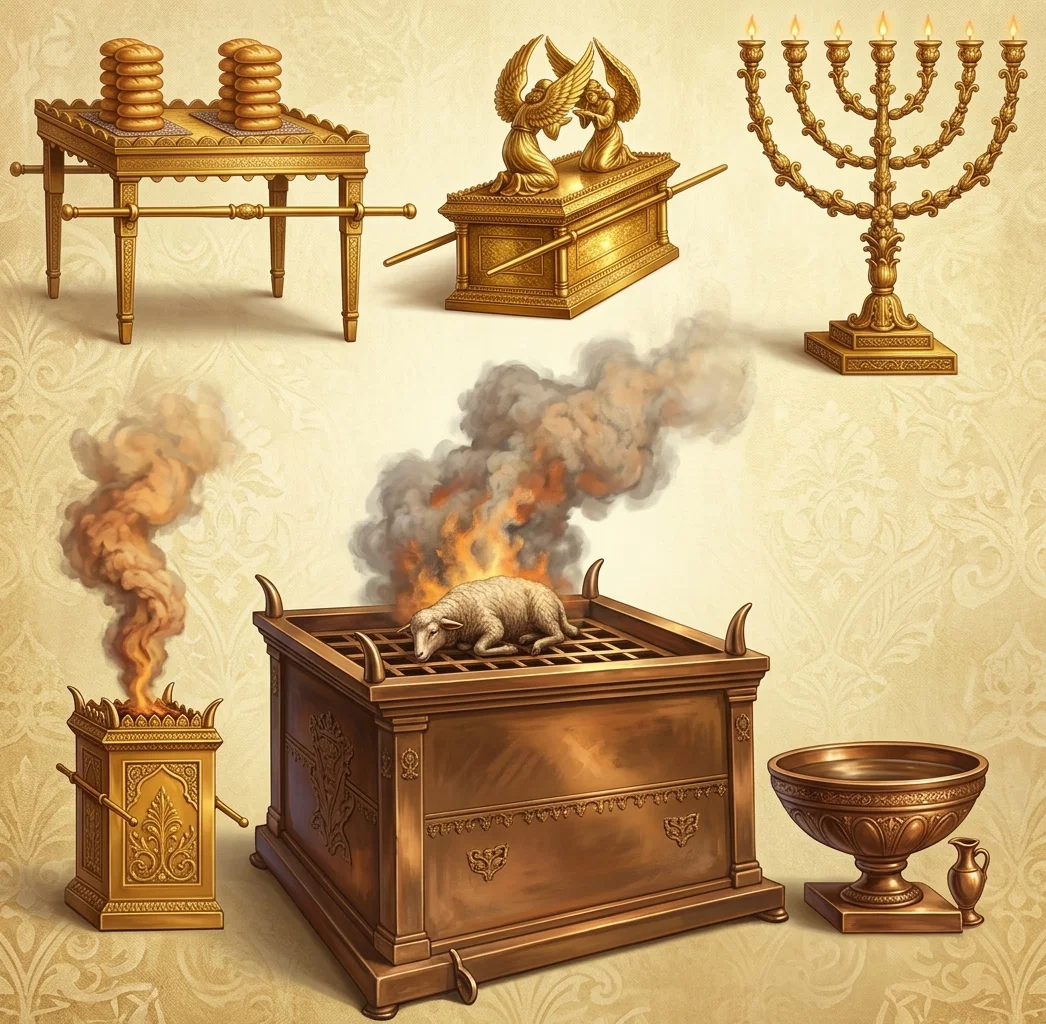
NOTE.—The making of this sanctuary and its furniture is described in Exodus, chapters 25 to 30, 36 to 40. A brief description (see engraving) is as follows: It was an oblong building 30 cubits long, 10 cubits high, and 10 cubits wide, made of upright boards of acacia wood, overlaid with gold without and within. It was divided into two compartments, the holy place and the most holy, separated by a heavy curtain, or veil; the former twice the size of the latter. Ex. 26:33. It opened toward the east, so that the priest in his ministrations faced to the west. Num. 3:38.
Before the sanctuary was the altar of burnt offering, where the victims were slain, and the laver where the priests washed. Ex. 27:1–8; 30:18.
On the right as one entered, the north side, was the table of showbread, representing the Word of God. Ex. 25:23–30; John 6:48, 56, 63. On the left, the south side, was the seven-branched candlestick, representing the fulness of the Spirit of God. Ex. 25:31–40; Rev. 4:5. In front of the veil separating the holy places, was the altar of incense, the incense representing the grace of God which makes His people’s prayers effectual. Ex. 30:1–10; Rev. 8:3.
Within the second curtain, or veil, was the most holy place. Here was the holy ark. In that ark were the tables of stone upon which God had written with His own finger His holy law of Ten Commandments. Ex. 24:12; 32:15, 16; 25:21; Deut. 10:1–5. The transgression of this law is sin. 1 John 3:4; Rom. 7:7. The cover of this ark was the mercy-seat, upon which abode the glorious shekinah over which spread the wings of the covering cherubim. This was symbolical of God’s throne between the cherubim (Ex. 25:17–22; Ps. 99:1), where mercy and truth meet together, and righteousness and peace kiss each other (Ps. 85:10).
Over all the sanctuary was a richly woven linen curtain, blue, purple, and scarlet, in which were wrought, with gold, figures of cherubim. This formed the ceiling. Over this curtain was one of goats’ hair; and as a tent over the sanctuary were placed two curtains of ram skins and badger, or seal skins. All these were made after a heavenly pattern, which the Lord showed to Moses. Ex. 25:40; Heb. 8:5.
Holy garments were prepared for the priests, and very particular rules were given for their ministrations.
17. What did all these sacrifices, the priests, and the priestly services, typify or symbolize?
“An High Priest . . . holy, harmless, undefiled, separate from sinners, and made higher than the heavens; who needeth not daily, as those high priests, to offer up sacrifices, first for his own sins, and then for the people’s: for this He did once, when He offered up Himself.” Heb. 7:26, 27.
NOTE.—All these things are object-lessons of the God who “delighteth in mercy,” and who “taketh pleasure in them that fear Him, in those that hope in His mercy.”
[The meaning of these symbols, and what they symbolized in Christ’s work, will be our next study.]