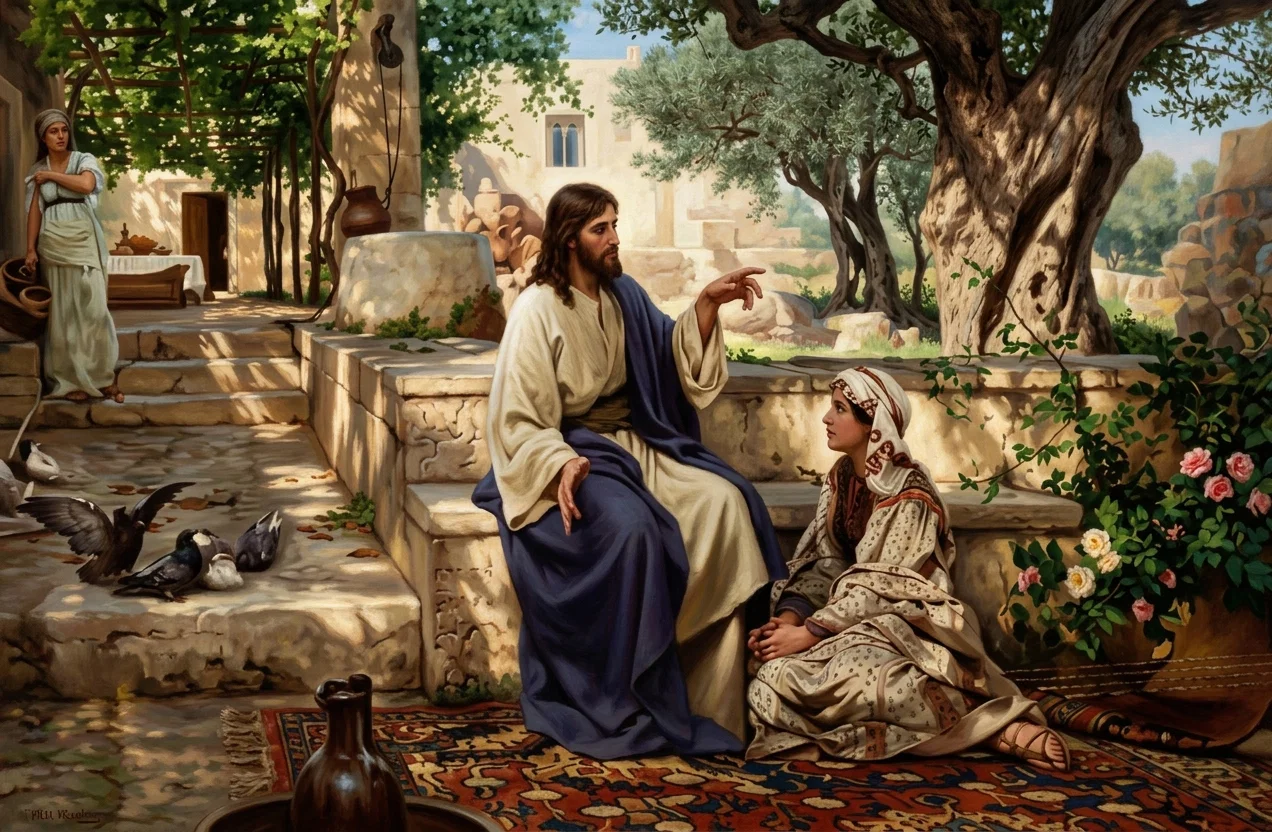
Lazarus, Come Forth!

3%

Pacific Press Publishing Association · Mountain View, California · Nov 10, 1909

FromSigns of the Times, Vol. 36, No. 44.

Read the full edition

“Lazarus, Come Forth!”

By Mrs. E. G. White
“AT THE HOME OF LAZARUS JESUS HAD OFTEN FOUND REST”

The Home at Bethany

Among the most steadfast of Christ’s disciples was Lazarus of Bethany. From their first meeting, his faith in Christ had been strong; his love for Him was deep; and he was greatly beloved by the Saviour. It was for Lazarus that the greatest of Christ’s miracles was performed. The Saviour blessed all who sought His help; He loves all the human family; but to some He is bound by peculiarly tender associations. His heart was knit by a strong bond of affection to the family at Bethany; and for one of them His most wonderful work was wrought. At the home of Lazarus Jesus had often found rest. The Saviour had no home of His own; He was dependent on the hospitality of His friends and disciples; and often when weary, thirsting for human fellowship, He had been glad to escape to this peaceful household, away from the suspicion and jealousy of the angry Pharisees. Here He found a sincere welcome, a pure, holy friendship. Here He could speak with simplicity and perfect freedom, knowing that His words would be understood and treasured.
Sorrow entered the peaceful home where Jesus had rested. Lazarus was stricken with sudden illness, and his sisters sent to the Saviour saying, “Lord, behold, he whom Thou lovest is sick.” They saw the violence of the disease that had seized their brother, but they knew that Christ had shown Himself able to heal all manner of diseases. They believed that He would sympathize with them in their distress; therefore they made no urgent demand for His immediate presence, but sent only the confiding message, “He whom Thou lovest is sick.” They thought that He would immediately respond to their message, and be with them as soon as He could reach Bethany.
Anxiously they waited for a word from Jesus. As long as the spark of life was yet alive in their brother, they prayed and watched for Jesus to come. But the messenger returned without Him. Yet he brought the message, “This sickness is not unto death,” and they clung to the hope that Lazarus would live.
After waiting for two days, Jesus said to the disciples, “Let us go into Judea again. . . . Our friend Lazarus sleepeth; . . . I go, that I may awake him out of sleep.” Then said His disciples, “Lord, if he sleep, he shall do well.” Howbeit Jesus spake of his death; but they thought that He had spoken of taking rest in sleep. Then said Jesus unto them plainly, “Lazarus is dead. And I am glad for your sakes that I was not there, to the intent ye may believe; nevertheless let us go to him.”

The Coming of the Life-Giver

Had Christ been in the sick-room, Lazarus would not have died; for Satan would have had no power over him. Death could not have aimed his dart at Lazarus in the presence of the Life-giver. Therefore Christ remained away. He suffered the enemy to exercise his power, that He might drive him back, a conquered foe. He permitted Lazarus to pass under the dominion of death; and the suffering sisters saw their brother laid in the grave. Christ knew that as theylooked on the dead face of their brother, their faith in their Redeemer would be severely tried. But He knew that because of the struggle through which they were now passing, their faith would shine forth with greater power. He suffered every pang of sorrow that they endured. He loved them no less because He tarried; but He knew that for them, for Lazarus, for Himself, and for His disciples, a victory was to be gained.
On His journey to Bethany, Jesus, according to His custom, ministered to the sick and the needy. Upon reaching the town, He sent a messenger to the sisters with the tidings of His arrival. The message was given to Martha so quietly that others in the room did not hear it. Absorbed in her grief, Mary did not hear the words. Rising at once, Martha went out to meet her Lord; but thinking that she had gone to the place where Lazarus was buried, Mary sat still in her sorrow, making no outcry.

Comforting the Mourners

Martha hastened to meet Jesus, her heart agitated by conflicting emotions. In His expressive face she read that same tenderness and love that had always been there. Her confidence in Him was unbroken, but she thought of her dearly loved brother, whom Jesus also had loved. With surging grief in her heart because Jesus had not come before, yet with hope that even now He would do something to comfort them, she said, “Lord, if Thou hadst been here, my brother had not died.” Over and over again, amid the tumult made by the mourners, the sisters had repeated these words.
With human and divine pity Jesus looked into the sorrowful, care-worn face. Martha had no inclination to recount the past; all was expressed by the pathetic words, “Lord, if Thou hadst been here, my brother had not died.” But looking into that face of love, she added, “I know, that even now, whatsoever Thou wilt ask of God, God will give it Thee.”
Jesus encouraged her faith, saying, “Thy brother shall rise again.” His answer was not intended to inspire hope of an immediate change. He carried Martha’s thoughts past the present restoration of her brother, and fixed them upon the resurrection of the just. This He did that she might see in the resurrection of Lazarus a pledge of the resurrection of all the righteous dead, and an assurance that it would be accomplished by the Saviour’s power.
Martha answered, “I know that he shall rise again in the resurrection at the last day.”
Still seeking to give a true direction to her faith, Jesus declared, “I am the resurrection, and the life.” In Christ is life, original, unborrowed, underived. “He that hath the Son hath life.” The divinity of Christ is the believer’s assurance of eternal life. “He that believeth in Me,” said Jesus, “though he were dead, yet shall he live; and whosoever liveth and believeth in Me shall never die. Believest thou this?” Christ here looks forward to the time of His second coming. Then the righteous dead shall be raised incorruptible, and the living righteous shall be translated to heaven without seeing death. The miracle which Christ was about to perform, in raising Lazarus from the dead, would represent the resurrection of all the righteous dead. By His word and His works He declared Himself to be the Author of the resurrection. He who Himself was soon to die upon the cross, stood with the keys of death, a conqueror of the grave, and asserted His right and power to give eternal life.

Thou Art the Christ

To the Saviour’s words, “Believest thou this?” Martha responded, “Yea, Lord: I believe that Thou art the Christ, the Son of God, which should come into the world.” She did not comprehend in all their significance the words spoken by Christ; but she confessed her faith in His divinity, and her confidence that He was able to perform whatever it pleased Him to do.
“And when she had so said, she went her way, and called Mary her sister secretly, saying, The Master is come, and calleth for thee.” On hearing the message, Mary rose hastily, and with an eager look on her face left the room. Thinking that she had gone to the grave to weep, the mourners followed her. When she reached the place where Jesus was waiting, she knelt at His feet, and with quivering lips said, “Lord, if Thou hadst been here, my brother had not died.”
“Where have ye laid him?” He asked. “They said unto Him, Lord, come and see.” Together they proceeded to the grave. It was a mournful scene. Lazarus had been much beloved, and his sisters wept for him with breaking hearts, while those who had been his friends mingled their tears with those of the bereaved sisters. In view of this human distress, and the fact that the afflicted friends could mourn over the dead while the Saviour of the world stood by,—“Jesus wept.”

The Grief of Ages

It was not only because of His human sympathy with Mary and Martha that Jesus wept. The weight of the grief of ages was upon Him. He saw the terrible effects of the transgression of God’s law. He saw that in the history of the world, beginning with the death of Abel, the conflict between good and evil had been unceasing. Looking down the years to come, He saw the suffering and sorrow, the tears and death, that were to be the lot of man. His heart was pierced with the pain of the human family of all ages and in all lands. The woes of the sinful race were heavy upon His soul, and the fountain of His tears was broken up as He longed to relieve all their distress.
“Jesus therefore again groaning in Himself cometh to the grave.” Lazarus had been laid in a cave in a rock, and a massive stone had been placed before the entrance. “Take ye away the stone,” Christ said. Thinking that He only wished to look upon the dead, Martha objected, saying that the body had been buried four days, and corruption had already begun its work. She was unwilling that the decomposing body should be brought to view. The human heart is slow to understand Christ’s words, and Martha’s faith had not grasped the true meaning of His promise.
Christ reproved Martha, but His words were spoken with the utmost gentleness. “Said I not unto thee, that, if thou wouldest believe, thou shouldest see the glory of God?” Why should you doubt in regard to My power? Why reason in opposition to My requirements? You have My word. If you will believe, you shall see the glory of God.
The command is obeyed. The stone is rolled away. Everything is done openly and deliberately. All are given a chance to see that no deception is practised. There lies the body of Lazarus in its rocky grave, cold and silent in death. The cries of the mourners are hushed. Surprised and expectant, the company stand around the sepulcher to see what is to follow.

Triumphant Over Death

In all that He did, Christ was co-operating with His Father. Ever He had been careful to make it evident that He did not work independently; it was by faith and prayer that He wrought His miracles. Christ desired all to know His relationship with His Father. “Father,” He said, “I thank Thee that Thou hast heard Me. And I knew that Thou hearest Me always: but because of the people which stand by I said it, that they may believe that Thou hast sent Me.” And when He had thus spoken, He cried with a loud voice, “Lazarus, come forth.” His voice, clear and penetrating, pierces the ear of the dead. As He speaks, divinity flashes through humanity. In His face, which is lighted up by the glory of God, the people see the assurance of His power. Every eye is fastened on the entrance to the cave. Every ear is bent to catch the slightest sound. With intense and painful interest all wait for the test of Christ’s divinity, the evidence that is to substantiate His claim to being the Son of God, or to extinguish the hope forever.
There is a stir in the silent tomb, and he who was dead stands at the door of the sepulcher. His movements are impeded by the grave-clothes in which he was laid away; and Christ says to the astonished spectators, “Loose him, and let him go.” Lazarus is set free, and stands before the company, not as one emaciated by disease, and with feeble, tottering limbs, but as a man in the prime of life, and in the vigor of a noble manhood. His eyes beam with intelligence and with love for his Saviour. He casts himself in adoration at the feet of Jesus.
The beholders are at first speechless with amazement. Then there follows an inexpressible scene of rejoicing and thanksgiving. The sisters receive their brother back to life as the gift of God, and with joyful tears they brokenly express their thanks to the Saviour. But while brother, and sisters, and friends are rejoicing in this reunion, Jesus withdraws from the scene. When they look for the Life-giver, He is not to be found.