The declaration of the apostle Paul has ever been the watchword of the militant church of God, emblazoned upon the escutcheons of her standard-bearers, proclaimed in clarion tones by her heralds:
“I AM NOT ASHAMED OF THE GOSPEL OF CHRIST; FOR IT IS THE POWER OF GOD UNTO SALVATION TO EVERY ONE THAT BELIEVETH; . . . FOR THEREIN IS THE RIGHTEOUSNESS OF GOD REVEALED FROM FAITH TO FAITH; AS IT IS WRITTEN, THE JUST SHALL LIVE BY FAITH.” ROM. 1:16, 17.
That faith was based upon the word of God.
“ALL SCRIPTURE IS GIVEN BY INSPIRATION OF GOD [LITERALLY, GOD-BREATHED], AND IS PROFITABLE FOR DOCTRINE, FOR REPROOF, FOR CORRECTION, FOR INSTRUCTION IN RIGHTEOUSNESS: THAT THE MAN OF GOD MAY BE PERFECT, THOROUGHLY FURNISHED UNTO ALL GOOD WORKS.” 2 Tim. 3:16, 17.
That watchword and battle-cry was heard faint and far and infrequent during the Dark Ages; but the Reformation revived it. The Bible came to its own. Chained tho it often was, it set men free. That Gospel, that Reformation, revolutionized Europe, and changed the face of the world. Thus its historian D’Aubigne speaks:
“The Reformation was accomplished in the name of a spiritual principle. It had proclaimed for its teacher the word of God; for salvation, faith; for king, Jesus Christ; for arms, the Holy Ghost; and had by these very means rejected all worldly elements. Rome had been established by the law of carnal commandment; the Reformation by the power of an endless life.”
“If there is any doctrine that distinguishes Christianity from every other religion, it is spirituality. A heavenly life brought down to man—such is its work.”
“The Gospel of the Reformers had nothing to do with the world or with politics.”—Book XIV, Chap. 1.
Upon the foundation of faith in the word of God was virile, aggressive, winning Protestantism built. Into the soil of that word it stuck its roots and grew and flourished and bore fruit. Millions sought its shade and shelter and sustenance, and found salvation and life and growth.
Not all the truth of God’s Book did Protestantism possess. That was and is evidenced by her numerous branches. The spell of hoary tradition was still strong upon the Reformation. The human creed-power still bound her. The power of the state still had its attractions; but her face was Godward, her principles were sound, and she was on the highway to truth and freedom.
Would God she had broken the spell of tradition. Would God she had left the human shaping of creeds, and remained loyal to the Bible wherever the Old Book led. Creeds would not have multiplied. National churches would not have been formed. Dead formalism would not have cursed her congregations. The union with the state would not have tempted her; for the church of Christ never asked human power to enforce a truly Scriptural teaching.
Intolerance and persecution would never have been known in Protestant ranks. The monopoly of church and state and its fruitage would have been left to Rome. Great power would have remained with Protestantism.
Problems to Solve
Then grave problems faced her. Long downtrodden truths, forever settled by the Bible, confronted her. The full claims of the Decalogue were pushed upon heart and soul. Should she break with the civil power? Should creeds by dead hands be set aside, and defined human standards erected? That word clearly showed errors still to be relinquished. Right here Protestantism made a fatal mistake. In the words of the Right Honorable James Bryce, present British Ambassador to the United States:
“The principles which led the Protestants to sever themselves from the Roman Church should have taught them to bear with the opinion of others, and warned them from the attempt to connect agreement in doctrine or manner of worship with the necessary forms of civil government. Still less ought they to have enforced that agreement with civil penalties, for faith, upon their own showing, had no value save when it was freely given.”
“But whether it was that men only half saw what they had done; or that, finding it hard enough to un-rivet priestly fetters, they welcomed all the aid a temporal prince could give; the result was that religion, or, rather, religious creeds, began to be involved with politics more closely than had ever been the case before. Through the greater part of Christendom, wars of religion raged for a century or more; and down to our own days, feelings of theological antipathy continue to affect the relations of the powers of Europe. In almost every country the form of doctrine which triumphed associated itself with the state, and maintained the despotic system of the Middle Ages, while it forsook the grounds on which that system had been based.
“The will of the sovereign, as in England, or the will of the majority, as in Holland, Scandinavia, and Scotland, imposed upon each country a peculiar form of worship, and kept up the practices of medieval intolerance without their justification.
“Therefore the intolerance of Protestants, if the forms it took were less cruel than those practised by the Roman Catholics, was also far less defensible; for it had seldom anything better to allege on its behalf than motives of political expediency, or more often the mere headstrong passion of a ruler or a faction, to silence the expression of any opinions but their own.”—Holy Roman Empire, Chap. 18.
Out of this condition, Protestantism slowly emerged. The world grew sick of intolerance. It drove from some countries, like France, the best of her citizens. England led in liberty of conscience. America opened her doors to the oppressed of all nations, and set a higher standard of religious liberty than any government of the world had ever known. Under that liberty, religion, and education and all the beneficent practices which flow therefrom flourished.
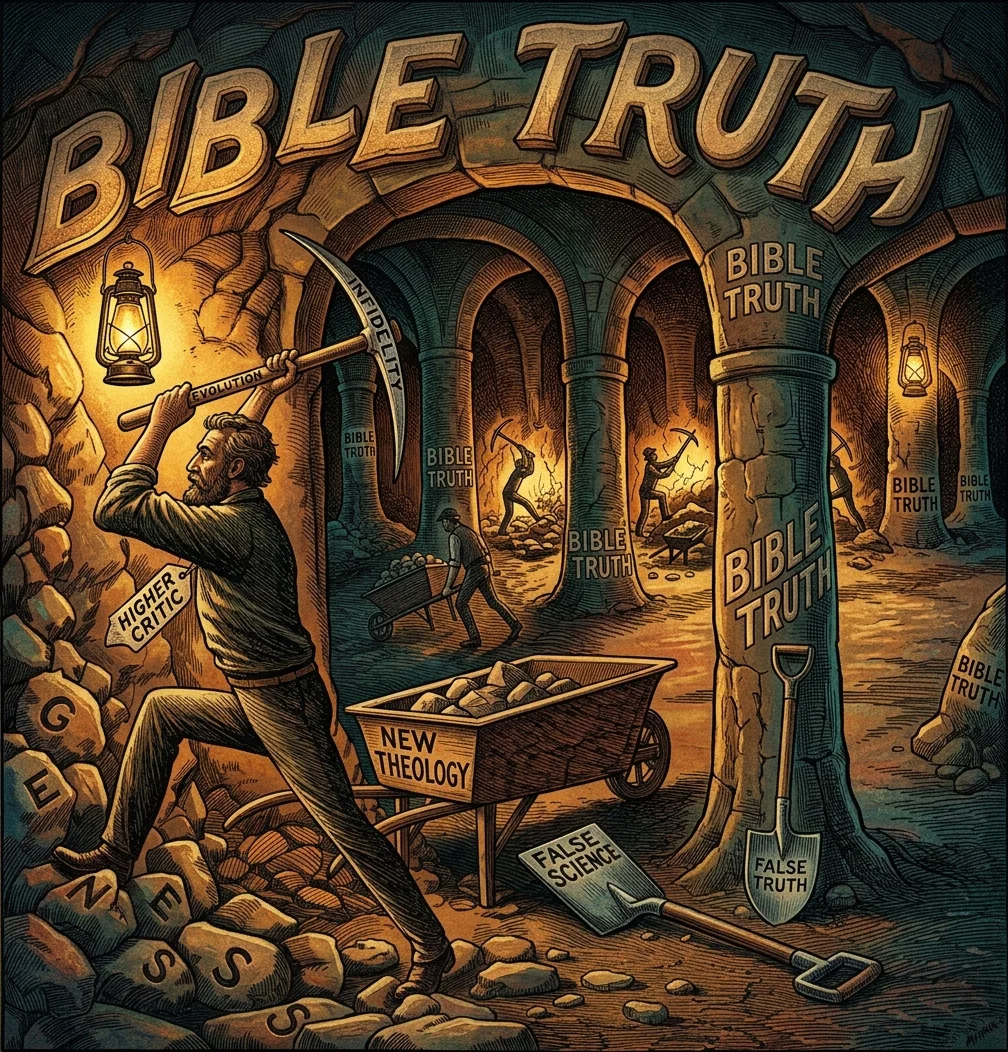
But great, present truths, lying dormant, demanding resurrection, or ripe for the times, pressed upon the great Protestant denominations. Fulfilling prophecy demanded their attention. A wounded, divided church demanded their application. The power of tradition and denominational pride held the church from her duty. The offense of the cross was too great to bear. The scientific sedatives of geology and evolution came in11to blind the eyes which began to see, to harden the consciences which began to be troubled.
What was the worth of the story of Creation in Genesis in the light of geology, hypothetical tho it was? What was the story of the origin of man worth in the light (?) of the Darwinian theory of evolution and origin of the species? Men began to measure God’s power by themselves, His word by their word. The evil leaven crept into education and leavened the lump. There have been many and strong protests against the higher criticism, against the rejection of the Genesis story of man and his fall. But they have rapidly grown weaker and fewer, till now one is scarcely heard. Heresy is triumphant. With the rejection of Moses goes ultimately the rejection of Christ. In the rejection of Creation and its memorial, the Sabbath, goes the regeneration and restoration of the sinful soul. The awful results of that first step are thus stated by the New York “Independent” of June 24, one of the leading semi-religious journals of America:
“When we found that the world was more than six thousand years old, that there was no universal flood four thousand years ago, that Adam was not made directly from dust, and Eve from his rib, and that the Tower of Babel was not the occasion of the diversification of languages, we had gone too far to stop. The process of criticism had to go on from Genesis to Revelation, with no fear of the curse at the end of the last chapter. It could not stop with Moses and Isaiah; it had to include Matthew and John and Paul. Every one of them had to be sifted; they had already ceased to be taken as unquestioned, final authorities, for plenary inspiration had followed verbal inspiration just as soon as the first chapter of Genesis had ceased to be taken as true history. The miracles of Jesus had to be tested as well as those of Elijah. The date and purpose of the Gospel of John had to be investigated historically as well as that of the prophecy of Isaiah; and the conclusion of historical criticism had to be accepted with no regard to the old theologies. We have just reached this condition, and there is repeated evidence that it makes an epoch, a revolution, in theologic thought. This is what we learn from Chicago and New York, from two such militant denominations as the Baptist and the Presbyterian.
“Consider what it means. In England Professor Forsyth is repeating with emphatic insistence that Christianity centers not in the teachings but in the person of Christ, the Christ of the trinity, miraculously conceived, risen from the dead, ascended up into heaven, and there seated as one of the three persons in the trinity of God. But the current, critical theology, which we read in the current Bible dictionaries, and which is taught in venerable theological seminaries, doubts or denies all this. To this present teaching, which has invaded all our denominations, Jesus is the world’s prime teacher, but it can assert nothing more. There is, it declares, no reasonable proof of His birth from a virgin, no certainty of a physical resurrection; the Gospels must be analyzed, for they contain mythical elements, non-historical miracles, unverified assertions. The synoptic Gospels give us more correctly the oral teachings of Jesus, but the Gospel of John and the epistles of Paul make the person of Jesus central and represent a stratum added to the genuine, simpler teachings of the Master, and must be analyzed and questioned or rejected.
“But this doubt, even this questioning or denial, changes the old, evangelistic theology. It questions or denies the trinity, the Resurrection, the Sacrifice of the Cross, even all miracles, and it undermines all authority of inspiration or even revelation, and sends us back to human reason, with such divine guidance as may be allowed; the authority of the Bible and the authority of the church both to be validated only by human reason. Just how this differs from the old Unitarianism, and what need there is for Unitarianism to maintain itself, are questions that must arise for consideration.”
Of the present and future of this trend of Protestantism we have more to say in future issues.