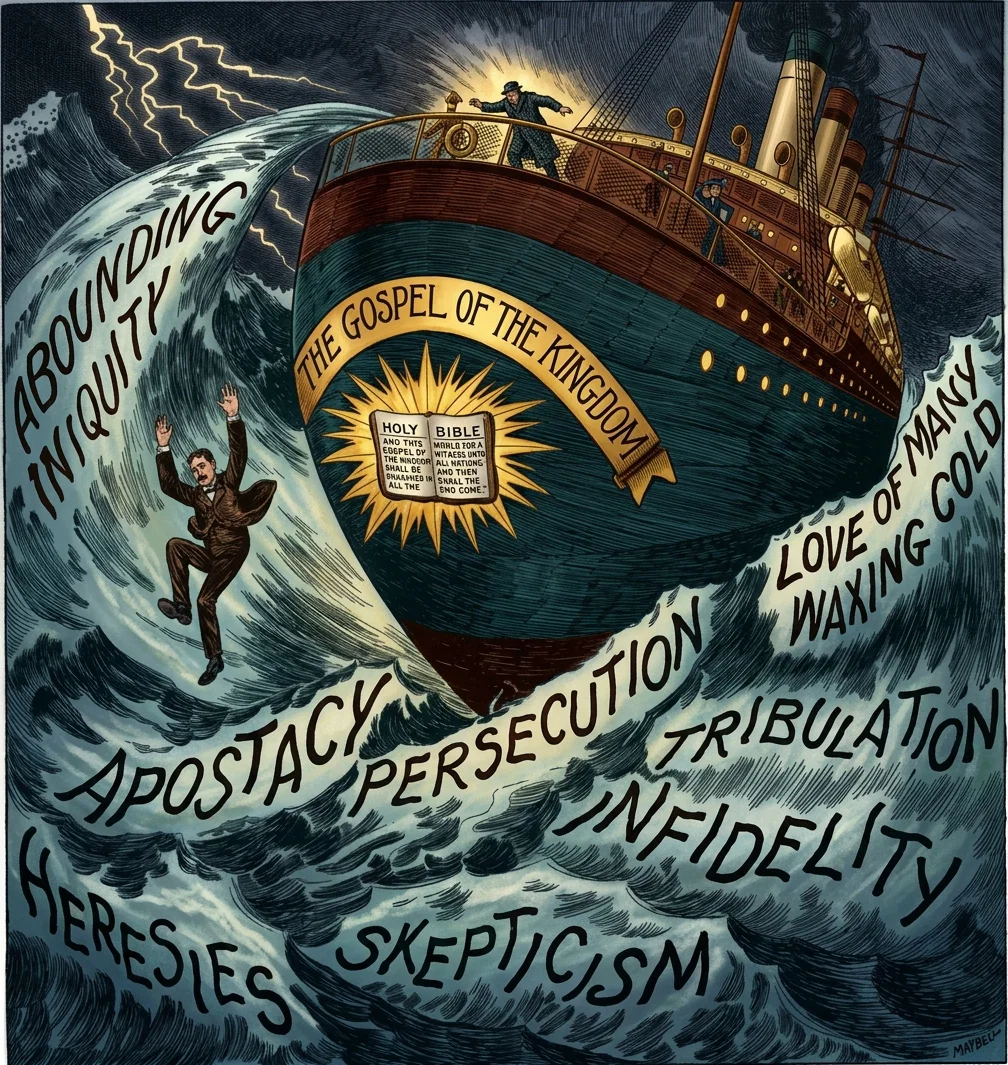
“ABIDE IN THE SHIP.” Acts 27:31 Is it safe to leave the old ship Zion which has withstood the storms of six millenniums, and plunge into the breakers of skepticism, infidelity, and doubt?
In our last issue it was shown that the basis of primitive Christianity was the Gospel, “the power of God unto salvation to every one that believeth” (Rom. 1:16, 17); that the standard was the all-sufficient Holy Scriptures (2 Tim. 3:16, 17); and that genuine Protestantism was built on the same principles, tho not possessing the clear knowledge of the truth. When Protestantism failed to meet the problems thrust upon her, divisions came; failing to follow the word, creeds multiplied; freedom was circumscribed, causing still other divisions, and then more creeds.
Yet God used these branches of His church despite the divisions and differences. Sometimes they were decidedly aggressive and belligerent and contentious; yet were their labors blessed of God. Sometimes they emphasized error; God blessed them despite the error because of the truth of salvation through Jesus Christ, which they heralded because in principle if not in practise they were loyal to His word. We gladly, gratefully acknowledge the mighty uplifting, elevating influence they have been in the world.
Various of these great denominations grew strong and wealthy and proud. Selfish men sought membership. Politicians sought their favor. Unconverted church-members multiplied. Worldliness was fostered. Standards were lowered. Even the forms of creed lost their power. Backsliding grew apace.
The world outside the church can not injure her whatever it may do. The evil, the danger, comes only when the world is inside, when its aid is thought necessary, when aid wins voice or control in management, when worldly policies take the place of Christian principles of faith and righteousness. From devoted men in all these denominations have come messages as from the prophets of old, jeremiads, denunciations, warnings, exhortations, against the incoming flood of worldliness. Take the following, for instance, from the Cincinnati “Western Christian Advocate,” of July 19, 1893. It was written by the editor, Rev. David H. Moore, now Bishop Moore:
“TO THE CHURCH OF METHODISTS, WRITE:
“The great trouble with us to-day is that the rescue of imperiled souls is our last and least consideration. Many of our congregations are conducted on the basis of social clubs. They are made centers of social influence. Membership is sought in order to advance one’s prospects in society, business, or politics. Preachers are called who know how to ‘smooth down the rugged text to ears polite, and snugly keep damnation out of sight.’ The Sunday services are made the occasion of displaying the elegancies of apparel in the latest fashions. Even the little ones are tricked out as tho they were the acolytes of pride. If the ‘Rules’ are read, it is to comply with the letter of a law whose spirit has long since fled. The class-books are filled with names of unconverted men and women. Official members may be found in box, dress-circle, and parquet of opera and theater. Communicants take in the races, and give and attend card parties and dances. The distinction between inside and outside is so obscure that men smile when asked to unite with the church, and sometimes tell us that they find the best men outside.”
“When we go to the masses, it is too often with such ostentatious condescension that self-respect drives them from us.”
“And yet we have so spread out under the inflation of the rich and ungodly, that they are a necessity to us. The enforcement of the unmistakable letter of the discipline for a single year would cut our membership in half, bankrupt our missionary society, close our fashionable churches, paralyze our connectional interests, and leave our pastors and bishops unpaid and in distress. But the fact remains that one of two things must happen,—the discipline must purge the church, or God’s Holy Spirit will seek other organized agencies. The ax is laid at the root of the tree. The call is to repentance. God’s work must be done. If we are in the way, He will remove us.”
What a confession! What a prophecy! We know that Bishop Moore’s people are not worse than others, and spiritual men in other denominations will so acknowledge, and have so testified.
It was only sixteen years ago that this was written. The creed was then professedly held. The Bible was then the professed standard of truth. We have drifted far and fast since then. Listen to another David, the Rev. David James Burrell, D.D., L.L.D., of New York, author of several books, pastor of a Presbyterian church. The excerpts are from an article in the “Homiletic Review” of July 1907:
“The examination for church-membership is, as a rule, far less searching in these times than that to which candidates for freemasonry are subjected. The ‘fencing of the tables’ is quite out of fashion; and there is practically no such thing as church discipline.
“And men are received into the ministry in the same loose way. No matter what they believe, gather them in. The process known as ‘The Examination of Candidates for the Ministry,’ in ecclesiastical courts is usually a diaphanous farce. A theologue who is prepared to say that he is more than half inclined to believe that two and two make four, or that a straight line is the shortest distance between two points, is morally certain to get in. . . .
“What is the result? The Trojan horse is lodged within the gates. There are no notable open and avowed infidels in the outside world to-day. The last of the old guard were Bradlaugh and Ingersoll. Brave men they! On the heights above Elah they took their stand, brandishing spears like weavers’ beams, and shouting, ‘We defy the armies of the living God.’ To-day the only infidelity worth reckoning is that which masquerades in the livery of heaven. Out of the belly of the Trojan horse come men in canonicals, regardless of oaths, laughing at creeds, explaining away the supernatural, flouting the ordinances of Zion, and demanding the right to be left alone while they unbolt the gates. . . .”
The course of liberal thought is in evidence. It seems but yesterday when the boldest of free-thinking clergymen in evangelical pulpits could scarcely summon courage to deny the entire truth of any portion whatsoever of the Scriptures; to-day there are many who flout in toto the three miracles on which Christianity rests; to wit, the Incarnation, the Atonement, and the Resurrection of Christ. There is nothing strange in the11denial; the strange thing is that the deniers are ministers of Christ, under oath to preach and maintain the very doctrines which they deny. This is not ‘liberalism’; it is infidelity. It is not merely infidelity; it is mendacity. It is not merely mendacity; it is a flagrant violation of common honesty, and would be instantly branded as such in any of the common walks of life.”
“It is a matter of common fame among ministers that some are accustomed to make statements sub rosa which they never make and probably never would dare to make in the presence of those who furnish the loaves and fishes. Is it possible to imagine a blacker form of turpitude than this? Welcome the day when the drawing of the lines shall force all such from cover! For there is really no neutral ground in the territory of truth and righteousness.”
And during the last two years the drift outward to the regions of infidelity has been more pronounced, decided, rapid. The very church in which Dr. Burrell is a devoted minister ordained recently three men to the ministry who could not say that they believed in the great miracles of the atonement. A few years before, Professor Briggs was forced out of the denomination for holding far less objectionable heresies. He would be considered almost a conservative now.
Now? Now advanced Protestantism has no standards. As the “Independent,” of June 24, 1909, (quoted last week), declares, this drift: “SENDS US BACK TO HUMAN REASON with such divine guidance as may be allowed; the AUTHORITY OF THE BIBLE and the AUTHORITY OF THE CHURCH BOTH to be validated ONLY by HUMAN REASON.”
Is there any wonder that “Christian Science,” “New Thought,” “Spiritualism,” “Theosophy,” “Theistic Evolution,” and Oriental philosophies and cults are making the inroads upon the churches they are? What else could be expected? When we have no standard outside of man, when the Bible is no longer a guide to “human reason,” but “human reason” is the critic, the censor of the Bible, what else could we expect than just what we see? When the professed friends of the Bible, when those who are sworn to declare its sacred truths as a message of life from God to a dying world, are rejecting its fundamentals, or apologizing for its “errancies,” when uncertain evolution and infidel science make loud, strong, positive, braggart assertions, what wonder that the flocks are doubtful, dismayed and scattered.
What divine guidance could “human reason” ask when it rejects the divine revelations of the ages? If human reason is the court of last resort, of what use is any divine guidance? Its divinity and superiority must be judged by “human reason.” In other words, the logic of the situation is that each man is his own deity. Roman Catholicism has but one vicar of Christ; liberal Protestantism has a multitude, and all contradictory. To this the drift has brought us.
[We shall present other articles in this department showing the drift of Protestantism and the result of higher criticism by other writers. We shall discuss further results and the remedy editorially.]