“Antitype, that which corresponds to and is represented by the type; the original of the type.” (“Standard Dictionary.”)
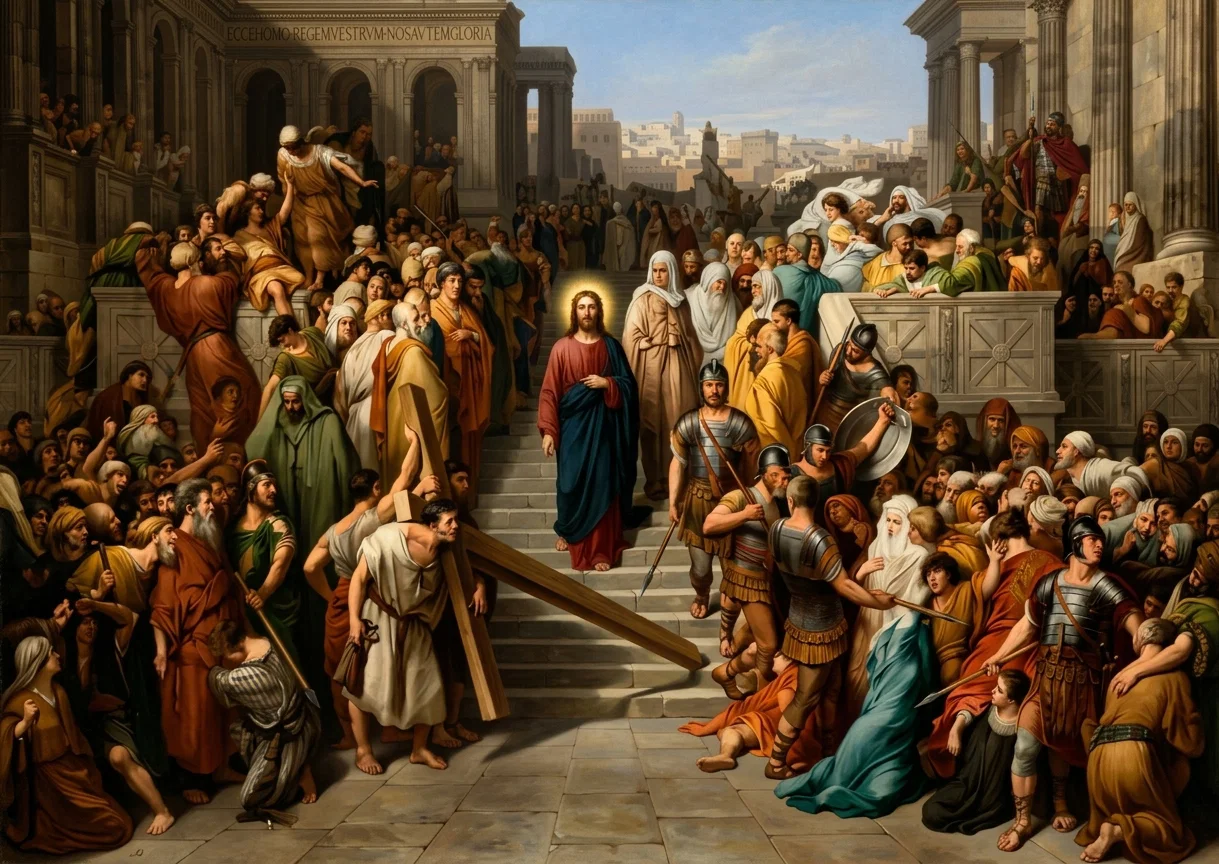
For four thousand years the Saviour of men had been prefigured in the types and shadows of the sacrificial system. In the presence of a vast multitude, on the banks of the river Jordan, the forerunner of Christ, pointing to the Messiah, proclaimed, “Behold the Lamb of God, which taketh [“beareth,” margin] away the sin of the world.” In Jesus, John saw the antitype of all the lambs and other animals slain in sacrifice, from Abel’s offering to Calvary. The lamb is a symbol of sacrifice. Jesus is “the Lamb slain from the foundation of the world.” Isaiah in prophetic vision saw Him “brought as a lamb to the slaughter.” Peter declares, “Ye were not redeemed with corruptible things, as silver and gold, . . . but with the precious blood of Christ, as of a lamb without blemish and without spot.” In describing what he saw in vision, the revelator says, “I beheld, and, lo, in the midst of the throne and of the four beasts, and in the midst of the elders, stood a Lamb as it had been slain.” Rev. 13:8; Isa. 53:7; 1 Peter 1:18, 19; Rev. 5:6.
The Sins of the World upon Christ
If man is saved, sin must be put away. In the divine plan for the accomplishment of this purpose, the sins of the world are laid upon Jesus; hence John speaks of Him as “the Lamb of God, which taketh away the sin of the world.” In speaking of the work of Christ as our great High Priest, the writer of the epistle to the Hebrews (9:26) says, “Once in the end of the world hath He appeared to put away sin by the sacrifice of Himself.” Sin could be put away only by a sacrificial lamb. Not an earthly lamb; for it is written of the offerings which the priests of the earthly sanctuary presented daily, that they “can never take away sin.” And again, “It is not possible that the blood of bulls and of goats should take away sins.” Heb. 10:4. It must be a divine sacrifice—the Lamb of God.
When Adam sinned in the Garden of Eden, he transgressed God’s holy law. “Whosoever committeth sin transgresseth also the law: for sin is the transgression of the law.” “Where no law is, there is no transgression.” And “sin is not imputed when there is no law.” 1 John 3:4; Rom. 4:15; 5:13. The standard erected in Eden must have been a perfect rule of life, else no such penalty as was pronounced against Adam could in justice have been meted out to him for its violation. This truth has been clearly stated by many inspired writers.
“The law of the Lord is perfect, converting the soul: the testimony of the Lord is sure, making wise the simple. The statutes of the Lord are right, rejoicing the heart: the commandment of the Lord is pure, enlightening the eyes. The fear of the Lord is clean, enduring forever: the judgments of the Lord are true and righteous altogether.” Ps. 19:7-9. “All His commandments are sure. They stand fast forever and ever, and are done in truth and uprightness.” Ps.4111: 7, 8. “Faultless are all His precepts.” (Isaac Leeser translation.) “Wherefore the law is holy, and the commandment holy, and just, and good.” Rom. 7:12.
The Law Not Changed to Meet the Transgression
When man fell by transgression, the law was not changed in order to save him from its penalty, but a remedial system was established to bring him back to obedience. The law being perfect, it was impossible to alter it in the slightest degree. To do so would make it imperfect, and would justify man in his course of rebellion against God and His government. There was therefore but one of two courses for God to pursue in dealing with man after his fall. He must leave him to reap the full fruitage of his evil course, or He must provide a remedy. God’s love for man would not permit Him to take the former course; but it did provide a complete remedy, which has been revealed in the plan of salvation.
“The soul that sinneth, it shall die,” “for the wages of sin is death.” Such was the unalterable fiat that went forth against disobedience to God’s just and holy law. It is life, then, that the law demands of every transgressor. If, therefore, man is saved from this penalty, a substitute must be provided. The just claims of God’s righteous and holy law could be met only by Christ, who was above law. He, as Creator of all, could meet the demands of His own law in behalf of any or all His own creatures. Such an offering would provide a way of escape for the transgressor, while at the same time it would maintain the integrity of God’s kingdom, preserve the honor of His name, and uphold the majesty of His law. Such a life, unforfeited to the righteous demands of the law—a life equivalent to that of every created being—was all that was called for, and would bring salvation within the reach of every member of the fallen race.
Sacrifices That Were Only a Type
As soon as Adam passed outside the gates of Paradise, the smoke of sacrifice began to ascend to heaven. Not that God took pleasure in the death of His creatures, but that the slain lamb was a very expressive type of the “Lamb slain from the foundation of the world.” The sacrificial offerings served as a means of expressing the faith of the penitent sinner in the perfect offering made on Calvary.
The life of the Son of God being equivalent to the life of all His creatures, since He is their Creator, when He laid down His life as a sacrifice for the sins of the world, a way of escape was provided for every soul who would avail himself of it by sincere repentance and confession, and by steadfast adherence to the right. It was not necessary that Jesus should “offer Himself often,” but “once in the end of the world hath He appeared to put away sin by the sacrifice of Himself.” “But this Man, after He had offered one sacrifice for sins forever, sat down at the right hand of God.” “By one offering He hath perfected forever them that are sanctified.” For those who neglect or refuse to avail themselves of this wonderful salvation through this one offering, “there remaineth no more sacrifice for sins, but a certain fearful looking for of judgment and fiery indignation, which shall devour the adversaries.” Heb. 9:26; 10:12, 14, 26, 27. Surely we can unite with the angelic throng in saying, “Worthy is the Lamb that was slain to receive power, and riches, and wisdom, and strength, and honor, and glory, and blessing.”