A PAMPHLET is being circulated in Germany that pictures the downfall of the British Empire and the rise of a new universal German sovereignty.
The title of this pamphlet is “After the Storm,” the storm being understood as a great European war. England’s world-wide empire is pictured as collapsing like a house of cards as a result of the destruction of her fleet. Previous to this time England is pictured as having “dared to humiliate every great empire in turn.”
“Victorious Russia was forced at the command of England to turn back before the gates of Constantinople; France met the same fate at Fashoda where she was compelled to strike her colors; and Germany was obliged during the Boer War to submit to the holding up and searching of her proud merchantmen by British cruisers, like the ship of any little piratical state.”11
The British fleet of England is imagined to be destroyed off Helgoland by air-ships dropping dynamite bombs which blow the ships to atoms. Following this the German navy comes in with her ironclads and finishes up the destruction. The news of this German victory is carried to England by a German army corps. France is also taught a lesson by being invaded and occupied by a vast German army. Japan, which would be supposed to send help to England, seizes Hongkong instead. Russia also holds back from assisting England, and sends her Cossacks into India, while Italy looks after Egypt.
Following this bloody program, South Africa publishes a declaration of independence, and hoists the flag of the United Free States of Africa. At this point the United States Government gets interested, and Congress passes a resolution that American troops are to march into Canada “for the preservation of law and order.” Ireland, to make the failure still more complete, becomes an independent republic. As German ships sweep the ocean, the commerce of England is paralyzed, all her provision ships are seized, and with famine staring the country in the face, the government submits to a humiliating peace.
All of this, of course, is purely imaginary, and yet those who are acquainted with the ambitions of Germany, and especially the German Emperor, know that it is a picture that they would willingly have real. A certain writer stated years ago that “when England does declare war, all nations will have an interest of their own to serve, and there will be general war, general confusion.”
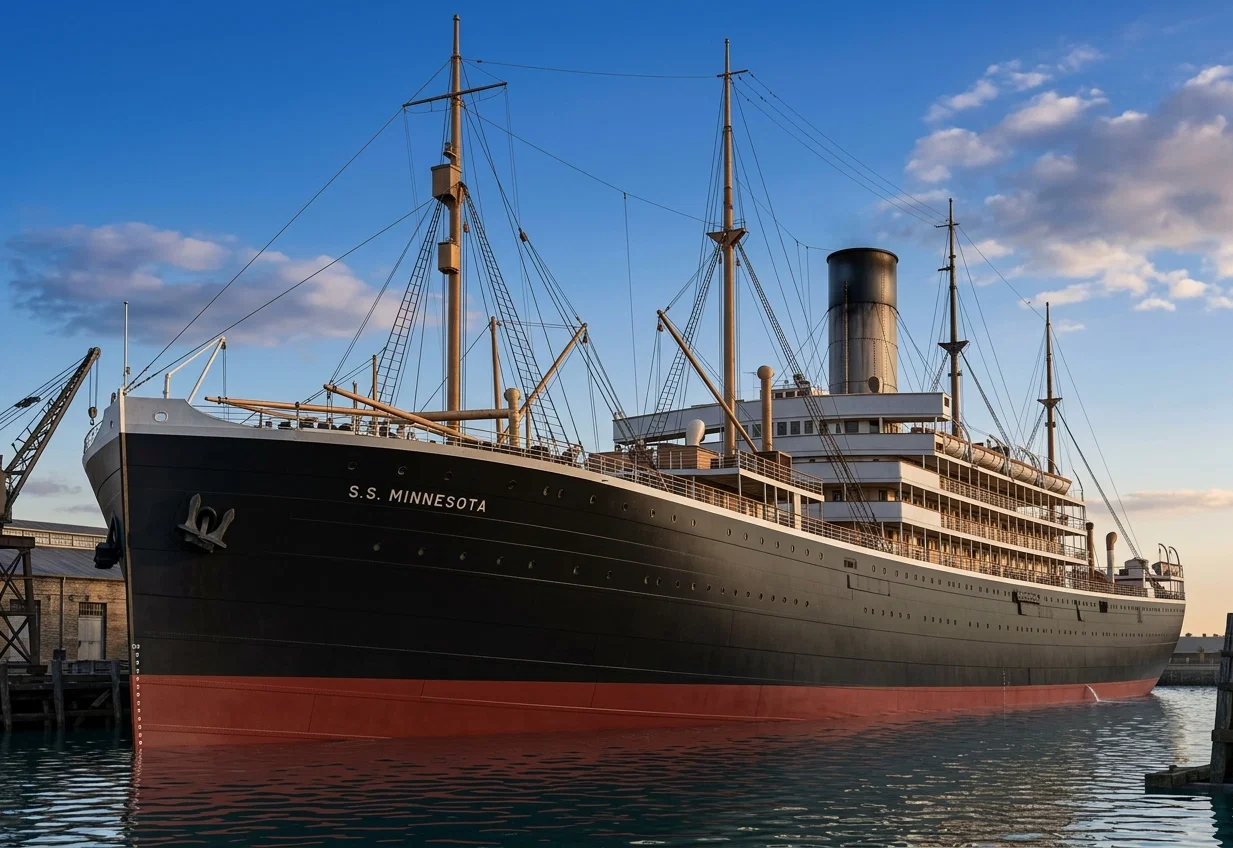
Pacific Liner "Minnesota," injured June 20 by fire.
An English Writer’s View
There is plenty of war talk both in England and in Germany. Mr. H. W. Wilson in “The National Review” (London), supposed to be the organ of King Edward, has this to say:
“The nation which in 1864 attacked and despoiled Denmark; which in 1866 attacked and defeated Austria; which in 1870-71 picked a quarrel with France, levied an indemnity of £200,000,000 upon her, and annexed two French provinces; which in 1905 suddenly threatened France with war unless she dismissed her Foreign Minister; and which in 1909 menaced Russia with invasion unless Russia surrendered to Austria, is not likely to spare England if given a chance of effecting that ‘settlement’ which Treitschke a generation ago foretold would be the ‘last and the most difficult’ for the German people. An indemnity of a thousand millions, an expenditure of five hundred millions on our own army and navy too late to secure success, and the destruction of British credit, trade, and industry, will be the penalties of any weakness on our part. There is only one way in which such a calamity can be averted—by developing our armed strength to the utmost without delay, and by concentrating our whole attention upon survival in the struggle for existence which has been forced upon us.”
The View of a Frenchman
Another writer, Mr. Gaston Dru, in the “Echo de Paris,” places the greater responsibility for this war talk upon the Germans as follows:
“The German attempt after universal monarchy is destined to make shipwreck as did that of Philip II, Louis XIV, and Napoleon I. Germany is now a prey to the demon of that national character by which her destiny is controlled. It would be impossible for her to avoid, even if she wished it, the struggle toward which she is rushing with such precipitancy. She is inevitably bound by the law of competition to the death, and in the European drama she is playing the role exemplified by the fate-driven hero in a Greek drama. Like Siegfried, Germany’s favorite hero, her fatal genius has forged the unbreakable sword, and she rushes headlong to the capture of the golden ring which shall give her all power, and, recklessly blind, is destined to kindle the frightful conflagration of the political Walhalla, amid the twilight and eclipse of independent nationalities. At this present moment, however, the tri-entente, England, France, and Russia, represents the anti-Germanic sentiment of the entire world and is quite capable of winning the cause of civilization against Germanism. This is what will force Germany to halt, and will avert that hideous abomination, a European war. This is what will prevent such a retrograde movement of humanity as would result from the hegemony of a single race, through which international competitions, the most potent elements of progress, would totally disappear.”
Sensational Rumors
Just to see how firmly the English nation is being imbued with the belief in a German invasion, we have but to note some of the stories that are credited by the English people. A short time ago a policeman reports having seen a powerful air-ship passing over Peterboro in the early morning. A countryman described a squadron of aeroplanes flying the German flag which he saw, or imagined he saw, moving silently but irresistibly under the low English sky. Another saw the whole countryside lit up by the searchlights of a German air-ship traveling so fast against the wind that it vanished almost as soon as it was seen. Even in Ireland such reports are being heard. For example, the Belfast newspaper recently reported the appearance of an air-ship passing over at a great altitude, its light being visible for about twelve minutes. Another rumor has it that the German navy has been experimenting at sea with small air-ships and has made it quite clear that these air-ships can ascend from the vessels and land upon them. Then there is a rumor that dirigible balloons manned by Germans are making a very careful study of the English coast defenses. The question was put to the Secretary of War not long ago as to the truth of the report that there are 60,000 foreign soldiers in England and that there are in a cellar not far from Charing Cross 5,000 stands of rifles and 7,500,000 cartridges. On top of all this is the further statement that over 5,000 secret German agents are working in England, making a minute study, after the thoro German fashion, of all the details that may be of advantage to an invader. These spies it is said are often Belgian, Swiss, or French, and are inspected every six months, the whole brigade being controlled by a well-known member of the German secret police.
This batch of scare stories will hardly be believed by people who are not personally affected but there is no question but that the continuance of such reports, and the resulting talk that will come from it, will go a long way toward fomenting trouble between these two great nations. How far the sober English mind is affected by these things we can not tell, but the constant repetition of these things emphasizes them and finally brings about some sort of conviction. If talk of war is to continue uninterruptedly between England and Germany, and the two nations are constantly to eye one another with suspicion and enmity, the fact itself will go a long way toward bringing about serious trouble.
The Outlook
We know that in a little while from now, whatever the conditions at present may be, the nations will be plunged into one great, final war. The word of God prophesies it, and the word of God can not be broken. Sometime that terrible storm will break, and the longer it is postponed, the more fearful will be the results. The angels of God, heavenly influences, are restraining the nations of the world. But when God’s work in the earth is done this restraining influence will be withdrawn and men will follow out all the promptings of the powers of evil. Then we will have universal war, universal conflict. Only God then can be our haven of refuge. He has promised to care for all those who put their trust in Him. R.