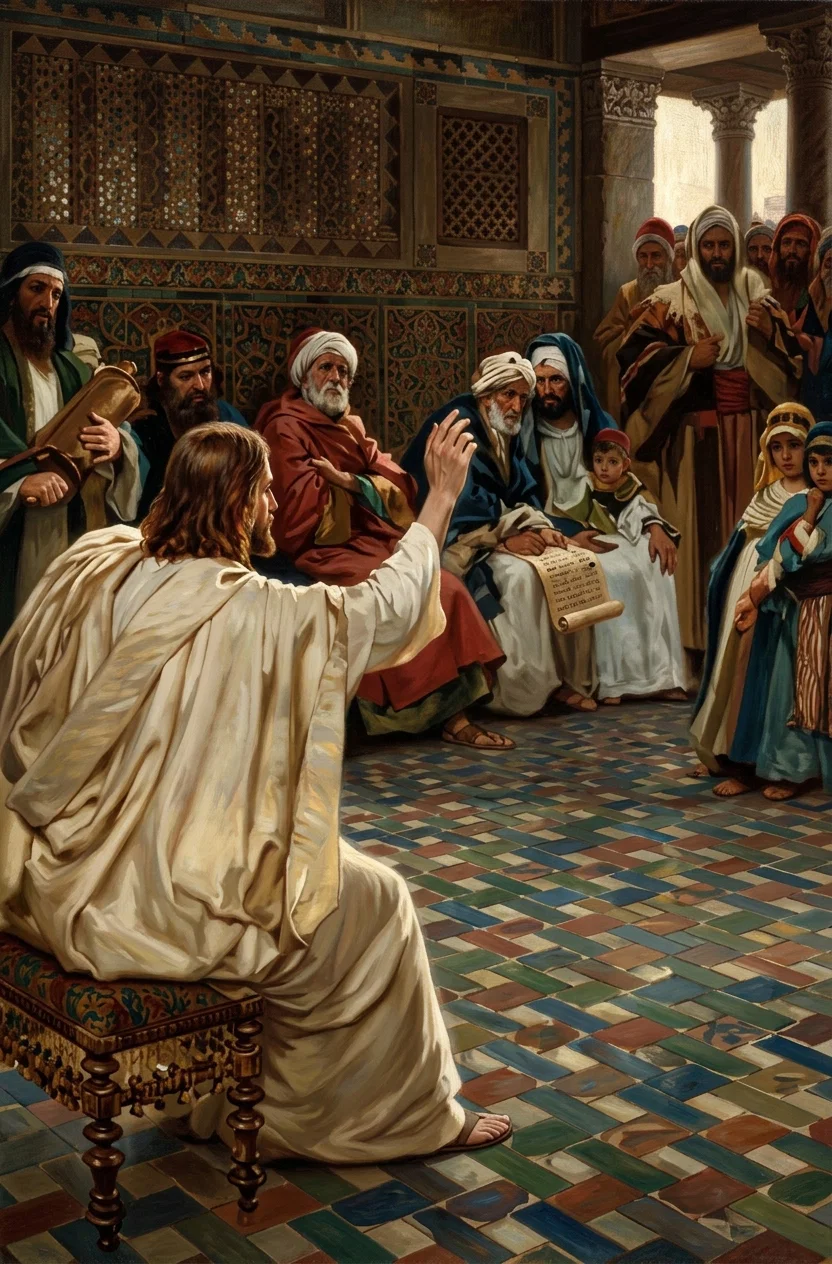
In the early part of His ministry in Galilee, Jesus visited Nazareth, the home of His early years. During His childhood and youth, Jesus had worshiped among His brethren in the synagog at Nazareth. Since the opening of His ministry He had been absent from them, but they had not been ignorant of what had befallen Him. As He again appeared among them, their interest and expectation were excited to the highest pitch. Here were the familiar forms and faces of those whom He had known from infancy. Here were His mother, His brothers and sisters, and all eyes were turned upon Him as He entered the synagog upon the Sabbath day, and took His place among the worshipers.
In the regular service for the day, the elder read from the prophets, and exhorted the people still to hope for the coming One, who would bring in a glorious reign, and banish all oppression. He sought to encourage his hearers by rehearsing the evidence that the Messiah’s coming was near. He described the glory of His advent, keeping prominent the thought that He would appear at the head of armies to deliver Israel.
When a rabbi was present at the synagog, he was expected to deliver the sermon, and any Israelite might give the reading from the prophets. Upon this Sabbath Jesus was requested to take part in the service. He “stood up to read, and there was delivered unto Him a roll of the prophet Isaiah.” The scripture which He read was one that was understood as referring to the Messiah.
“The Spirit of the Lord is upon Me, Because He hath anointed Me to preach the Gospel to the poor; He hath sent Me to heal the broken-hearted, To preach deliverance to the captives, And recovering of sight to the blind, To set at liberty them that are bruised, To preach the acceptable year of the Lord.”
“And He closed the roll, and gave it back to the attendant; . . . and the eyes of all in the synagog were fastened on Him. . . . And all bare Him witness, and wondered at the words of grace that proceeded out of His mouth.”
Jesus stood before the people as a living expositor of the prophecies concerning Himself. Explaining the words He had read He spoke of the Messiah as a reliever of the oppressed, a liberator of captives, a healer of the afflicted, restoring sight to the blind, and revealing to the world the light of truth. His impressive manner and the wonderful import of His words thrilled the hearers with a power they had never felt before. The tide of divine influence broke every barrier down; like Moses, they beheld the Invisible. As their hearts were moved upon by the Holy Spirit, they responded with fervent amens and praises to the Lord.
But when Jesus announced, “This day is this scripture fulfilled in your ears,” they were suddenly recalled to think of themselves, and of the claims of Him who had been addressing them. They, Israelites, children of Abraham, had been represented as in bondage. They had been addressed as prisoners to be delivered from the power of evil; as in darkness, and needing the light of truth. Their pride was offended, and their fears were aroused. The words of Jesus indicated that His work for them was to be altogether different from what they desired. Their deeds might be investigated too closely. Notwithstanding their exactness in outward ceremonies, they shrank from inspection by those clear, searching eyes.
Who is this Jesus, they questioned. He who had claimed for Himself the glory of the Messiah, was the son of a carpenter, and had worked at His trade with His father Joseph. They had seen Him toiling up and down the hills, they were acquainted with His brothers and sisters, and knew His life and labors. They had seen Him develop from childhood to youth, and from youth to manhood. Altho His life had been spotless, they would not believe that He was the promised One.
What a contrast between His teaching in regard to the new kingdom and that which they had heard from their elder! Jesus had said nothing of delivering them from the Romans. They had heard of His miracles, and had hoped that His power would be exercised for their advantage; but they had seen no indication of such purpose.
As they opened the door to doubt, their hearts became so much the harder for having been momentarily softened. Satan was determined that blind eyes should not that day be opened, nor souls bound in slavery be set at liberty. With intense energy he worked to fasten them in unbelief. They made no account of the sign already given, when they had been stirred by the conviction that it was their Redeemer who addressed them.
But Jesus now gave them an evidence of His divinity by revealing their secret thoughts. “He said to them, Doubtless ye will say unto Me this parable, Physician, heal Thyself; whatsoever we have heard done at Capernaum, do also here in Thine own country. And He said, Verily I say unto you, No prophet is acceptable in his own country. But of a truth I say unto you, There were many widows in Israel in the days of Elijah, when the heaven was shut up three years and six months, when there came a great famine over all the land; and unto none of them was Elijah sent, but only to Zarephath, in the land of Sidon, unto a woman that was a widow. And there were many lepers in Israel; in the time of Elisha the prophet; but none of them was cleansed, but only Naaman the Syrian.” By this relation of events in the lives of the prophets, Jesus met the questionings4of His hearers.
The servants whom God had chosen for a special work, were not allowed to labor for a hard-hearted and unbelieving people. But those who had hearts to feel and faith to believe were especially favored with evidences of His power through the prophets. In the days of Elijah, Israel had departed from God. They clung to their sins, and rejected the warnings of the Spirit through the Lord’s messengers. Thus they cut themselves off from the channel by which God’s blessing could come to them. The Lord passed by the homes of Israel, and found a refuge for His servant in a heathen land, with a woman who did not belong to the chosen people. But this woman was favored because she had followed the light she had received, and her heart was open to the greater light that God sent her through His prophet.
The words of Jesus to His hearers in the synagog struck at the root of their self-righteousness, pressing home upon them the bitter truth that they had departed from God, and forfeited their claim to be His people. Every word cut like a knife as their real condition was set before them. They now scorned the faith with which Jesus had at first inspired them. They would not admit that He who had sprung from poverty and lowliness was other than a common man.
Their unbelief bred malice. Satan controlled them, and in wrath they cried out against the Saviour. They had turned from Him whose mission it was to heal and restore; now they manifested the attributes of the destroyer.
When Jesus referred to the blessings given to the Gentiles, the fierce national pride of His hearers was aroused, and His words were drowned in a tumult of voices. These people had prided themselves on keeping the law; but now that their prejudices were offended, they were ready to commit murder. The assembly broke up, and laying hands upon Jesus, they thrust Him from the synagog, and out of the city. All seemed eager for His destruction. They hurried Him to the brow of a precipice, intending to cast Him down headlong. Shouts and maledictions filled the air. Some were casting stones at Him, when suddenly He disappeared from among them. The heavenly messengers who had been by His side in the synagog were with Him in the midst of that maddened throng. They shut Him in from His enemies, and conducted Him to a place of safety.
So angels protected Lot, and led him out safely from the midst of Sodom. So they protected Elisha in the little mountain city. When the encircling hills were filled with the horses and chariots of the king of Syria, and the great host of his armed men, Elisha beheld the nearer hillslope covered with the armies of God,—horses and chariots of fire round about the servant of the Lord. So, in all ages, angels have been near to Christ’s faithful followers. The vast confederacy of evil is arrayed against all who would overcome; but Christ would have us look to the things which are not seen, to the armies of heaven encamped about all who love God, to deliver them. From what dangers, seen and unseen, we have been preserved through the interposition of the angels, we shall never know, until in the light of eternity we see the providences of God. Then we shall know that the whole family of heaven was interested in the family here below, and that messengers from the throne of God attended our steps from day to day.