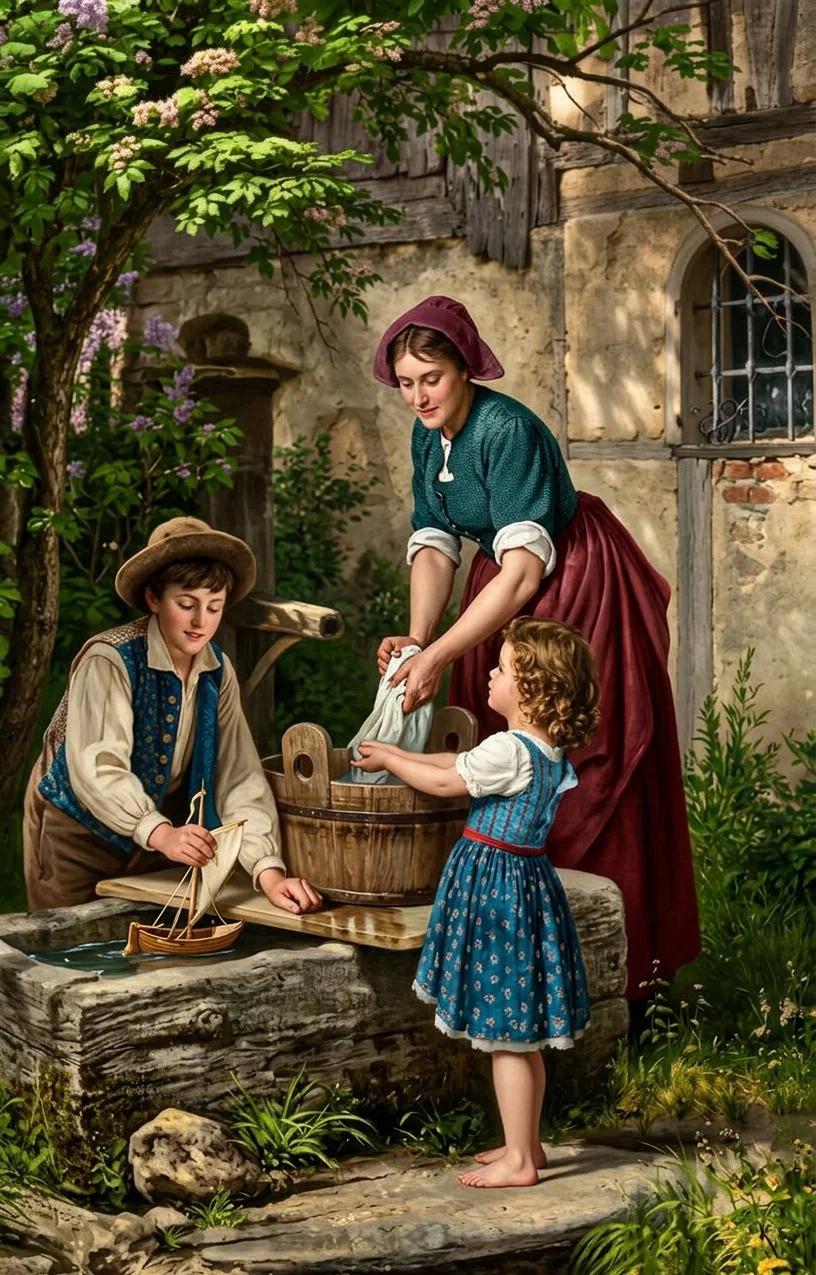
Did you ever visit at a home in which the sons and daughters, grown up or otherwise, confided implicitly in their parents? where Miss Mary or Jane, even tho almost out of their teens, never so much as bought a cheap dress for themselves without the approval of mother; and where Frank or William refused to decide anything of importance until they had consulted with father? Of course it goes without saying, that the younger members of the household will follow the example and leadership of the older.
MOTHER AND CHILDREN IN HAPPY CONFIDENCE
If you have ever visited in such a home as this, I will guarantee that you had a very enjoyable visit. We all remember a few such homes as these, and can point out a few such families — ideal homes — ideal families. But their name is not legion.
On the contrary, about as soon as the average youngster arrives at the age of fourteen or fifteen, he no longer stands in the need of the advice of father or mother, whom he regards as quite behind the times. To such youths it is really astonishing that mother has lived so many years and knows so little; or that father has been such a long, long time in acquiring a little property. He is sure he could do much better.
I have in mind just now a young lad who declared with a boastful swagger, as he was about leaving the beautiful home of his childhood, beautified by the loving hand and the generous purse of an indulgent father, that he didn’t ask more than three short years in which to accumulate as much as his old father had been half a century in getting. Of course the egotism and folly of this silly youth were only equaled by his utter unfitness for any kind of useful labor.
So he soon found to his surprise and chagrin, that the great, wide world was not waiting to boost him upon its shoulders and listen to his advice, and that greenbacks and gold dollars didn’t grow on bushes. Long before the three years were gone, the foolish lad, grown somewhat wiser, let us hope, had returned again to the home he had so despised.
But listen while I ask Miss Edith her opinion on this subject. She declares that she would be glad to confide in mother, but never having been accustomed to doing so, she hardly knows how to begin.
“My mother is a very busy woman, you see, and she has so many things to attend to that I hardly feel like bothering her with my own private affairs. She is secretary of the temperance league, and they have their clubs and their suppers and what not; then she is leader of the Foreign Mission Society; besides the Epworth League and the Dorcas Society claim much of her attention. So you see I feel that I may not trespass on her time, except on matters of real importance to me,—and even then she seems worried and annoyed. Just yesterday I ventured to ask her a question on a matter very near my heart, just as she was going out to attend a Foreign Mission meeting, and she spoke to me so hastily that I almost cried. She asked me why I troubled her; that she feared she would be late to the meeting. ‘Edith,’ she said, ‘when will you learn to be more self-reliant? Do as you like about the matter, of course.’ Sometimes I ask father; but it’s a good deal the same with him; father never visits with us; so brother Jack and I are left to our own devices.”
I am somewhat interested in this case, and so I ask: “Is brother Jack a good, steady boy, Edith?”
“O yes, Jack’s a good boy, but lately he’s taken to staying out nights real late. I hope nothing bad will come of it. I told mother the other day that I did wish she’d talk to him, and she said, yes, she surely intended to that very night, if she had time,—and if not, to speak to father, and he’d talk to Jack. But that night the Dorcas Society met, and she didn’t have time, and father was very busy reading the newspaper all the evening, and I didn’t hardly feel like interrupting him. So after a little, Jack slipped on his overcoat and hurried out of the hall door. I looked at him and shook my head, but he didn’t pay any attention, and that night,” continued Edith, “he didn’t get home until after midnight. Mother looked quite worried the next day; tho whether it was Jack’s conduct that worried her, I don’t know, for she said afterward that the Dorcas Society had failed to raise as much money as they did last year, so maybe it was that which troubled her; I didn’t dare ask. My mother never confides in us, nor do we children confide in her,” and Edith sighs softly, while a suspicion of a tear glistens for a moment in her eye. Then she turns hastily away, remarking as she does so: “Please don’t think mother or father are to be blamed, they are good and kind to us, and I am sure Jack and I love them very much,—only I don’t feel quite satisfied, somehow,—and I don’t believe Jack does, either.”
Now I am sorry to believe that this is only a typical case. There are many and many mothers who seem to be more burdened for the far-away heathen than they are for their own sons and daughters. And it is well that they do have hearts to feel for others, and for the miseries of the wretched on the other side of the globe. No one can have any too much sympathy for the sorrowing, the ignorant, or the suffering.15It is not good by any means to be so wrapped up in our own affairs, our own business, our own loved ones, that we have no time in which to minister to others.
But while this is true, it is certainly not pleasing in the sight of Him who has commanded parents to bring up their children “in the nurture and admonition of the Lord,” for them to be so engrossed in caring for some one’s else family, as to neglect either the spiritual or the temporal welfare of their own. Nor is it His will for them to fail to make themselves companionable to their sons and daughters.
I tell you, I believe the great trouble is, parents and children never get half acquainted with each other; the one is too busy, the other too timid.
O, to win the perfect confidence of the boys and girls is a beautiful thing. Father, it pays to take the time and the pains to do so. Mother, it pays to take James and Mary by the hand; to look into their eyes; to feel their moral pulse; to pray with them; to enter heart and soul into all their troubles.
Father, mother, as you value your peace of mind hereafter, as you long for the eternal welfare of your loved ones, don’t let the boys and girls get away from you. Cling to that wayward boy of yours, father; show him that you still believe in him, and have confidence in his integrity; then he will see that you truly love him, and will give you his love and confidence in return. Parents, those boys and girls were given you as a precious charge, to train for heaven. Christ is able and willing to give you wisdom enough to do it. Will you ask Him?