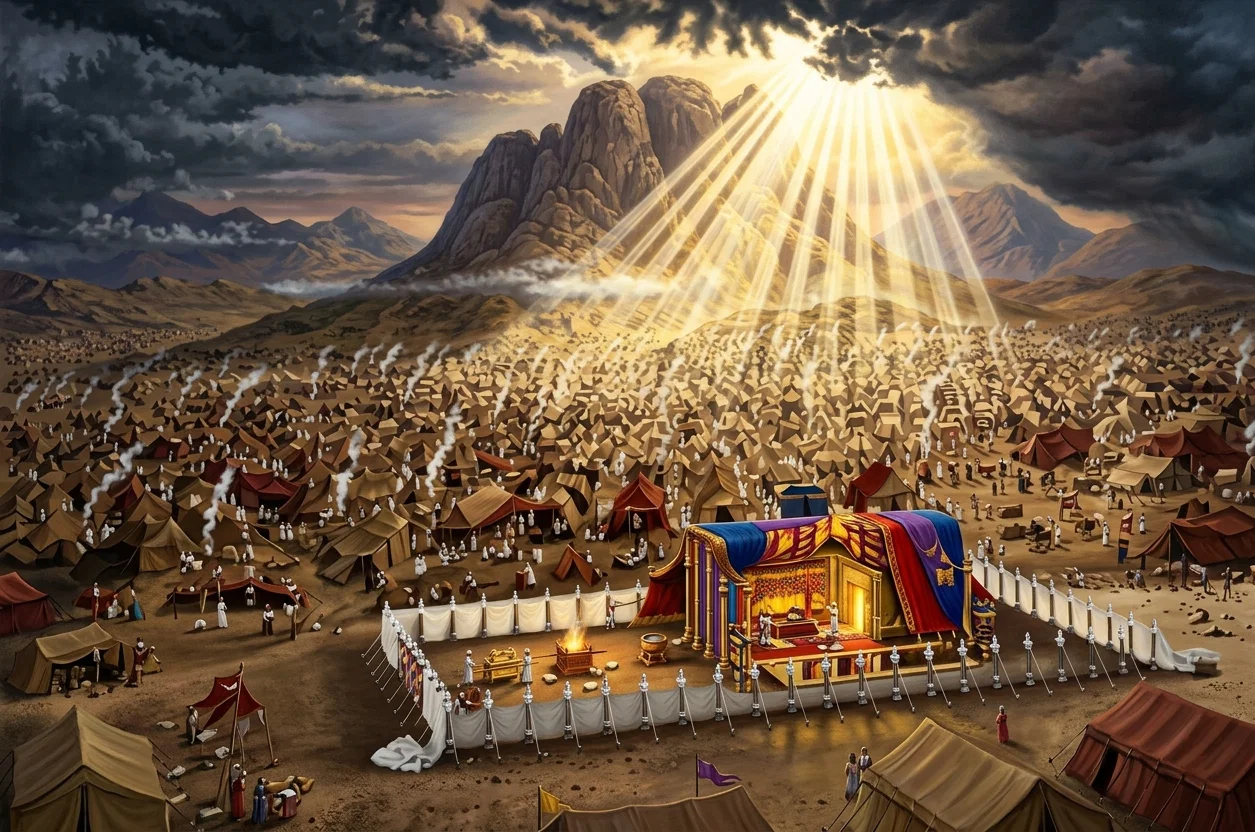
THE word “Theocracy” is derived from two Greek words, Theos, God, and krateo, rule; meaning a government of God; a true example of which is found in the early history of Israel.
There are religious bodies who are very arduous in their efforts to influence our legislators to enact laws enforcing religious observances under heavy penalties by the stern arm of civil law. When remonstrated with, that enforcement of religion is not in the purview of civil government, these religio-political reformers immediately fly to the Theocracy of Israel, thinking that to be an example and proof for enforcing religion by law to-day. It will be interesting to investigate the subject for help in deciding whether the position is sound or not.
A true theocracy is a government in which God alone frames the laws, interprets the same, and pronounces the penalties. He is the sole legislator. Thus, and only thus, can there be a government combining under one head, or rule, both moral and civil enactments.
The constitution of Israel was summarily contained in the Ten Commandments, written and spoken by Jehovah, and pronounced “the whole duty of man.” The specific moral and civil statutes growing out of this law, with the penalties for violations, were revealed to Moses from heaven, and chronicled by him in the “book of the law.” This book contained the divine interpretations of the law. That was truly a government of God. In no case in a theocracy is it in the province of man to enact laws, interpret them, or to attach penalties thereto. The province of the Hebrew rulers was only to enforce the laws God had given. One writer has truly said:
“The government of Israel was administered in the name and by the authority of God. The work of Moses, of the seventy elders, of the rulers and judges, was simply to enforce the laws that God had given; they had no authority to legislate for the nation. This was, and continued to be, the condition of Israel’s existence as a nation. From age to age, men inspired by God were sent to instruct the people, and to direct the enforcement of the laws.”—“Patriarchs and Prophets,” chap. 59, par. 1.
This government was completed with Israel in the compact, or covenant, of Jehovah and recorded in Ex. 19:5-9. Being under the immediate supervision of the Lord, in any case of doubt in its administration, the judges would put the offender in ward and the Lord would reveal the true situation, either by His prophets or by Urim and Thummim in the breastplate of the high priest. Lev. 24:11, 12; Num. 15:32-35. In this, no innocent person might suffer nor any unjust penalty be administered. This infallible precision in administration can not be found in any earthly government to-day.
The Coming in of the Kingdom
Israel desired a kingdom,—a kingdom like the nations about them,—but this did not change the principles of the Theocracy. The people still allowed the Lord to choose their kings. Altho it was contrary to the will of God, He permitted it. “The Lord foresaw that Israel would desire a king, but He did not consent to a change in the principles upon which the state was founded.” As full proof that the Theocracy did not end at this time, we read: “Solomon sat on the throne of the Lord, as king, instead of David his father.” 1 Chron. 29:23.
The succession to the throne descended in David’s line to Zedekiah who was made subject to Babylon in 588 B.C. Contrary to many writers, however, the Theocracy could not have ended with this overthrow of the kings. The Theocracy continued, but with many interruptions, till the time of Christ’s crucifixion. At that time Israel rejected the Messiah, their King and only hope, and delivered Him into the hands of Rome and declared —
“We Have No King but Cæsar.”
“Away with Him, crucify Him.” In this, Israel, as a nation, rejected the government of God, and He allowed the Romans to destroy their city and kingdom, and to scatter them to the four quarters of the earth. Jesus said, “Your house is left unto you desolate.” Since they had denied their King, He said: “But now is My kingdom not from hence.” “My kingdom is not of this world.” John 18:36. As another proof that the Theocracy did not cease until Christ’s time, we hear Him acknowledge Nicodemus as a ruler in Israel.
A Prophecy of Its Perversion
That the Theocracy continued until Christ’s time, is clearly shown in the words7of the Lord to Zedekiah (Eze. 21:25-27), when he was taken by the king of Babylon: “Thou profane and wicked prince of Israel, . . . remove the diadem and take off the crown.” This was done by Babylon in 588 B.C. The Lord continues: “I will overturn, overturn, overturn it.” This was fulfilled first by Medo-Persia, again by Grecia, and lastly by Rome to the finish, as an earthly kingdom, in A.D. 70 under Titus.
The word “overturn” is from the Hebrew aváh, literally, to crook; metaphorically, to bow down, trouble, or pervert (see margin), as a tree bowed down to the ground. The word does not have the meaning of destroy. It is very evident that a government to be three times overturned, or bowed down, must have had an existence during all that time. This is conclusive evidence that the Theocracy of Israel continued, in a varied existence, until Christ came and announced the principles of His kingdom which they rejected.
Zerubbabel and Nehemiah were selected by the Lord as governors who rebuilt and restored Jerusalem and governed under the theocracy of Israel. Another writer expresses the existence of the Theocracy in these words:
“Thus by choosing a heathen ruler, the Jewish nation had withdrawn from the Theocracy. They had rejected God as their king. Henceforth they had no deliverer. They had no king but Cæsar. To this the priests and teachers had led the people. For this, with the fearful results that followed, they were responsible. A nation’s sin and a nation’s ruin were due to the religious leaders.”
The text concludes, “It shall be no more, until He come whose right it is; and I will give it Him.” The One “whose right it is,” is Jesus. “The Lord shall give unto Him the throne of His father David; and He shall reign over the house of Jacob forever. Of His kingdom there shall be no end.” Luke 1:31-33. His kingdom is spiritual, and “not of this world.” Thus “the throne of the Lord,” or the true Theocracy, has been removed from the national world, and will be no more until Christ’s second coming, when all earthly kingdoms shall have an end and He shall set up His everlasting kingdom and rule forever.
Therefore, while this world stands, a true theocracy can never be erected in it again, therefore, every theory of an earthly theocracy is false, every pretension to it is false; and wherever any such theory is advocated, whether in Rome, New England or elsewhere, it puts man in the place of God and certainly can not be a model for modern governments.
Moral and Civil Government
Moral government and civil government are separate and distinct, the one from the other.
Moral government has to do with the conscience—the spiritual and moral rights of man. God has reserved this rule to Himself and can and does forgive the repentant offender; but He will punish the unrepentant offender in the last day. Matters of faith relate wholly to man and his Maker. He is the only One who can really read the convictions and motives of the heart.
Civil government has to do with natural rights between man and man, such as the protection of life, property, and chastity and reputation, which is necessary to the “pursuit of happiness.” The protection of natural rights between man and man, God has ordained as the rightful rule of man in civil government (Rom. 13:1-10), with which our own nation’s most beneficent Constitution accords.
When civil government steps beyond God’s ordination and seeks to grasp the prerogative to rule which He has reserved to Himself, and attempts to bind the consciences of men by legislating in matters of faith, it thereby places man above God, which The Word instructs us is antichrist. Further it is a union of church and state, and entirely obliterates the dividing line between moral and civil law so clearly defined by our divine Master, “Render therefore unto Cæsar [civil government] the things that are Cæsar’s, and unto God the things that are God’s.”
Result of Perversion
The matter of worship is due alone to God: “Thou shalt worship the Lord thy God and Him only shalt thou serve.” The Sabbath is the Lord’s,—I am “Lord of the Sabbath;” and is spiritual—“My holy day.” Therefore, any attempt to legislate upon a rest day in any form, or upon baptism, or any other forms of religion, tho in themselves right and just, would be wicked, unchristian, and uncivil. In the case of the exaltation of a false institution, which is always the case in religious legislation, immediate persecution would follow those who remained loyal to God and dared to say, “We ought to obey God rather than man.”
The protection of life, property, character, and liberty, both civil and religious, belongs to civil government. It should protect man in matters of faith, but not compel therein. Civil government is a compact between man and man to compel men to be civil who do not regard the equal rights of their fellow men, but it can not compel them to be religious.
And so, friends and countrymen, let our prayers ever ascend to the Father of life and liberty on behalf of our civil rulers, that they may remember the principles of our divine Master, to “keep the church and the state forever separate” in matters of religion, and not to confound morality—our duty to God—with civility—our duty to our fellow men.