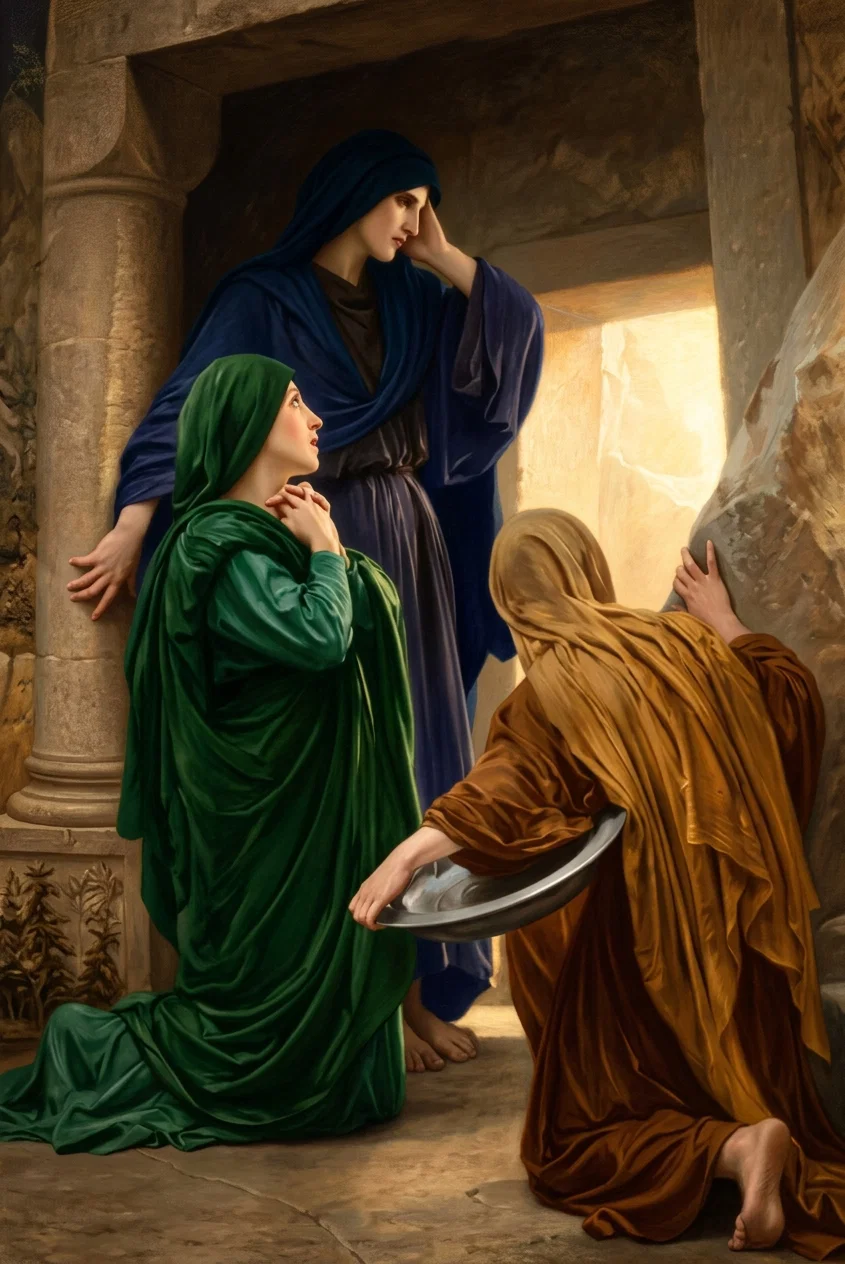
The Holy Women at the Tomb. “He is not here, for He is risen.”
The eternal Son of God came to this world. He was made flesh, and dwelt among men. He was “born of a woman, born under the law, that He might redeem them that are under the law, that we might receive the adoption of sons.” He grew to manhood through infancy, childhood and youth.
Physically, He was like other men. He walked among them. He ate and drank at their tables, sat in their circles of converse, slept in their beds, walked in their fields. He was baptized, tempted forty days, and He conquered by the word. He went about doing good, preaching the word of life, healing the sick, casting out demons, breaking the bonds of sin, and raising the dead. Finally, He died upon the cross. His hands and feet and heart were pierced. He was laid in a new rock tomb by loving hands, and the strong Roman government, by her legates, sealed the sepulcher and imprisoned Jesus of Bethlehem and Nazareth.
But they could not imprison the Prince of Life. Why?—Because He was also the Righteous One. In the ethics of human warfare “Might makes Right,” and it often seems demonstrated; but it is only temporarily. In the eternal spiritual warfare only Right is Might. Within absolute Right is the potency of eternal power, the assurance of perennial existence. He who was “made to be sin in our behalf” “did no sin, neither was guile found in His mouth.” He demonstrated the power of God above sin in the flesh. He was working out: “In the way of righteousness is life, and in the pathway thereof there is no death.” He bore sin on our behalf; on our behalf He died. But in Himself He had no sin, and therefore God raised Him up, “having loosed the pains of death; because it was not possible that He should be holden of it.” Acts 2:24. No rock-bound tomb could imprison the character of “everlasting righteousness,” thrice sealed tho’ be the prison door.
Therefore when the holy women came to anoint the hastily buried body on the morning of that first day, they found an empty tomb; but a living message of mighty import brought the angel messenger, who had been commissioned of Heaven. When, then, they came asking themselves, “Who shall roll us away the stone from the door of the tomb?” they found it rolled away, the body of Jesus gone, and a messenger of God who said: “Be not amazed: ye seek Jesus, the Nazarene,” who hath been crucified:
He Is Risen; He Is Not Here:
Behold, the place where they laid Him! But go, tell His disciples and Peter, He goeth before you into Galilee: there shall ye see Him.” Mark 16:3-7. That was the Lord’s message to His church then; it is His message to His church now. Condense it to its pith:
“He is risen; He is not here: . . . He goeth before you into Galilee; there shall ye see Him.”
“HE is risen.” The same Jesus who died; the One whom they crucified; the One whom they locked in the tomb, of Him is the message.
“He is risen.” He is not a dead Saviour or friend. He lives. He who thus rises has power over death; He is stronger than death, stronger than sin, of which death is the finished product. He is risen from the dead; the tomb holds Him no longer.
Would God the church had heeded the message. Beginning with 1096, for nearly two centuries the deluded followers of tradition, many of whom believed themselves to be sincere Christians, laid down their lives to recover that empty tomb, neither then nor since surely known. Seven times the armies of the Crusaders beat their waves of humanity against the wall of Saracen arms, to suffer defeat and destruction, in all save temporary successes. If the Roman Catholicism of Europe had but known the thrice-repeated message of Christ to His church, thousands of lives would not have been slaughtered to recover a hole in the rock, empty of the Master.
The Crusades are no more. We pity the deceived ones. But the church goes on following the same principles of perversion, seeking Christ in the ancient, musty relics and museums of antiquity, once pressed mayhap by His feet or brushed by His seamless robe, but in which He now is not. The enormous, half-truth traditions of men; the human creeds of dead hands; the crypts of traditions which make void the commandments of God; the outworn, worthless methods of medieval education; the arbitrary control of pope or council or conference or creed; the world-curse of civil interference in4religious matters, or religious interference of civil matters; the harness in which some devoted worker dragged souls into the kingdom, designed for none but him, and blessed of God perhaps despite His machinery and method,—all are become to a greater or less extent empty sepulchers in which men are seeking the Risen Christ. O, let them hear the heavenly message: “He is risen; He is not here.”
Would you find Him, soul? You have followed the vain quests so long. “I know ye seek Jesus,” is God’s message still to His blundering disciples; and “Why seek ye the living among the dead?” is still His searching question.
He is not in empty sepulchers. He goeth before you into Galilee. He is out where the slaves of sin are longing for freedom; where the souls in darkness and gloom are praying for light; where eager ears are waiting for living words instead of dead traditions; where hungry hearts are longing for the Bread of Life instead of the scientific husks of men; where sin-sick, soul-sick, body-sick men are eagerly looking for the healing word and touch of the Gospel of health and life; where His own word is given free course instead of the arbitrary authority of men. “He goeth before you” with His mighty blessed healing word in all these needy fields, to all these needy souls; there shall ye find the Risen Christ.