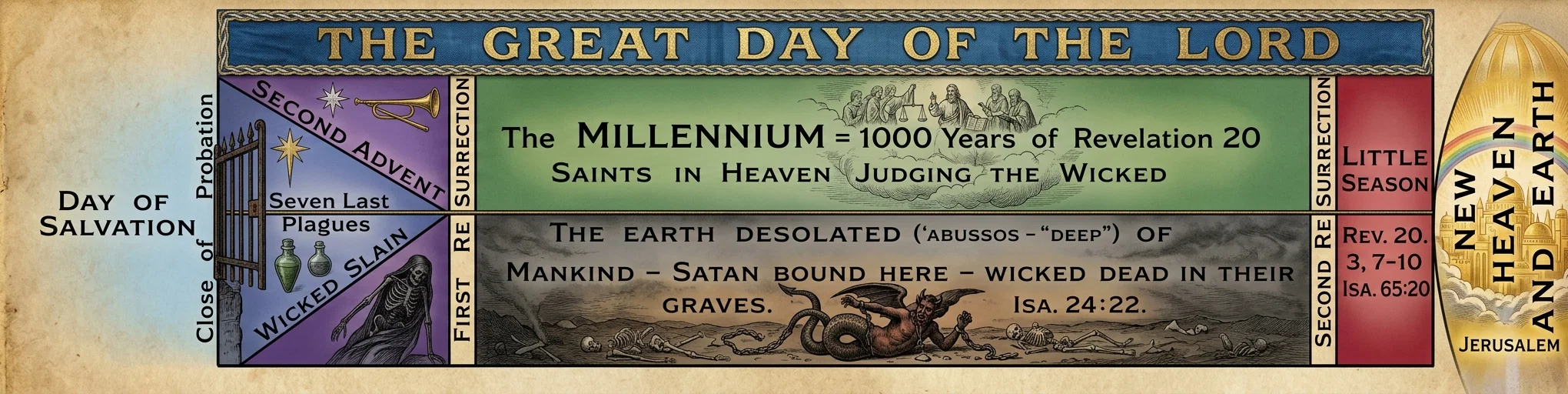
The rest of the dead lived not again until the thousand years were finished.” Rev. 20:5, first part. “And when the thousand years are expired, Satan shall be loosed out of his prison.” Verse 7. That is, the resurrection of the wicked dead and the loosing of Satan are events that occur at the close of the millennium, and are therefore coincident. When the wicked dead are raised, they come up as they went down, with the carnal mind which is enmity with God and not subject to His law. Rom. 8:7. They are fit subjects of Satan’s temptations and deceptions because of their resistance to the pleading of God’s Spirit and their rejection of His grace and mercy freely offered to them in the Gospel, before they fell under the power of death. Hence, we read in verses 8 and 9 that Satan goes out to deceive the nations, and gathers them together to battle, and leads them to attempt the capture of the beloved city and the saints of God.
The “beloved city” is the New Jerusalem which is above and is the mother of us all. Gal. 4:26. It is the city for which Abraham looked, “a city which hath foundations, whose builder and maker is God.” Heb. 11:10. It is the holy city, New Jerusalem, which John saw “coming down from God out of heaven.” Rev. 21:2. Thus at the beginning of the millennium Christ comes to this earth and gathers His saints and takes them to the holy city, New Jerusalem, and they reign with Him a thousand years. Rev. 20:4. Then at the end of that period He comes with all His saints and the holy city, raises the wicked dead, thereby loosing Satan, and then follows the last desperate effort of Satan and those he has deceived to capture the holy city and overthrow the kingdom that Christ is then setting up on the earth with the New Jerusalem as its capital.
This is the culmination of Satan’s effort against God and His government. It ends in failure and the total destruction of Satan and all his followers; for fire comes down from God out of heaven and devours them. Rev. 20:9, 10.
Satan’s character, work, and final end are described in Eze. 28:12-19, under the symbol of the king of Tyrus. First, he was a holy angel, exalted in position, the anointed cherub that covereth. Verses 12 to 14. He was perfect in his ways till iniquity was found in him. Verse 15. He became lifted up with pride, and God cast him out of heaven and decreed his destruction. Verses 16 to 18.
Satan Not Immortal.
Some have thought that the devil can not be destroyed because he is immortal. His life came from God, the Creator, and surely God can take it away when He chooses. The Father hath life in Himself, and hath given His Son the same life, so that He also hath life in Himself. John 5:26. But He has not given Satan life in himself so he can exist eternally, as a menace to God’s government and a tempter and an accuser of God’s people. It would be contrary to God’s character and attributes to create beings that, by an evil course, could perpetuate sin in His universe, and be rivals whose power and influence He could not destroy. God’s wisdom and love preclude such a view. It is a moral impossibility.
We can conceive how God can permit the existence of evil for a limited time and overrule it for His glory and the good of His universe by placing before all intelligencies an object-lesson of sin and its dire results, and of His love and mercy in redeeming from sin all who would choose life and loyal obedience to the Creator. But God’s wisdom and love make it utterly inconsistent for Him to immortalize sin by creating any being who could and would sin and could not die, and could not be destroyed. That would make Him responsible for the existence of sin throughout eternity. Such a view is contrary to God’s character as revealed in Christ, and to the plain teaching of the Scriptures.
The Lake of Fire.
Once, in the days of Noah, a flood of waters enveloped the earth and destroyed the wicked then living. Matt. 24:38, 39; 2 Peter 3:5, 6. “But the heavens and earth which are now, by the same word [the word of God] are kept in store, reserved unto fire against the day of judgment and perdition of ungodly men.” Verse 7. The Saviour speaks of this fire when He describes the judgment upon the wicked in Matt. 25:41: “Depart from Me, ye cursed, into everlasting fire, prepared for the devil and his angels.” Peter describes the scene in 2 Peter 3:10-12: “The heavens shall pass away with a great noise, and the elements shall melt with fervent heat, the earth also [will melt with fervent heat] and the works that are therein shall be burned up.” This will constitute the lake of fire which will envelop the earth as the flood of waters enveloped the earth in the days of Noah. It is called everlasting fire because it is everlasting in its results. There is no life beyond it. We have an example of what eternal fire will do in the experience of Sodom and Gomorrha. They were turned into ashes by eternal fire, and their destruction is declared to be an example of the fate of the ungodly. Jude 7; 2 Peter 2:6. They will be turned into ashes, destroyed root and branch. Mal. 4:1, 3. Satan is the root because the originator of evil; and evil angels and wicked men are the branches.
This lake of fire is formed or prepared at the end of the thousand years by the fires from within the earth uniting with the fire that comes down from heaven. Thus it was in the days of Noah. The fountains of the great deep were “broken up, and the windows of heaven were opened.” Gen. 7:11. Water from below and from above united to form a lake of water, “whereby the world that then was, being overflowed with water, perished.” 2 Peter 3:6. Hence, when the lake of fire envelops the world, the elements and the earth melt with fervent heat, “and the works that are therein [Satan and all his followers] shall be burned up.” They are consumed, devoured, destroyed in the lake of fire, and therefore it is called “the second death.” Rev. 20:14, 15.
[The concluding article in this series is upon the glorious climax of redemption, “The Earth Made New.”]