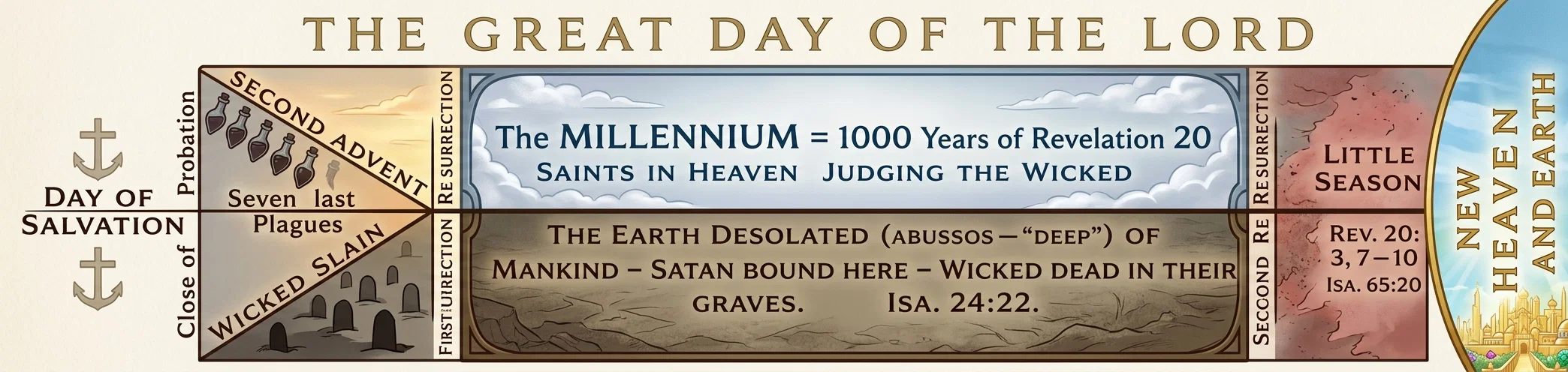
Millennium means a thousand years. While the term is not in the Bible, its equivalent, “a thousand years,” is used six times in Revelation 20, in six consecutive verses; namely, 2–7, inclusive.
The millennium is marked at its beginning by the first resurrection, and it closes with the second resurrection. Verses 4 and 5. The last sentence of each verse refers to the resurrection of the just. “Blessed and holy is he that hath part in the first resurrection.” Verse 6. The first part of verse 5 is evidently parenthetical; the connection shows this clearly. After speaking of the righteous in verse 4, the last clause says: “They lived [that is, they were raised from the dead] and reigned with Christ a thousand years.” The question would then naturally arise in the mind of the reader, what about the rest of the dead? Hence the parenthetical statement concerning them in verse 5, before declaring in the last clause, “This is the first resurrection,” referring to the righteous dead mentioned in verse 4, who “lived” again and reigned with Christ a thousand years.
The Saviour speaks of a “resurrection of the just” (Luke 14:14), and also of a “resurrection unto life,” and a “resurrection unto damnation.” John 5:29. Paul also taught two resurrections, one of the “just” and one of the “unjust.” Acts 24:15.
The Time of the Resurrection.
While the Saviour and Paul both teach two resurrections, they do not, in these scriptures, indicate how far apart they are. But in the Revelation it is plainly taught that the resurrection of the just is at the beginning of the millennium, and the resurrection of the unjust at the close of the millennium. The following scriptures show conclusively that the first resurrection takes place when Christ comes the second time: Matt. 24:30, 31; 1 Cor. 15:22; 23:51–54; 1 Thess. 4:16, 17. At that time the living wicked are slain by the glory and brightness attending the Saviour’s coming. 2 Thess. 1:7, 8; 2:8; Matt. 16:27; 24:30; Luke 9:26. The brightness of one angel caused the Roman soldiers at the sepulcher of Christ to fall as dead men. Matt. 28:2–4. The wicked are unable to endure the great glory manifested when Christ comes again. They are consumed.
Peace and Safety.
When the day of the Lord is near, and God’s wrath is to be poured out in the seven last plagues, and the coming of the Lord is nigh, the cry of peace and safety is raised that the people may rest in a false hope, and be unprepared for the impending destruction. The peace and safety cry is heard in the declaration by “many people” that the world is growing better, and will be won to Christ; that swords shall be beaten into plowshares, and spears into pruning-hooks, that nation shall not lift up sword against nation, neither shall they learn war any more. Isa. 2:2–4; Micah 4:1–3. “Many people” say these things in “the last days.” See Isa. 2:2, 3, and Micah 4:1.
The people also declare that “the mouth of the Lord hath spoken it.” Verses 4, 5. Yet in “that day” God “will arise to shake terribly the earth,” and His judgments will be visited upon the ungodly. See Isa. 2:10–21.
Paul also testifies that just before the second advent and the day of the Lord, there will be a cry of “peace and safety” from those upon whom His coming is as a thief in the night, and sudden destruction will come upon them, and they shall not escape. 1 Thess. 4:16–18; 5:1–3. He also declares that perilous, not glorious, times shall come in the last days (2 Tim. 3:1), and that “evil men and seducers will wax worse and worse, deceiving, and being deceived.” Verse 13.
God’s word says that men will prophesy peace in the last days; that men will say that the nations will learn war no more. In marked contrast with this, God says the nations will be stirred up to war, the heathen will be awakened, plowshares will be beaten into swords and pruning-hooks into spears. Joel 3:9–13.
Shall we believe man’s word or God’s word? God says, “Cease ye from man, whose breath is in his nostrils: for wherein is he to be accounted of?” Isa. 2:22. He will soon cast his idols of silver and gold to the moles and bats, and seek refuge in the rocks and mountains, that he may be hid from the face of the coming King, and from the wrath of the Lamb, when He comes in flaming fire, with power and great glory. Verses 19–21; Rev. 6:14–17.
The Earth Desolate.
We have found that the day of the Lord begins with the pouring out of the seven last plagues. These are described in Revelation 16. They continue one year, as we learn from Rev. 18:8, where one day, prophetic time, is applied to them. In prophecy a day stands for a year of literal time. See Num. 14:34 and Eze. 4:4–6. The plagues destroy vast numbers of the wicked, no doubt. The remnant are slain by the consuming glory of the second advent of Christ (Rev. 19:11–21), and the righteous are taken to heaven. 1 Thess. 4:16, 17; John 14:1–3; Rev. 19:1. Thus the earth is emptied of its inhabitants and left desolate. Isa. 24:1–3; Jer. 4:19–27.
Here in the desolate earth, Satan is bound during the thousand years. Rev. 20:1–3. By the circumstances under which he is placed, with man entirely beyond his reach, the wicked being all dead and the righteous in heaven, Satan is as effectually bound as tho he were actually bound with a literal chain and cast into a cell, six by eight. A prisoner is confined that others may be safe from harm. So Satan is confined to the earth where he can do no harm during the thousand years. The term “bottomless pit” is from the Greek word abussos, which in the Septuagint is the word for “deep” in Gen. 1:2. The earth was then empty, without form and void, and this will be its condition during the millennium. Satan will be shut up in this prison-house, unable to visit other worlds, and not only under circumstances which limit his operations, but they absolutely take away all his opportunities to deceive and destroy souls.