After a sojourn of several days in the land of death and desolation, I am back again in the “Eternal City.” The mighty catastrophe that devastated southern Italy, the morning of the 28th of December last, eclipsed in destructibility all the earthquakes that have ever visited this old world of ours. Tongue can never describe nor pen portray the terrible ravages wrought by the great tremblore in a few seconds of time on one of the most beautiful spots of this fair land.
The words of the Italian Minister of Justice, fresh from the scene of the disaster, will help us to form some idea of the cruel cataclysm: “It is such a terrible catastrophe that it is impossible to find words adequate to portray it. It is certainly a calamity that can not be conceived of with the highest flight of imagination. The first reports of any disaster are usually highly colored and greatly exaggerated, and so I had hopes that such might be the case in this instance; but the spectacle that met my gaze can find its portrayal only in the apocalyptic descriptions of the end of the world.”
And the following words pronounced in the Italian parliament by a member representing one of the devastated regions will help to render the picture of the calamity more vivid: “In a cataclysm which no human mind could ever have conceived, not even the dreams of a Macaberesque fancy, that no word can describe or pen portray, we have lost everything. An entire people, or nearly so, have perished, and with their destruction fell the roofs under which our fathers were born and where we first saw the light of day: the churches where our mothers prayed; the museums where our treasures of art were collected; the archives where our documents of state and history were deposited: we have lost everything as if nature had wished in a moment of time to interrupt centuries of our history.”
“The catastrophe has overturned everything in its destructive fury. Commercial, social, industrial, and, in fact, every phase of life has come abruptly to a close. Men who before the earthquake were rich, go groping around among the ruins, reduced to paupers; orphans are found who are ignorant of their name and their family; there is hardly a survivor who has not lost all or a part of his family, and I do not know whose lot is more sorrowful, whether it be that of the people buried under the ruins, or the living who must affront the great calamity in all its terribleness.”
These words may seem to be born of a momentary agitation or a flight of eloquence, and not entirely in conformity with the facts in the case, but after one has climbed over mountains of debris for hours and hours at a time, and seen ruins and nothing but ruins as far as eye could see, and witnessed death and distress sown broadcast on every hand, he is fully convinced that the half of the gruesome story has never been, nor will ever be, told.
The Territory.
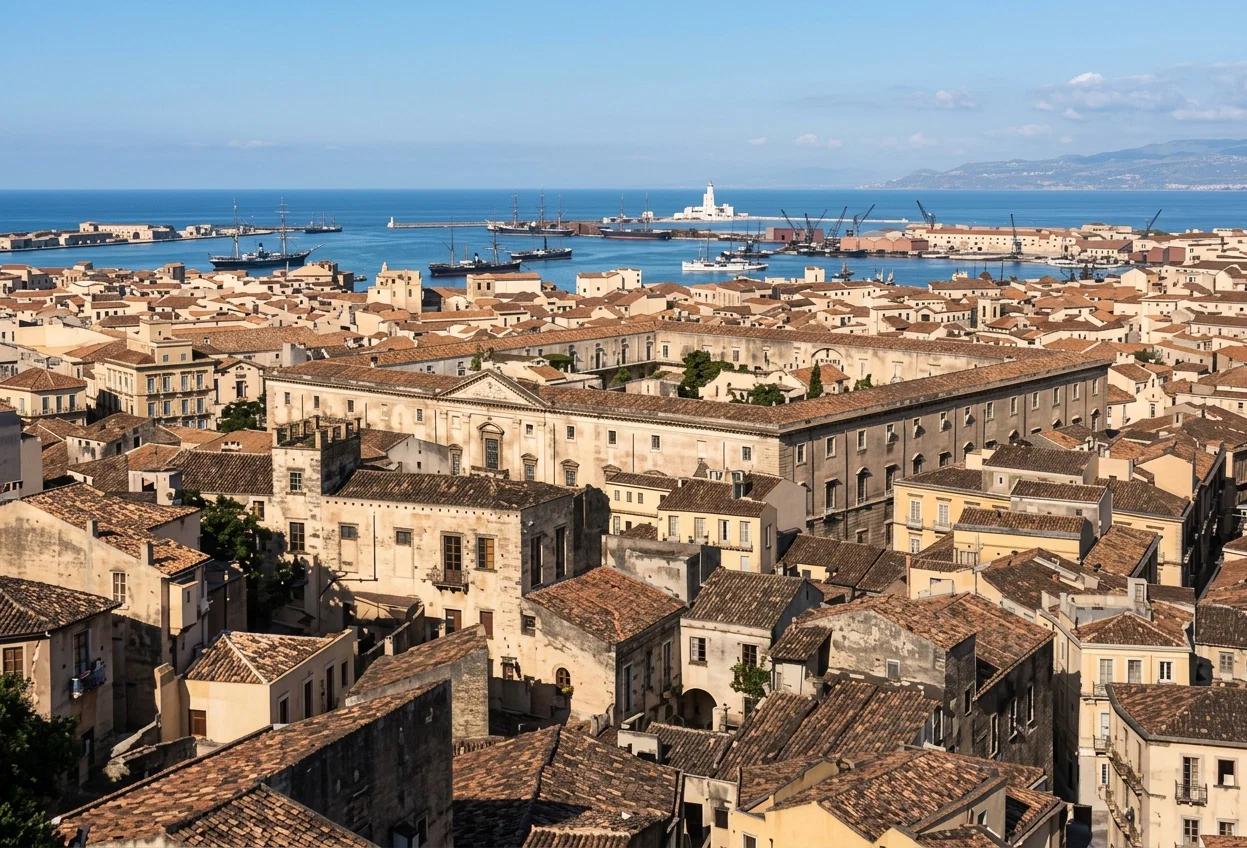
The cities razed to the ground by the terrific earthquake shock were situated upon the Straits of Messina, just where the toe of the Italian boot almost touches “the pearl among islands,” Sicily. Upon these smiling shores nature has bestowed with a lavish hand the choicest of her gifts. Seen from the opposite shore of the channel, Reggio or Messina presented a most charming aspect, with their white houses shining in the glorious Italian sunlight, at the foot of beautiful hills covered with vines and groves of orange, lemon, mulberry, and other fruit-trees. These cities, overhung with the radiant canopy of the deep blue Italian sky and reflected in their shining waters of the straits, formed a picture of a veritable fairy-land basking in the climate of eternal spring-time. The words of Byron will more fully describe this beautiful land:
“Thou art the garden of the world, the home
Of all Art yields, and Nature can decree:
E’en in thy desert, what is like to thee!
Thy very weeds are beautiful, thy waste
More rich than other climes’ fertility.”
This region has a very old and varied history. As I was wandering through Reggio, I saw upon the front of the cathedral the inscription, “Acts 28:13,” which refers to the visit of the apostle Paul to this historic town.
Messina, Reggio, and many towns and villages adjacent to them, were wrapped in deep sleep the morning of December 28, when at 5:20 the earthquake giant arose in all his fury and dealt the most decisive blow that he has ever given humanity in all its history.
The inhabitants of these beautiful towns went to bed the evening before without the slightest warning of the fate that awaited them. Peacefully they slept, cradled in the beautiful arms of nature, little suspecting that old mother earth would that night play havoc with her slumbering children.
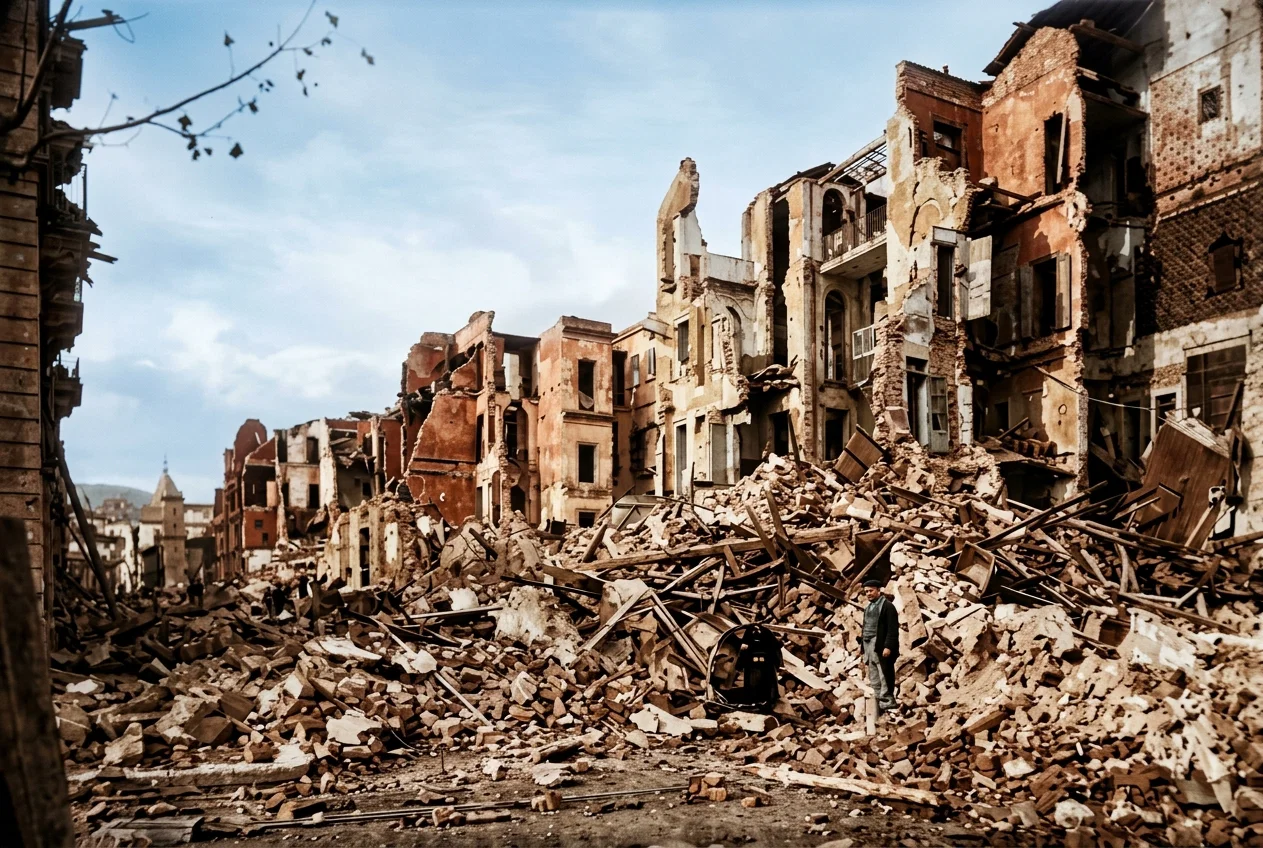
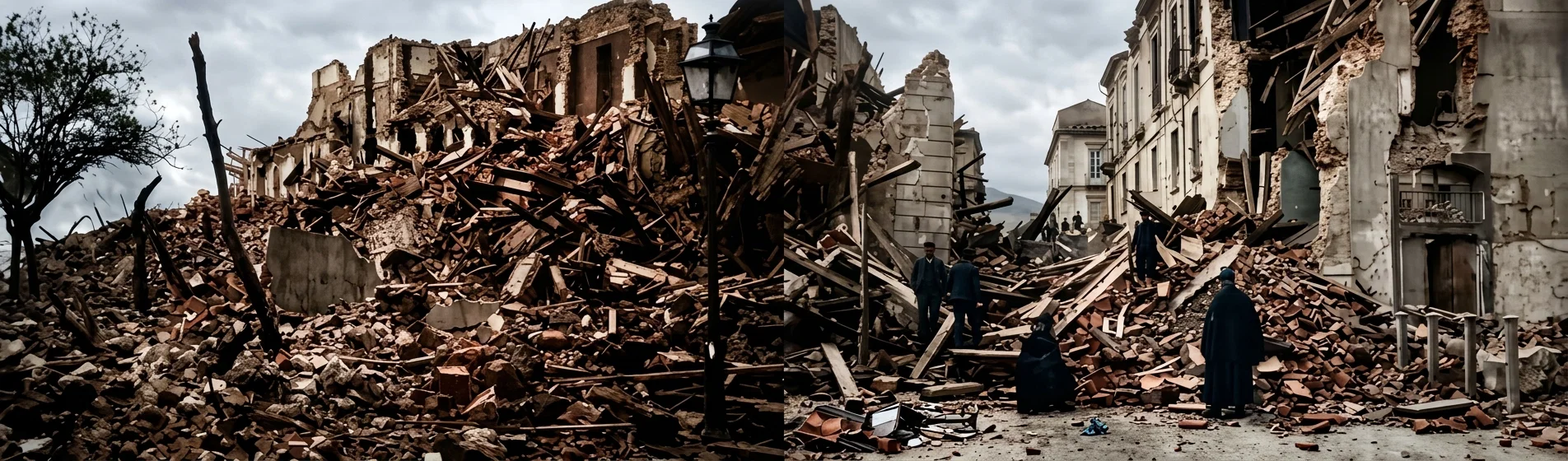
The earthquake lasted about 32 seconds, but it was a terrible shock. It seems as if the earthquake literally picked up the houses and then dropped them all in a heap. Some of the buildings were three and four stories high, and its looks as if the floors fell through and then the walls closed in upon the unfortunate sleepers. It was absolutely impossible to dream of escape in the case of the greater part of those that perished in the catastrophe. Death had full sway and gathered into its11grim bosom all without regard to age or condition.
The story of the catastrophe might be told in a few words: a terrific shock, a mighty cloud of dust arising from falling buildings, a wail of distress and anguish, followed by deep silence and impenetrable darkness, and many beautiful towns and villages were transformed into extensive cemeteries in which were buried dead and living.
Some who managed to escape from their homes, while hurrying down the streets, were buried under the falling walls which closed in over them from either side of the street and made escape impossible. And when it is taken into consideration that almost all the people were asleep at the time of the earthquake, and that there is scarcely a house left intact, we no longer wonder that so many perished, but rather that any escaped.
The population of Messina before the earthquake is estimated at 160,000 inhabitants, of which 100,000 are supposed to have perished in the catastrophe. Of the 60,000 inhabitants composing Reggio, it is estimated that more than half perished. Besides these two larger cities, there were about two hundred smaller towns and villages which were almost wiped out. The total number of victims that perished in the mighty catastrophe is put as high as 200,000 souls. Besides, thousands were wounded, and some of these died as a result of their injuries. Others were reduced to a deplorable condition, without a living relative to share their unhappy lot.
A Pile of Ruins, Reggio. Palace of the Prefect, Reggio.
In comparison with this mighty catastrophe, some of the great earthquakes of the past seem mere child’s play. San Francisco, with its 1,000 victims (probably nearer 5,000.—Ed.), and Lisbon, with its 50,000 sacrificed to the Moloch, earthquake, seem to lose much of their terribleness when put alongside of this great cataclysm.
The earthquake was accompanied, as in the case of the Lisbon disaster, by a great tidal wave. The mighty tremblore rolled the sea in upon the stricken cities, engulfing many of the people who had escaped from the clutches of the earthquake. In one place a boat was hurled hundreds of yards up against a railroad bridge. At Pellaro the lower part of the town disappeared under the sea. It was estimated that in that beautiful town of about 6,500 inhabitants, the greater part were swallowed up by the greedy sea. In Reggio, I saw several freight-cars in the sea and railroad-tracks suspended in mid-air as the bank had been washed away by the tidal wave. I saw a whole line of freight-cars so terribly damaged that a great railroad wreck could not have reduced them to greater ruins. At places the shore has been greatly lowered so that the sea covers a great section of the bank. Merchandise was scattered upon the turbulent waters. The aspect in general was one of a combination of all the calamities to which mankind is subject.
Great fissures are to be seen in the streets, especially in those bordering the sea. It is said that at Reggio, behind the railroad station where a huge fissure is to be seen, hot water and gases gushed forth. It is certain that in other localities boiling water issued forth, at times rising to quite a height. In one place there has been formed a fissure 650 feet long by four feet wide and sixty feet deep; the people call it the “gateway to hell.”
One of the guards stationed on the sea-shore stated that while doing service on the shore, suddenly an immense wave rolled in upon him, dashing him against the debris close at hand and then carried him out to sea, and if he had not been able to swim, he would have been lost, as were his companions, in the turbulent waters and the deep mud formed on the shore. Many bodies were washed ashore by the sea on both the Sicilian and Calabrian sides of the straits, for the distance is not very great from Messina to Reggio, only about forty minutes’ ride on the ferry-boat.
Dense darkness reigned everywhere immediately after the tremblore had begun its deadly work, as all the lighting plants were quickly disabled by the terrific shock. Suddenly the awful scene was lighted up by the fires which broke out here and there in different parts of Messina, and which helped to destroy the little that was saved from the earthquake and the tidal wave.
The terror-stricken people who survived these terrible onslaughts of the tremblore, the sea, and the fire, were drenched by the torrential rains that pelted down upon them unmercifully as they sought a refuge from the falling walls, in the open country. In fact, it seems that every element of destruction that nature holds in her storehouse was turned loose on this wretched people to insure as complete a catastrophe as it is possible to imagine. Then, added to the deadly work of the destructive forces of nature, the ferocious nature of man asserted itself to render the scene more gruesome. At the time of the earthquake, the prison of Messina contained about 500 prisoners. Of these, about three hundred escaped destruction, and were turned loose on the doomed city. Then from the neighboring towns and villages, the Sicilian brigands hurried to the spot of the disaster and began to loot and plunder, sparing neither living nor dead.
The city authorities, the police, and the garrison, were almost completely destroyed by the earthquake so that the city was left the prey of these bandits until help could be obtained from the government. But as all means of communication were completely cut off, the arrival of troops was delayed for some time. In the meantime these hyenas in human form looted everything that they could put their hands on, stripping the dead and terrifying the living.
A lady who was buried under the debris called to a passer-by, who proved to be a robber, and he came to her rescue only to relieve her of her rings and cut off one of her fingers to obtain one ring that he had not the patience to remove. A marchioness shouted from a window for help, when a robber came to her aid and relieved her of her rings and a finger. Many similar acts might be mentioned, but these will suffice to show that the most ferocious beast of this globe is man when depraved by sin. For even the beasts of the forest seem to have a heart when calamity overtakes one of their number.
These dastardly deeds highly incensed the whole Italian nation, and the earthquake-stricken region was in consequence immediately put under martial law. It is said that several hundred robbers have been shot by the military authorities since the earthquake. The last day that I was at Messina I saw four robbers in chains being conducted to the temporarily constructed jail of the military tribunal.
The Russian and English marines, who were among the first to arrive on the spot of the disaster, performed wonderful deeds of heroism in rescuing the unfortunate inhabitants of the earthquake-stricken districts. They also showed great bravery in warding off the brigands who had invaded the place. The self-sacrifice and ceaseless activity displayed by these brave marines won the applause and affection of the Italian people. They certainly merit all the praise that has been bestowed upon them, for they worked like Trojans, running here and there, wherever they heard a cry of distress, digging out those who were buried under the debris and carrying them to the hastily constructed hospital, equipped by the supplies that they had aboard their war-ship. Many were thus rescued who would otherwise surely have perished. However, it must not be imagined for a moment that their work was anything like adequate to the great needs of the case. For with about 200,000 persons buried under the ruins of 200 cities and villages, what could a few marines accomplish, even with a Herculean effort? For while riding on the ferry-boat, I could see, by means of a field-glass, town after town, village after village, and isolated buildings in the country that were but piles of ruins.