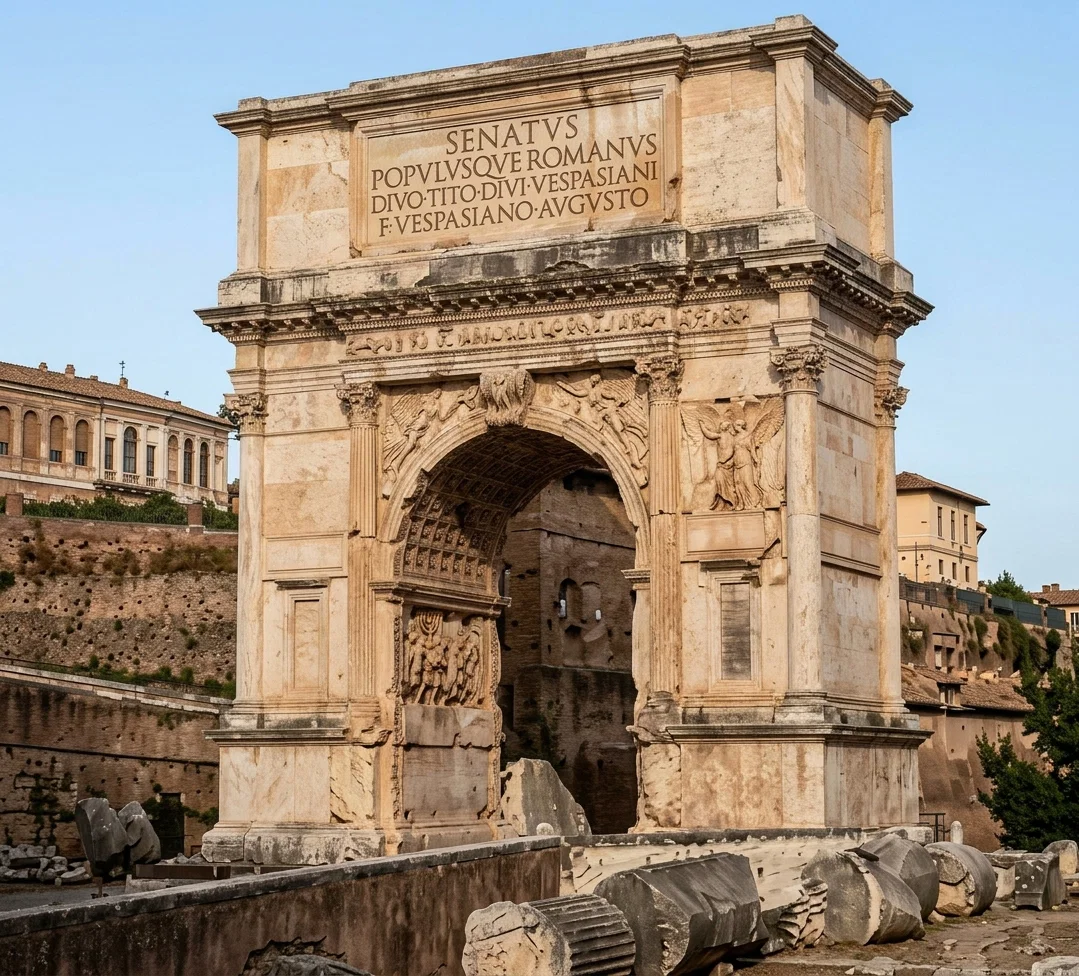
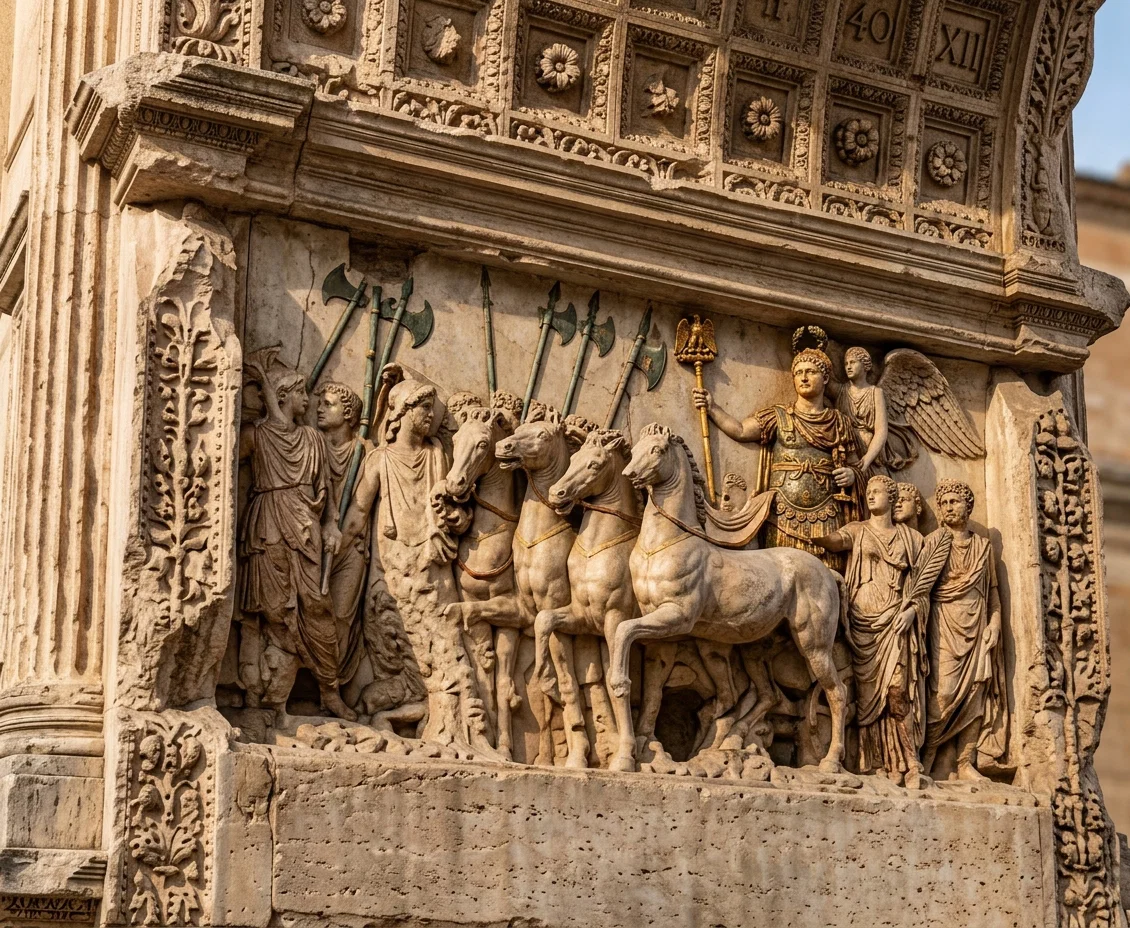
A relief on the triumphal Arch of Titus, representing victory crowning the Roman general.
Rome and the Stone Kingdom.
And the fourth kingdom shall be strong as iron: forasmuch as iron breaketh in pieces and subdueth all things; and as iron that breaketh all these, shall it break in pieces and bruise.” Dan. 2: 40. Great had been the power of the Macedonian phalanx; but greater still was the strength of the Roman legion. The Romans came on from the west like an irresistible storm; and the remaining fragments of Alexander’s empire were torn from their places of dominion. Death had hardly seized hold upon Alexander before his would-be successors beheld a new power asserting itself upon the seven-hilled city of Italy. The Eastern world soon heard the splash of oars upon the Mediterranean as the Roman triremes sailed away to the conquest of northern Africa and Spain. The struggle with Macedonia could not long be delayed. In the beginning of the second century, Rome, upon the pretext of friendship to a smaller power, imperiously interfered in Grecian affairs. War was declared; and upon the battle-field of Cynosphaelae in 197 B.C. the Macedonian phalanx went down before the Roman short sword.
The Government of Municipalities.
Two or three more important battle-fields, and the Eastern world became Roman territory. Over all their conquests in the East, as well as in the West, Romans extended a new and peculiar form of government. “Forasmuch as iron breaketh in pieces,” were the words of Daniel to Nebuchadnezzar. The Roman Empire, according to the famous historian Guizot, was a collection of municipalities. A municipality is the form of government for a city—not for a state or nation. The force sending out the legions to conquest, was, not a Nebuchadnezzar, nor a Cyrus, nor yet an Alexander. It was a municipality—a city government so thoroly convinced that its own form was the only enduring one, that it modeled all its conquests after itself. The world was therefore broken up into municipalities.
A Divided Kingdom.
Rome was deceived, however. The municipal form of government proved no more eternal than the empires of Greece or Babylon. “And whereas thou sawest the feet and the toes, part of potters’ clay, and part of iron, the kingdom shall be divided; but there shall be in it of the strength of the iron, forasmuch as thou sawest the iron mixed with miry clay.” Dan. 2: 41. There is only one force which can establish a nation—the truth of God. Practically all the conquests of Rome had been made before the birth of Christ. It was then ready for the Gospel. The Gospel would have solidified it and would have made its power enduring. But Rome rejected the Gospel. In the persons of the apostles and saints, it persecuted the Lord Jesus Christ. Morals declined, vice increased, the sturdy character of the people became undermined, and the empire was shaken by the strife of contending rivals. Eventually after many adjustments the imperial power was split in two and the Eastern and Western empires arose.
A house divided against itself can not stand. Ruin soon followed division. “And as the toes of the feet were part of iron, and part of clay, so the kingdom shall be partly strong and partly broken.” Dan. 2: 42. As the iron descends toward the toes, or as the empire approached the days of division into ten kingdoms; the elements of weakness, represented by the clay, began to appear. Great masses of men, barbarians, issuing from the forests of the north, fell upon the Western Empire. Its early strength gone, it was unable to withstand the attacks. In A.D. 476 the Western Roman Empire passed away, its territory occupied by various kingdoms. England, France, Germany, Spain, Portugal, Italy, etc., etc., arose in harmony with the predictions of the Hebrew chapter.
Efforts to Reunite.
Daniel foretold the efforts to reunite these fragments. “And whereas thou sawest iron mixed with miry clay, they shall mingle themselves with the seed of men; but they shall not cleave one to another, even as iron is not mixed with clay.” Dan. 2: 43. Charlemagne, that grand warrior of the ninth century, sought by the strong blows of his battle-ax to drive back again into one the nations which had split asunder. That is why he founded in 800 A.D. the Holy Roman Empire. In vain. No sooner had his mighty7figure passed away than years of confusion followed. Seven hundred years later, Charles V sought to encompass the same object. Yes, Napoleon called him a fool to have failed in seizing the grand opportunity events offered him. But Napoleon himself did no better. Tho for twenty-five years Europe shook under the tread of the armies of this commanding soldier of destiny, nevertheless Napoleon founded no enduring empire.
The Stone Kingdom.
What was the difficulty?
“My kingdom is not of this world,” said Christ.
“Forasmuch as thou sawest that the stone was cut out of the mountain without hands,” cried Daniel to Nebuchadnezzar. The kingdom of Christ alone is eternal. Over none of the preceding empires was Jesus Prince and Ruler. Over one kingdom only shall Christ sit on the eternal throne of His right—the stone kingdom. This leads us to three considerations.
1. The stone kingdom is not Christianity.
Christianity is with us to-day; it is a force which is invisible, tho its effects may be visible. The stone kingdom on the other hand is, or is to be, outward, tangible, visible. The head of gold symbolized Babylon. The kingdom of Babylon was not an invisible force; it had its visible king, capital, territory, and armies. So did Medo-Persia, Greece, and Rome, represented respectively by the silver, brass, and iron. All this is not true, however, of Christianity as it dwells among men to-day. It is a spiritual power, mighty to be sure, but symbolized in no manner by the characteristics of the stone kingdom.
2. The stone kingdom is Christ’s everlasting kingdom:
The stone kingdom is not the United States.
Nor is it any other earthly nation past, present, or future.
All such nations have been set up by human hands. In particular the United States was founded by a Washington, a Jefferson, a Hamilton, and their associates. But of the stone kingdom, Daniel expressly declared “the stone was cut out of the mountain without hands.”
Moreover the stone kingdom is eternal. Of it the prophet said, “The God of heaven shall set up a kingdom which shall never be destroyed.” None of the four empires represented in the image itself were enduring; no reasoning can assure a better future to the United States.
There is only one nation that can be represented by the great stone. It is that everlasting kingdom of Christ, of which God declared, “Of the increase of His government and peace, there shall be no end, upon the throne of David, and upon His kingdom, to order and to establish it with judgment and with justice from henceforth even forever.” Isa. 9: 7.
3. The stone kingdom is near.
The complete fulfilment of the dream was not left to indefinite time. “There is a God in heaven that revealeth secrets, and maketh known to the king Nebuchadnezzar what shall be in the latter day.” Dan. 2: 28. The TIME of the events, as well as the events, of the future was clearly stated. We have seen set up the empires of Babylon, Medo-Persia, Greece, and Rome. Yes, we have seen set up the ten kingdoms of Italy, Spain, France, England, etc. Fourteen hundred years have passed since the date which history sets when the latest of these was set up. Surely we must be near the time for the stone to crush the image on the feet, to become a great mountain and fill the whole earth. Listen to the solemn declaration of Daniel: “And in the days of these kings [of the ten kingdoms] shall the God of heaven set up a kingdom which shall never be destroyed.”
Reader, the time allotted to the image has almost run out. Putting one hand upon Nimrod, the founder of the head of gold, and the other hand upon the second coming of Christ, the image spans a period of nearly 5,000 years. The universe pauses yet a few moments longer before the execution of the final sentence, “All is finished.” Precise signs, foretold by other chapters of Daniel and by Christ Himself, are sweeping across the face of each day’s record, to announce that the return of Jesus, the setting up of the stone kingdom, is impending. The movements of Providence await only one last act—the final preparation of those who shall be “alive and remain” (1 Thess. 4) when the Lord descends from heaven. It is for you that the Lord gave and interpreted the image. May you be ready at His coming.