BONDAGE TO FREEDOM

7%

Pacific Press Publishing Company · Oakland, California · Jul 6, 1904

FromSigns of the Times, Vol. 30, No. 27.

Read the full edition

BONDAGE TO FREEDOM.

BONDAGE TO FREEDOM
BONDAGE TO FREEDOM
FREEDOM is the watchword of the Gospel of Christ. Liberty is the purpose of its promulgation. With the freedom that human laws vouchsafe there may go that most terrible bondage, the freedom of sin. In the liberty the Gospel gives, the chains are slipped from the soul as well as from the body. In fact, the soul may be gloriously free, while as yet the body is chafed and bruised and bleeding from the chains and scourgings of oppressive human laws.
Liberty flows out of the Gospel like water out of the riven rock, like the river of mercy from the throne of the Eternal One. Is there a righteous law on the statute books of earth? The way for it was chiseled through the rock of oppression by the very hands that to-day in heaven bear the cruel nail-prints of human oppression and bigotry. That precious privilege for which the martyrs died; that sent the pilgrims across the stormy seas to the unexplored land of the free, with all the ties of earth broken and flung to the pitying winds; that privilege for which every soul cries out when it has learned the lesson and the joy of true worship; that privilege—freedom to worship God—is a fundamental bequest of our crucified and risen Saviour.
But even before our Redeemer burst the shackles of the tomb, the machinery of Satanic malice was set in swifter operation to crush out more effectually that hope of the race. So we find the trembling disciples gathered behind closed doors “for fear of the Jews.” So we find that stalwart Christian, Stephen, paying with his life for the exercise of his Gospel-given freedom of worship. So we find the disciples and the early believers “scattered everywhere” by the persecution that raged in Palestine after the resurrection of Christ. And so we find Saul “exceedingly mad” and “breathing out threatenings and slaughter” against the believers in Christ, who chose to worship in accordance with their belief.
But that was the religion of ceremony, warring against the religion of soul; and wherever religion has deteriorated into form and ceremony it has found use for invective, hatred, “threatenings and slaughter,” with all the body-bruising accompaniments of thumbscrew, rack, fire, and dungeon. In proportion as the light of the Gospel of Christ has permeated the darkness of this world, those instruments of oppression and that unchristian spirit have slunkaway into the darkness, their native habitat.
Following the persecution of the early Christians by Jewish officials came that organized and legalized oppression of centuries under the iron monarchy of Rome, with occasional rifts of light followed by denser gatherings of the clouds of darkness. Then came that long, unrelieved, persistent campaign of a backslidden church with a formal religion to grind down, and, literally, in the language of God’s Word, “wear out” the company who clung to their God-given bequest of religious freedom. That was a terrible struggle—a long struggle in the darkness, out of which there come but faint sounds to tell of the cruel work that was being done. Then the dawn of a new day began to break, and O, what a record that long, pitiless night had made for itself! What myriads of human lives snuffed out in the name of religion because men, claiming to be Christian, would not hear the voice of Christ, would not heed the precepts which He enunciated, would not practise the principles which He in love pronounced!
In the dawning of that day God opened a door in another land—opened it and flung it wide, as wide as the great sea that rolled between the land of “civilized” savagery and the land of the untutored savage. That highway to liberty was lashed by no gale so fierce as the storms that surged over Europe, seeking to drive upon the rocks of death every mariner who sought to guide his bark into the true harbor of refuge. The wildest sea is merciful beside the wrath of him who pretends to sit in the place of God. If God had treated men as men have treated each other, the race would have perished in the ages agone. But because of the great love wherewith He loved us, He has given us over and over again the principles of love and justice and truth and mercy and liberty. He not only gave us those principles in written form, but sent One to us, to be with us and among us, who Himself was those principles incarnate. His mission was to free men in the kingdoms of this world and to save men out of the kingdoms of this world, so they might enter the kingdom of the eternal world; and incidental to that mission was the teaching of men, how to conduct themselves toward their fellow-men. His personally-illustrated principles of doing for another what we would have another do for us, is but the principle of Gospel liberty at work.
He taught men that, and some of them learned it. But some of those who sought liberty in the New World had not learned it. They would turn the shrine of spiritual, soul liberty into a shambles of corporeal oppression and soul imprisonment. They would shackle the soul and put a padlock on the door of the mind, and establish their own Dark Ages at the very portals of liberty. But God would not permit that thing to take root here. The waves of ecclesiastical domination over the conscience and the soul had reached the shore-line beyond which they might not pass.
When that new nation arose out of the soil of liberty-hunger, some had learned the lesson for that day; and in the same precious document, in which they declared their bodily freedom, are set forth the principles of equality and justice, which the Word of God made known to the world. “We hold these truths to be self-evident, that all men are created equal; that they are endowed by their Creator with certain unalienable rights; that among these are life, liberty, and the pursuit of happiness.” That the men who established this nation intended that “liberty” to cover the liberty of conscience is shown in the first amendment to the Constitution of the United States: “Congress shall make no law respecting an establishment of religion, or prohibiting the free exercise thereof.” That was the principle upon which the nation stood. That the states have not always recognized the principles laid down in the Declaration, nor practised those declared in the national Constitution, is a matter of deepest regret. When state laws have permitted the fining and imprisonment of men for the peaceful exercise of their religious faith, they have been following the example of ancient papal states more than the principles of their own great Declaration and Constitution. It is the justice of the great principles then announced to the world that makes the fourth day of July a day worthy of memory. Such principles are eternal. They will shine with undiminished splendor when the very memory of bigotry, oppression, and soul-slavery has perished from the rejuvenated universe.
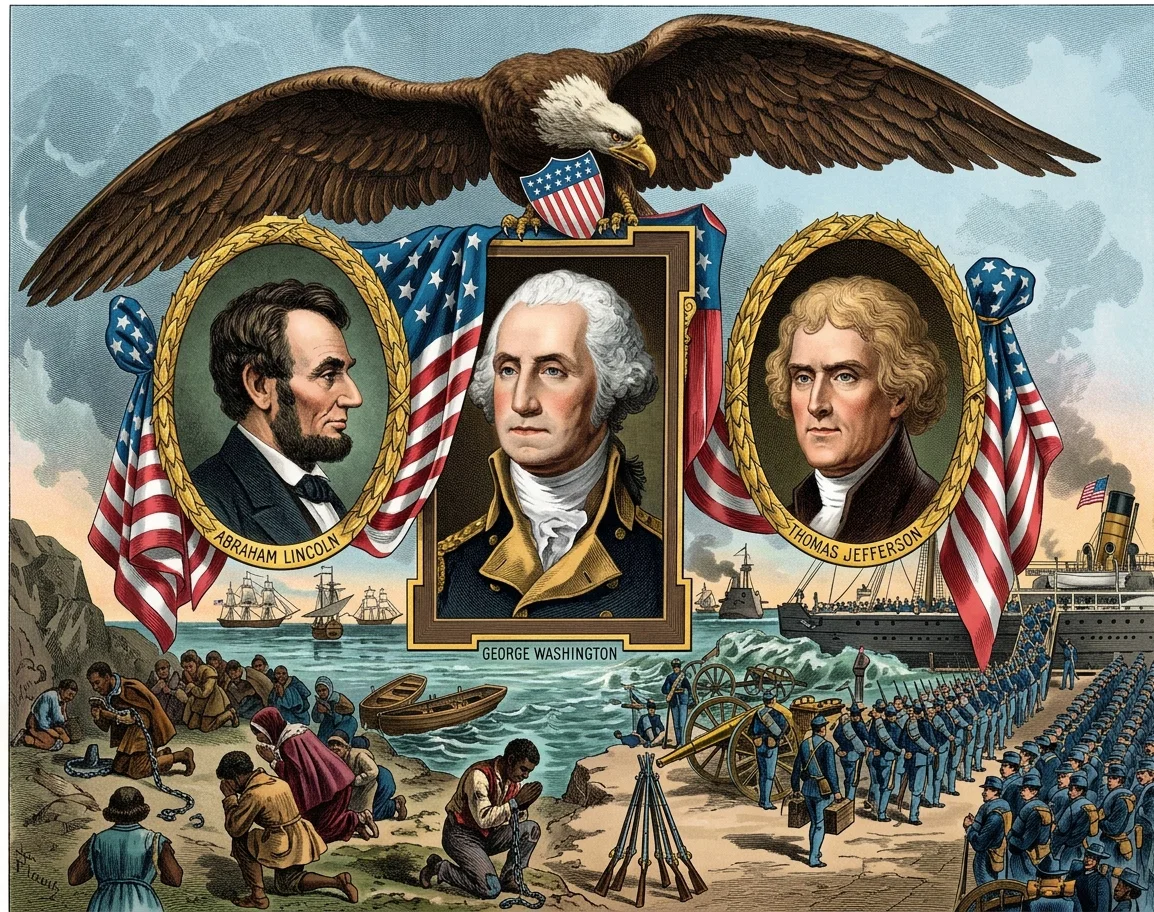
But there is a sad picture that presents itself before our eyes to-day. It is hinted at in the picture on the preceding page. It takes less than three hundred years to span the gulf between the thanks-giving pilgrims, who have found freedom on the New England shore and the embarkation of American troops to subjugate a race of people on a far foreign shore. Certain it is that the sun has turned backward on the dial, when America, the cradle of Liberty, rules a subject people in a foreign land, and takes from them the right of trial by jury—the very thing against which the Declaration of Independence protested to the world in 1776, and still protests—the very thing which the Constitution promised to all the people of the United States, and still promises.
The names of Washington and Jefferson and Lincoln are inseparably linked with the righteous foundation principles of the United States Government. On these principles they stood, and for them they labored. The nation can not repudiate the principles without repudiating also the memory of the men who gave their all in their defense.
The New World set before the Old a worthy example, a noble influence, in the matter of human rights; and that example and that influence have done much to ameliorate the conditions of the common people in the Old World; but the nation has drifted far from those righteous principles, and set its face toward the East, to follow the example of that other republic which ruled nations outside its borders and went down to ruin.
And in these latter days this same nation does in effect what its Constitution forbids,—establishes religion by ruling of its highest authority. That lowers the standard of the nation to that of the states in the matter of religious legislation. So we see a sweeping retrogression along both lines back to the principles that were dominant in the world before Columbia’s light was set upon its lofty tower. Does it mean a return of religious intolerance? There will come a time when this nation will “both speak, and cause that as many as should not worship the image of the beast should be killed.” Rev. 13:15. That is religious oppression, and that language is used concerning the nation in which we live. From oppression to liberty and back again is the prophetic outlook for this country, and the trend of events shows that the prophecy is true. It is a time for the Christian to have to exercise, and to teach, the principles of true liberty of body and soul as never before, that the world may see and choose which it will have, freedom or bondage, light or darkness, life or death. C. M. Snow.