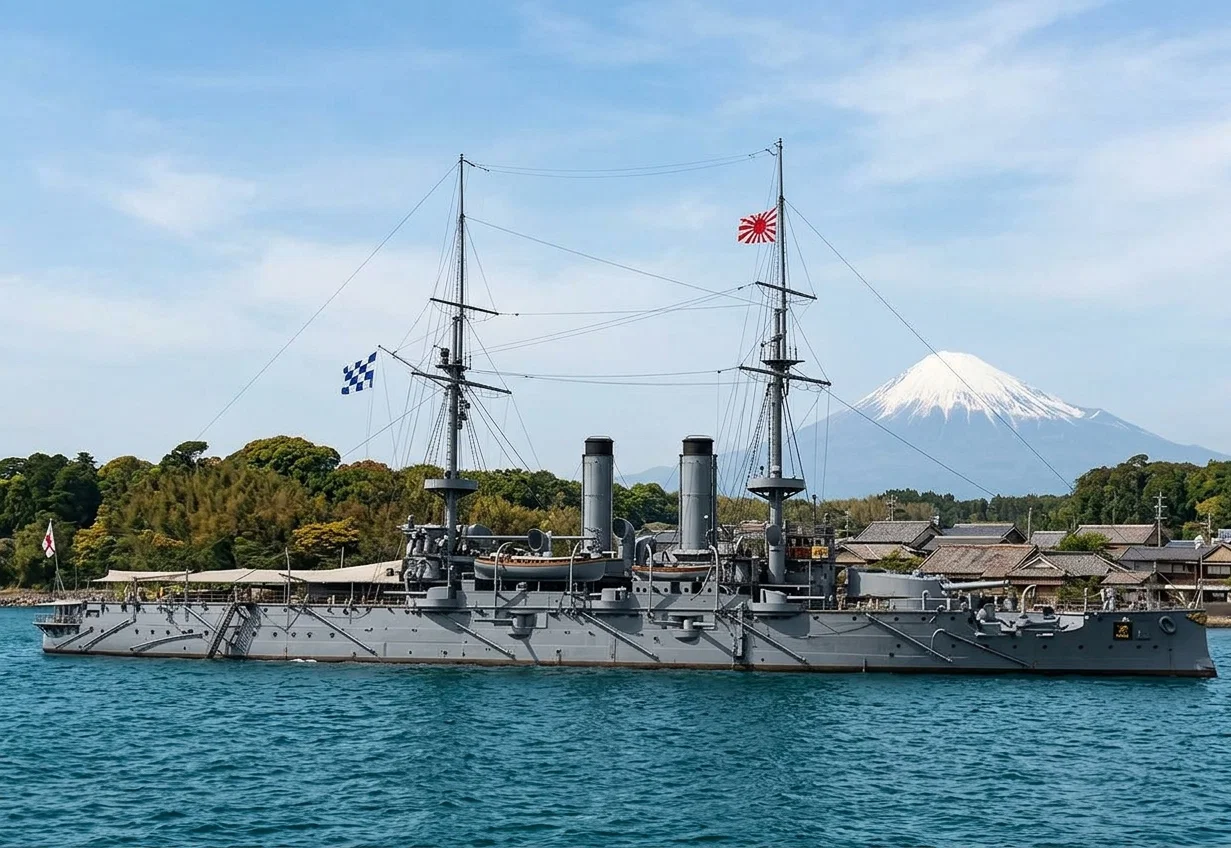
THE morning was beautiful. The first thing that attracted our attention was the presence of Mount Fujiyama, the tallest mountain in Japan, standing out boldly far above everything else. It is snow-capped, and this is very rare in such a warm climate. It is 23,950 feet above sea-level, and about twenty miles from the shore. We could see it sixty miles away. A native will take you to the top in five hours, descending in one hour. There are twenty active volcanoes in Japan, and about eighty mountains that have been volcanoes. Earthquakes are very common in this section of the country.
We were not out of sight of land all day. We arrived at the quarantine station at Kobe, and were inspected for disease, before our boat could go up into the harbor. We then anchored about one mile from the harbor, as the water is too shallow for our large steamer to go nearer. Dr. Lockwood came out to meet us, and found our company waiting anxiously for him. This was the stopping-place of Mr. and Mrs. Reese, who had come from Oregon with us to join Doctor and Mrs. Lockwood in their work at Kobe. Going ashore, we passed our empty grips before the customs, having taken them to carry some provisions back to the ship, as so much flesh food is served aboard the vessel.
Doctor Lockwood hired several jinrikishas to take us to the sanitarium. Here the stores looked better than those in Yokohama, and articles of all kinds were much cheaper. The Japs paced right along until we came to the bottom of a hill, where we had to get off or pay extra to be drawn up. They drew the ladies up the hill, and we walked. It was too dark to get a good view of the sanitarium. It is a two-story building above the basement, thirty by sixty feet; has two verandas in front, extending the whole length of the building, one on the first floor, and one on the second. The inside is very artistic. It is finished in Japanese style, and has American furniture. The first floor is occupied by the office, waiting-room, dining-room, kitchen, and storeroom. The second floor has four rooms for patients. These rooms are large and well-furnished. The bath and massage rooms are also on this floor. The sanitarium is located at the foot of the mountains, and in the city. Kobe has a population of 300,000.
The great Japanese battle-ship Fuji, the largest war-vessel of that country. To be an officer on such a vessel is the highest aspiration of the Japanese navy boys.
When we returned to our boat, we found that the passenger ladder had been lifted, and that they were about to leave. We became a little excited, and had to climb over the freight cargoes, and go up on the freight ladder, but were soon on deck, safe. We understood that the boat was to leave at 3 A. M., but it was billed to leave at 1 A. M., and drew out within twenty minutes after we got aboard.
We awoke the next morning about six o’clock. Looking out, we saw mountains on both sides of us. These did not have that rough contour of the mountains in America, but the land was cultivated. It was divided in terraced plots. These were covered with green vegetation. The plots vary in size, from a quarter of an acre to an acre and a half.
The crops are cultivated and cared for by hand. Some are in blossom, while others are ready for harvest. Here no land is wasted. A great deal of labor is placed upon it, and no weeds are allowed to grow.
If you could imagine a mountain covered with from seventy-five to one hundred flower beds similar to those you see in the parks, you could not do justice to the scenery that we have witnessed for miles along the coast. Every little while we see a lighthouse, as white as snow, on some prominent point, and little villages of a dozen to thirty houses, built on the rustic order. A railroad ran near the water’s edge. It was similar to an American railroad, and the trains ran with about the same speed. There were several cement factories along the coast.
The Japanese have some of the best fortresses in the world. They have guns forty feet long, with a bore of ten inches, and weighing one hundred and ten tons, located at strategic points in their straits.
All day we have met an immense number of fishing boats. At one point we counted one hundred and twenty-five of these sailboats. Some of them are rather large, and are on the rustic order, the same as the old style of houses. But the government is anxious to become modern as fast as she can; so will not permit any more of these to be made, but requires modern ones. Modern homes are also being built, and every native is anxious to learn the English language. In fact, things are changing very fast in Japan, and in many respects it appears as a modern country.
Our vessel had to pass through the narrows this evening before dark, or she could not have gone through. It is a narrow strait where the tides meet between two islands. It is called Shimonoseki Strait. Here on each side are the strongest fortresses on the coast. The ground is all undermined, and the guns are hidden from sight. It was at this point that Li Hung Chang was stabbed during the late war with China.
At Nagasaki, Japan, we took a launch and went to the post-office, then made a bargain with the Japs to take us to their famous temple. They asked fifty cents, but finally accepted thirty. On the way we had opportunity to see more Japanese stores and many new things. Nails, pins, and tacks are sold by count, and eggs by weight. There were very few saloons. There were numerous peddlers on the street, who carried their goods on their shoulders to a large pole with a pail attached at each end. The fish markets are the largest meat markets, and the fish vary in size from minnows to those six feet long.
The minnows are dried and sold by weight. There were all kinds of crabs, and another fish they called the octagon, which looked like a dragon fish.
Here we got our English money changed into Japanese. As we did not have any friends in this place, we had to buy our own goods. They charged fifteen cents on the dollar for exchanging English money, and five cents for United States money, and there is more of the latter used in this country. At a vegetable store we bought some pomegranates and radishes. In Nagasaki we noticed blacksmiths using American tools for making boats; and in a tin-shop about the only tools for making cans were a hammer, soldering iron, and anvil.
Reaching the temple, we had to climb two hundred stone steps, as it was on the side of a mountain. In the court which led to the entrance were several Japanese documents written on boards, containing the history of some of their gods. On each side were Japanese scrolls. In this court was a stone trough containing dirty water, from which all the people drank, and around which hung their prayers written on flags. These were about one hundred13feet, and of many colors. We saw a woman take her child, and place one of these flags over its head, and then walk away again. General Grant visited this temple in his trip around the world. The shrine had a small red flag and a large white one in front. These were gods, and the white one was the god of sorrow. We took off our shoes and walked up to the door, but could go no farther. There was an altar with several candles upon it, and a screen behind which no one but the priests could go.
From this point we could look down upon the city. The view was a pretty one, as the city lies in a valley, and there are mountains on the other side covered with terraces.
We reached the boat at 3 P. M., and watched them loading coal. Ladders were fastened from the boat down to the coal barges, and men, women, and children passed the coal from hand to hand in rapid succession, with baskets holding about two scoop shovels full. They loaded fourteen hundred tons in three hours. It is a wonderful sight to see them do so much by hand. We left the harbor an hour later. We passed the rock from which the first missionaries to Japan—twenty in number—were thrown off and murdered. It is surrounded by water, and stands one hundred feet high. We soon came out of sight of land, and were on our way to Shanghai.