LETTER FROM ARGENTINA

6%

Pacific Press Publishing Company · Oakland, California · Aug 17, 1904

FromSigns of the Times, Vol. 30, No. 33.

Read the full edition
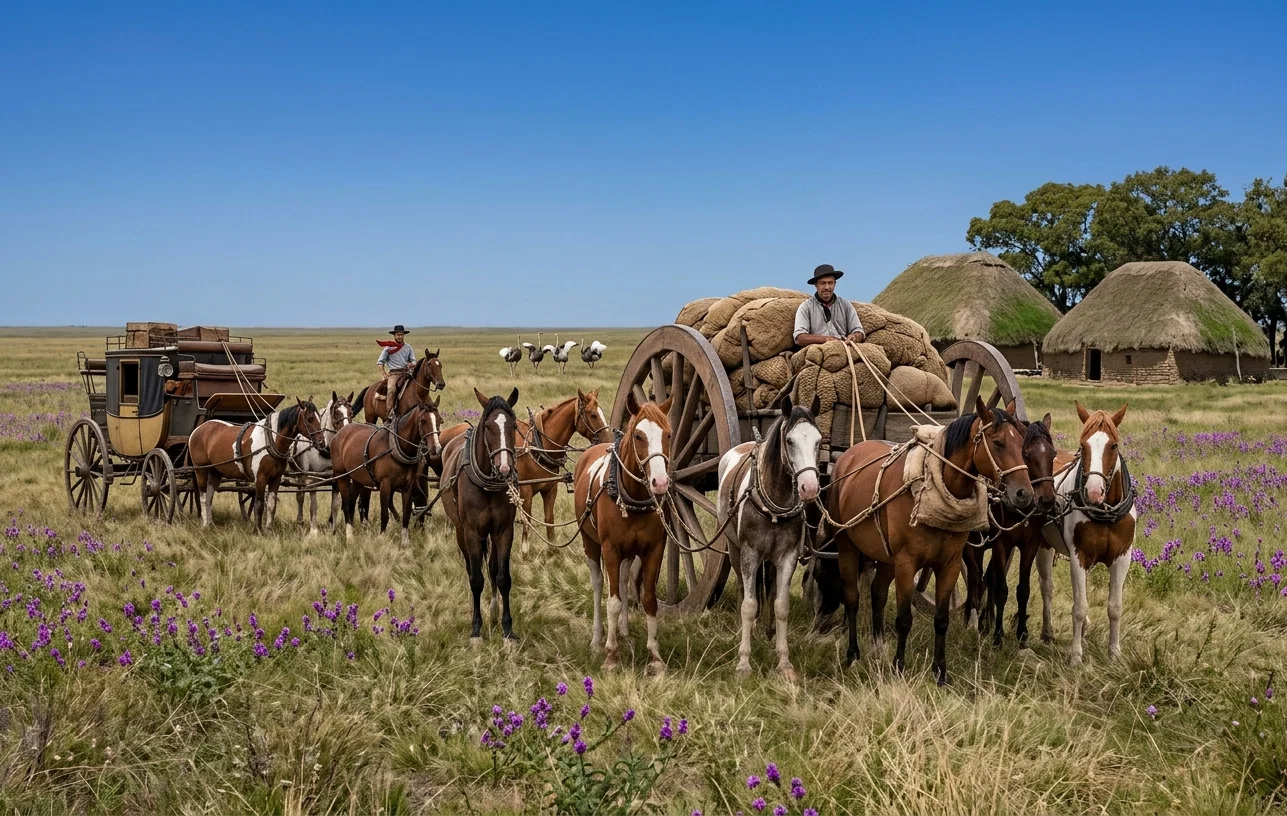
Country Scene in Argentina.

LETTER FROM ARGENTINA.

Going to the City.
BY SADIE R. TOWN.
Imagine yourself upon boundless plains with the bluest of skies over your head, coarse grass and wild verbenas under your feet, red-breasted birds rising to greet the morning sun, and an occasional owl circling over your head with protesting scream. The coach rocks from side to side in a manner alarming to the uninitiated, as the horses plunge on at full gallop over the uneven roads. For a while the motion, the pure air of the camp, and the gladness of nature are exhilarating, but after a time one wearies. Reading is impossible. Of scenery there is little change. The few horsemen one meets rock along on their ponies jauntily enough, the never-failing neck-cloth fluttering after them in the breeze, and the ostriches, surprised into flight by our approach, display a white plumage underneath the lifted wings, which transforms them, in our eyes, in spite of ourselves, to women picking their way through the tall grass with white under-skirt exposed to view. This is riding through the camps in Argentina. The country is very thinly settled, being new, and our coach stops only twice, for change of horses, in making twenty-five miles to the nearest railway station. As we draw nearer the town we pass loaded teams going in the same direction. The accompanying cut will give an idea of their appearance. Quantity, not quality, in horse-flesh seems to be regarded here. It is amusing to see the number of horses, large and small, old and young, of all colors and conditions, which are ingeniously attached to a cart designed to be drawn by one. One poor horse has an old sack fastened round the neck, and draws by means of a rope fastened to the same. Another is saddled, and attached by a strap from the saddle, etc., but all are abreast. The ox-carts, however, are really picturesque. Being raised up into the world on wheels ten feet in diameter, they are rendered so conspicuous as to justify the fanciful coat of paint nearly always bestowed upon them.
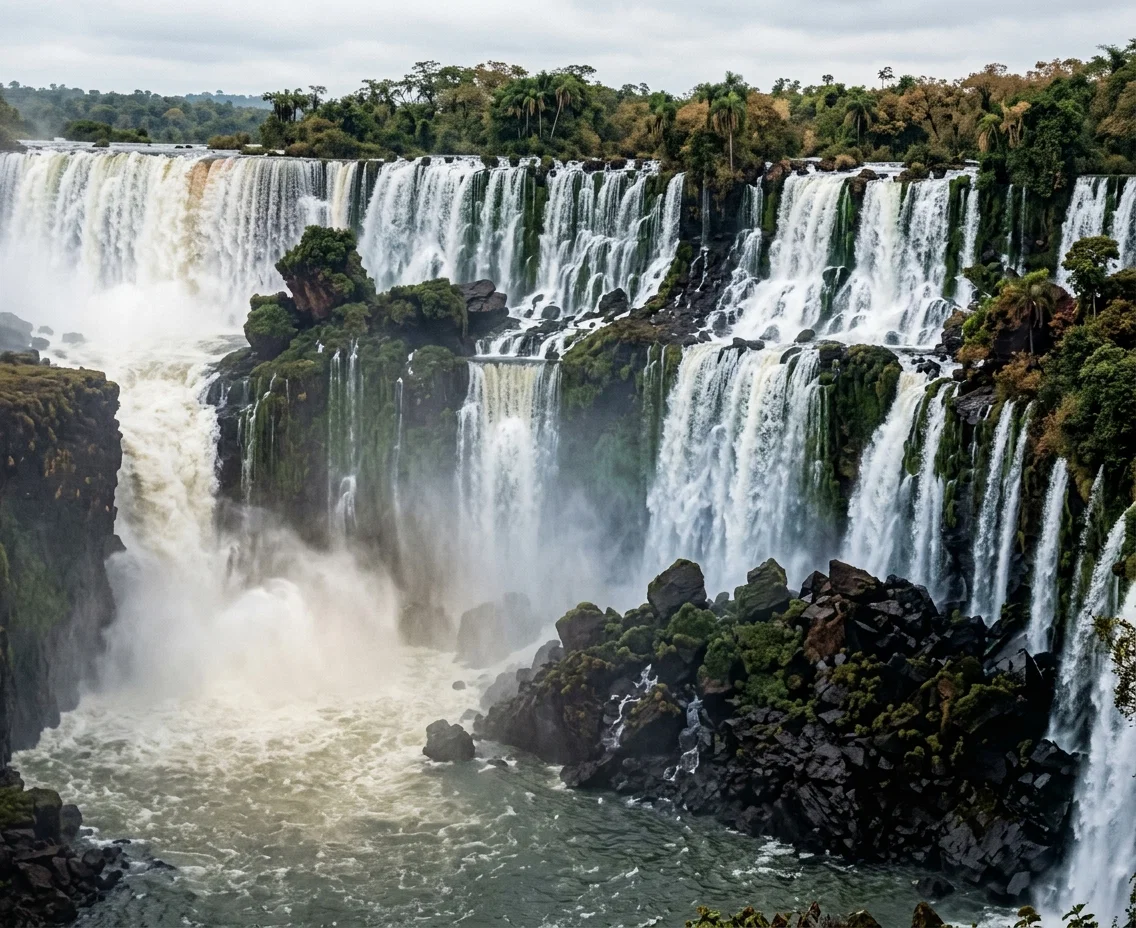
Iguasu Falls, Misiones, Argentina.
At last we arrive in the village and take lodgings in a hotel to await the next morning’s train. Our room is very plainly furnished, but does not lack the soap and water so grateful after a dusty ride.
In other parts of the world we should wonder at having to repair to town for fruit, fresh butter, eggs, and vegetables, but such is the case here. In the camp towns, meat, maté, and hard biscuit are all that can be depended upon, altho other things garnish the board at times. So, after lunching lightly on what is set before us, and taking a short stroll, we retire for the night.
And right here let me say that the traveler who finds his bed entirely unoccupied, and is able to rest all night in it, and get up refreshed in the morning, is fortunate indeed.
The journey by train presents the variation of wayside stops where the arrival and departure of the train is the event of the day, so that the town is pretty well represented on the platform. The predominating element, until one nears the larger towns, is the top-booted, slouch-hatted camp man, riding-whip in hand, but there is an intersprinkling of ordinarily-dressed men, bare-headed women, and dogs. This reminds me of the salutation one invariably receives upon riding up to a country house. Such a stampede of large, ferocious, vociferating canines makes one very glad that he is high enough to be out of reach.
The pace of the train inclines one to walk a while to economize time. On some lines the trains make but fifteen miles an hour, and it is no uncommon thing for them to slacken this speed (!) that the grazing herds may escape from the track, warned by the engine’s whistle.
We are glad of a change when the time comes to transfer to a river steamer; and altho the craft suffers in comparison with our luxurious appointments at home, the rest of the journey is much pleasanter. Here are clean, comfortable cabins, room to roam about, ten-course dinners, awn-covered decks, and large, comfortable salons with tables and chairs, and musical instruments.
Our fellow passengers are bent on business or pleasure. The ladies are stout, stylishly dressed, but with too much evident consciousness of their personal appearance, and satisfaction therein.
Several families are on their way from Paraguay, having spent the colder months (June, July, and August) in that favorite winter resort. They can not say too much of the beautiful, wooded hills and dales where swarms of gorgeous butterflies precede the forest rider, and animal and vegetable life abound in greater variety. They have also visited the Iguazú Falls in Misiones, of which we have heard so much, and which are said to be “finer than Niagara.” The river is about three miles in width, but the falls are divided into three parts by small islands. Their exact height does not seem to have been determined, as in descriptions of the Falls, it varies from 150 to 200 feet. Of course, they will become more popular as they become better known and easier of access.
We are not alone upon the water now, and the farther down the Paraná we proceed, the more animation and life is displayed until we begin to feel that we are getting into the current of the world’s stir and bustle.
Upon attempting to rise the next morning, a feeling akin to sea-sickness takes possession of us, and looking from the cabin window we see that our river of the day before has widened into an apparent sea, upon which the wind is raising waves of sufficient size to account for our feelings. We lie down again to wait until we get a little nearer shore before attempting to dress, for it is nearly time for us to round into the port of Buenos Aires. Having passed the point where the waters of the Paraná unite with those of the Uruguay during the night, we are now on the broad bosom of the River Plata which is here thirty miles wide.
When we go on deck, the water is alive with craft, small and large; the white buildings and murky atmosphere of a city are plainly visible; and in half an hour’s time we are swinging into dock.