WONDERS IN THE HEAVENS

6%

Pacific Press Publishing Company · Oakland, California · Dec 30, 1903

FromSigns of the Times, Vol. 29, No. 52.

Read the full edition

"WONDERS IN THE HEAVENS."

ONE of the precursors of the great day of God, as given by the prophet Joel, is “wonders in the heavens.” The passage in which it is found reads as follows:—
“And I will show wonders in the heavens and in the earth: blood, and fire, and pillars of smoke. The sun shall be turned into darkness, and the moon into blood, before the great and the terrible day of Jehovah cometh.” Joel 2:30, 31.
The darkening of the sun occurred, as also definitely predicted by our Lord in His great prophetic discourse (Matthew 24; Mark 13), May 19, 1780. The night following, the moon, whenever it appeared in the overwhelming darkness, had the appearance of blood.
The blood and fire and pillars of smoke are common graphic appearances of various electric and light phenomena, manifest especially in the aurora borealis, the marvelous forms of which have excited alarm, wonder, admiration, and curiosity of earth’s children during the last century or so; for it is only in later times that these wonders have become manifest, evidences of decay, disintegration, and disturbance in the earth and its atmosphere. God inspired their prediction more than twenty-five centuries ago in His Word; He is confirming that Word by hanging these predicted signs in the heavens.
As Seen in Choteau, Mont.
As Seen in York Harbor, Me.
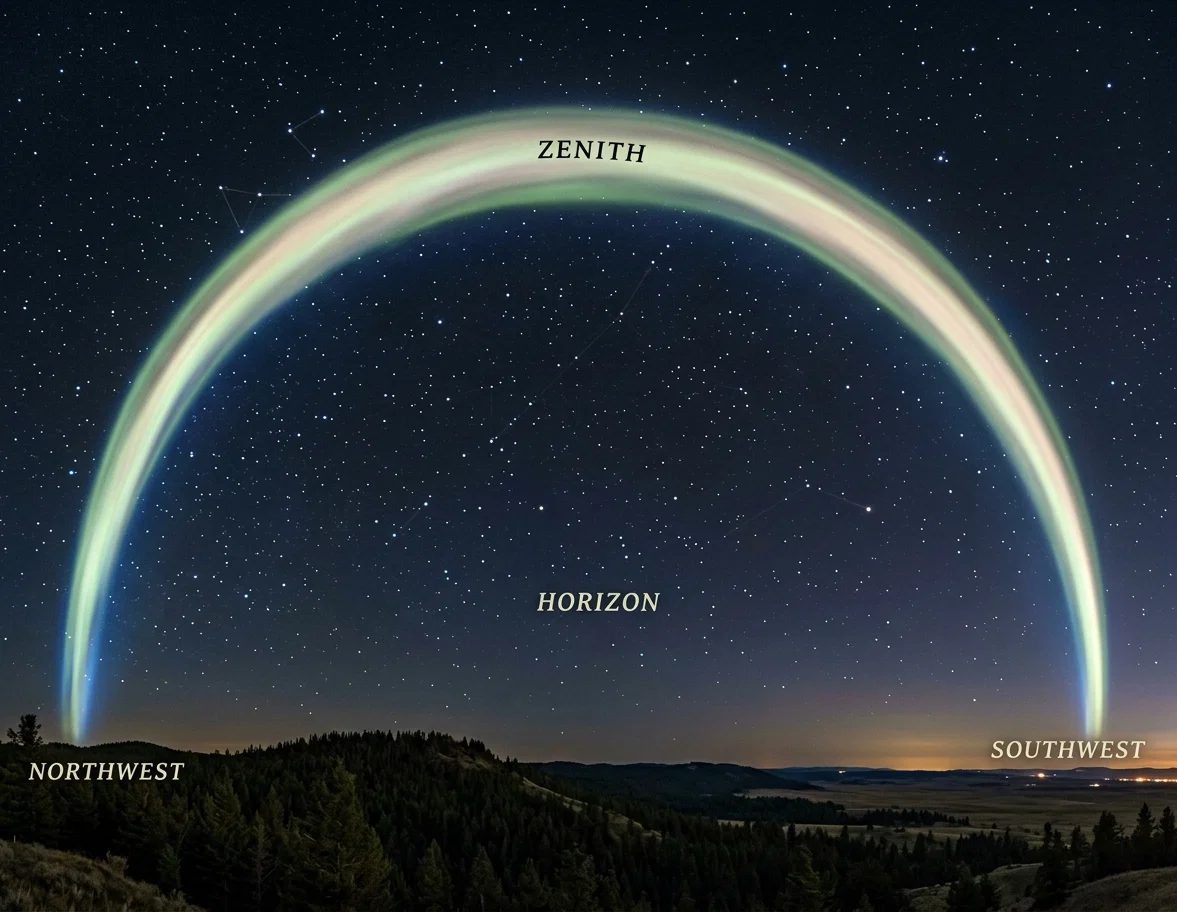
A remarkable wonder worthy of note occurred last August. A correspondent wrote us from Choteau, Mont., under date of August 24. This wonder, our correspondent, Mr. W. H. Holden, tells us, was seen by him August 25, 10:15 P. M. It consisted of a clearly defined band, or belt of light, extending athwart the heavens from the northwestern to the southwestern horizon, “passing directly overhead, and cutting the heavens into two equal parts. At the zenith it seemed a little wider than the disk of a full moon when half an hour high, and tapered toward either end.” The edges were clear cut and regular. There was no moon at the time. As the time passed (Illustration No. 1 is from a rough drawing furnished by Mr. Holden), the north end swung slowly to the west, as if moved by a gentle breeze, but did not break. “After maintaining its appearance for nearly an hour, it suddenly began to fade equally throughout its length, and in about ten minutes it had entirely disappeared.”
The Great Falls (Mont.) Tribune of August 22 declares it to be a path of light left by a large fire ball which passed across the heavens. This streak of light was at first deep red in color, gradually growing fainter. But the Tribune must be mistaken.
Those witnessing the phenomenon in Choteau, fifty miles away, declare that two blades of light shot up from the horizon, as though projected by a searchlight, and met in the zenith.
A similar phenomenon was witnessed at York Harbor, Me., on the same night at 9:30 P. M., preceded by an ordinary display of aurora borealis, which gradually faded. The one who records this, Dr. A. F. A. King, in the Popular Science Monthly, for October, thus describes it:—
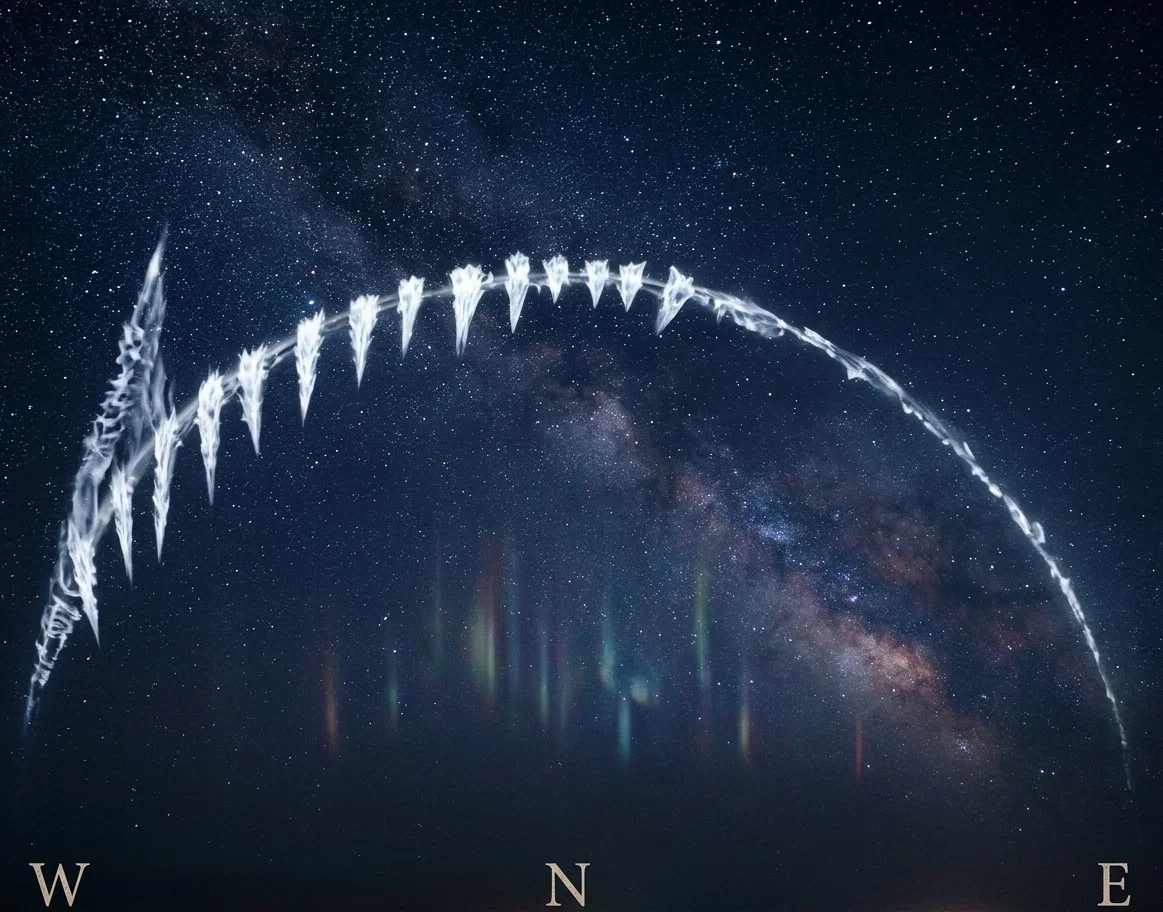
At 9:30 P. M. there appeared a magnificent arch spanning the heavens from east to west, the top of the arch being a little north of the zenith, and almost overhead. As shown in the diagram at least three-fourths of the eastern half of the arch consisted of a pale, only half-luminous column of visible streaks, the band being perhaps as wide as the diameter of a full moon appears to be. The western segment of the arch presented a most extraordinary and magnificent spectacle. [See cut No. 2.]
Beginning a little east of the zenith and continuing almost to the western horizon, there appeared what might easily be likened to a string of tremendous comets. These pennants of light, however—unlike comets—were more brilliant at their bases, less so at their apices. Their bases were directed upwards, their points down. They were constantly changing, appearing and disappearing, but not very rapidly.
At the western end of the arch, one long, half-luminous streak shot up obliquely (as shown in the figure) and remained some minutes after the arch had disappeared. The arch lasted from 9:30 to nearly 10 P. M.
No visible connection existed between the arch and the nebulous masses and streaks of light near the northern horizon.
In looking at the diagram the reader may well conceive it to be too toy-like and artificial to come within the range of truth or possibility, but so was the arch itself. No one could have conceived such a display to be either natural or possible. To some it suggested a festive arch adorned with luminous cornucopias, like a Christmas decoration. Those of us who for a few weeks before had obtained telescopic views of Borelli’s comet with some difficulty, seemed now to be rewarded by nature exhibiting a whole string of far more brilliant comets for our special delectation. The kind and degree of luminosity appeared to be almost exactly like that of the comet when seen through a good glass.
The splendor and magnificence of the display were beyond description; startlingly beautiful. The spectacle seemed almost to overstep the modesty of nature, but its coming unheralded during the majestic silence of night served to banish so unjust a thought. Surprise, delight, admiration, and awe—these were the feelings which thrilled with pleasure those of us who witnessed the sublime and mysterious scene.
Mr. J. N. Loughborough, in his book, “Last Day Tokens,” mentions a similar phenomenon which occurred in 1843, and the writer remembers when a child (1861 probably) of seeing an arch of light spanning the heavens from east to west, and lasting for some time, of the seeming width of the face of the full moon and uniform throughout. These are among the many tokens of the soon-coming day of God, when before His face the very heavens shall seem to be rolled up as a scroll, and all nature marred by sin shall crumble in His presence.