Curses come because blessings are misused. It is not pleasant to listen to the pronunciation of penalties; it is less pleasant to be serving time, as the human race is doing in the earth to-day. It is not pleasant to look upon pictures of crudity in grinding toil, and still they tell us by contrast of another kingdom, of a better past and a more glorious time that is yet to be. We gaze on this hard picture, and we know that it is outside of the purposes of God. We see this break in Divinity's plan of good, and we are reminded of the reason for the curse—reminded of the cause of our race's incarceration in this workhouse of the king of sin. “In the sweat of thy face shalt thou eat bread” was not God's original purpose for man, but a consequence of sin. That consequence still follows, and the sweat-drops of a race are drenching to-day the treadmill of their toil. There was a blessing even in that consequence, for idleness is a greater curse than hard work, especially when the seed of sin has sprouted in the heart. From famine-stricken Finland down over the whole circle of the globe to far, shivering Patagonia, a race is now serving time and taking its dole of bread.
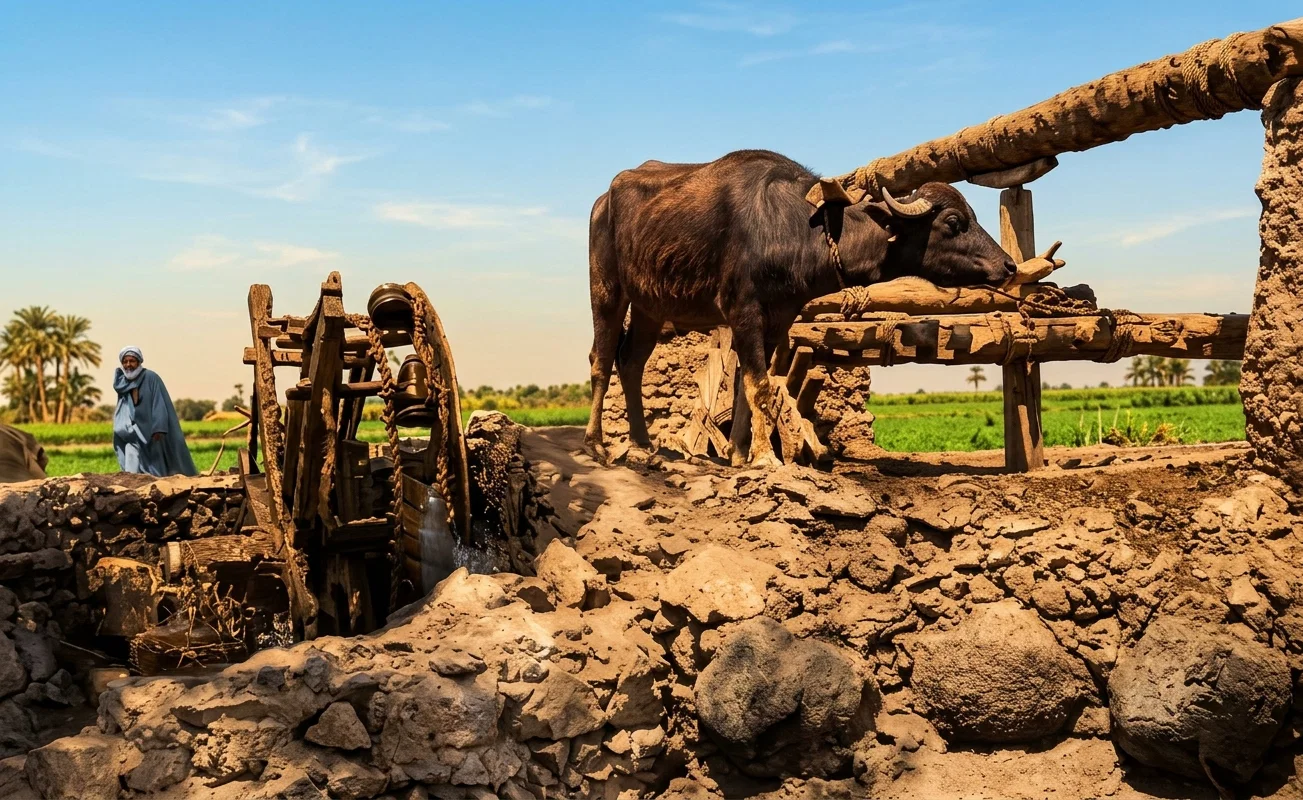
PUMPING WATER IN EGYPT.
While gardens still bloom in many a clime, there are countries upon which the load of the curse rests down with crushing weight, and Egypt is one of these. Again and again God has pronounced judgment upon Egypt—not because He would not save souls in Egypt, but because the people of Egypt clung to their idols and their sins. Neither was there partiality in this; for upon His own recognized people, God pronounced judgment when they clung to the idols and to the sins they had learned in Egypt. God had commanded them to forsake their Egyptian idolatry; but He declares: “They rebelled against Me, and would not hearken unto Me; they did not every man cast away the abominations of their eyes, neither did they forsake the idols of Egypt. Then I said I would pour out My wrath upon them, to accomplish Mine anger against them in the midst of the land of Egypt.” Eze. 20:7, 8. God led them out of Egypt to a land of liberty and blessing; their idolatry led many of them back to the land of oppression and the curse, to be buried in a hopeless grave in the very land from which Israel prayed that his bones might be taken when his children should return to the land of promise.
Because of Egypt's iniquity and her oppression of the people of God, the judgments of the Lord were pronounced upon her. From being one of the mightiest of the nations she has come to be the least. Her glory has vanished; her pride is humbled in the dust. But this is as the prophet of the Lord declared it would be: “By the swords of the mighty will I cause thy multitude to fall. . . . And they shall bring to naught the pride of Egypt. . . . When I shall make the land of Egypt desolate and waste, a land destitute of that whereof it was full, when I shall smite all them that dwell therein, then shall they know that I am Jehovah.” Eze. 32:12-15. Again He says: “The pride of Assyria shall be brought down, and the scepter of Egypt shall depart.” Zech. 10:11. The scepter of Egypt has long since departed, and another nation is doing for her now what she might have done for herself. England is ruling the country, collecting her revenues, and paying her debts, building her railroads, bridging her rivers, and storing with mighty dams the flood-waters of the Nile to keep alive the crops of the struggling toilers. The Egyptian still waters his land with his foot as in the days when the children of Israel were in bondage there, or lifts the water with a crude wheel and chain of earthen pots. What England2 (178)is doing for her now and will do she might have done for herself, had she not turned her blessings into curses by the misuse to which she put them. Because of the course which Egypt took, the Lord declared of her: “It shall be the basest of the kingdoms; neither shall it any more lift itself up above the nations; and I will diminish them, that they shall no more rule over the nations.” Eze. 29:15. All that has come to pass long since. She not only does not rule over the nations, but she does not even rule her own land. She stands to-day as a living example of the result of rebellion against God; and that example is not for nations alone, but for every individual in every nation.
EGYPT has come to be a symbol of spiritual darkness and sin. In the last book in the Bible it is so used (Rev. 11:8). God called His people Israel out of their bondage in that land, as He is calling His people to-day out of bondage in the land of spiritual darkness and sin. “Out of Egypt have I called My son,” was true of Christ, who was an exile there; it was true of Israel, who was a bondservant there; and it is true to-day of those who come out of spiritual Egypt into the liberty of the everlasting Gospel. Out of that country, smitten again and again with punishment for her sin, and steeped in the sweat of the toiler, God is calling men to-day; from her uncomely stones He is chiseling and polishing jewels for His crown of rejoicing. So out of this world, whose air is heavy with the odor of the plague of sin, God is perfecting characters to grace His heavenly temple. A curse whose lesson is learned is better than a blessing misused. The Egyptian, who, through God's punishment has learned to know God, has turned the curse into a blessing. It was God's purpose that it should be so; that Egypt should come to know Him through His punishments, as she had refused to know Him in His blessings. He uses every possible way to reach hearts and punishment for sin is His last resort, if by even this means He may save some. The lesson for us is that in whatever may come to us God is working for our good. Learn, then, to see Him in the sorrows as well as in the joys, in the darkness as well as in the light, in reproof, in affliction, and in the heaviest distress. Look up, then, and see the hand of God stretched out toward you. Job saw that whatever could come to him was for his good, and so he said: “Tho He slay me, yet will I trust Him.” Remember this, that “to them that love God all things work together for good.” You may not see the purpose; but rest assured it is there, and His dealings with you, as His dealings with Egypt of old, are to bring you to a saving knowledge of Himself. C. M. Snow.