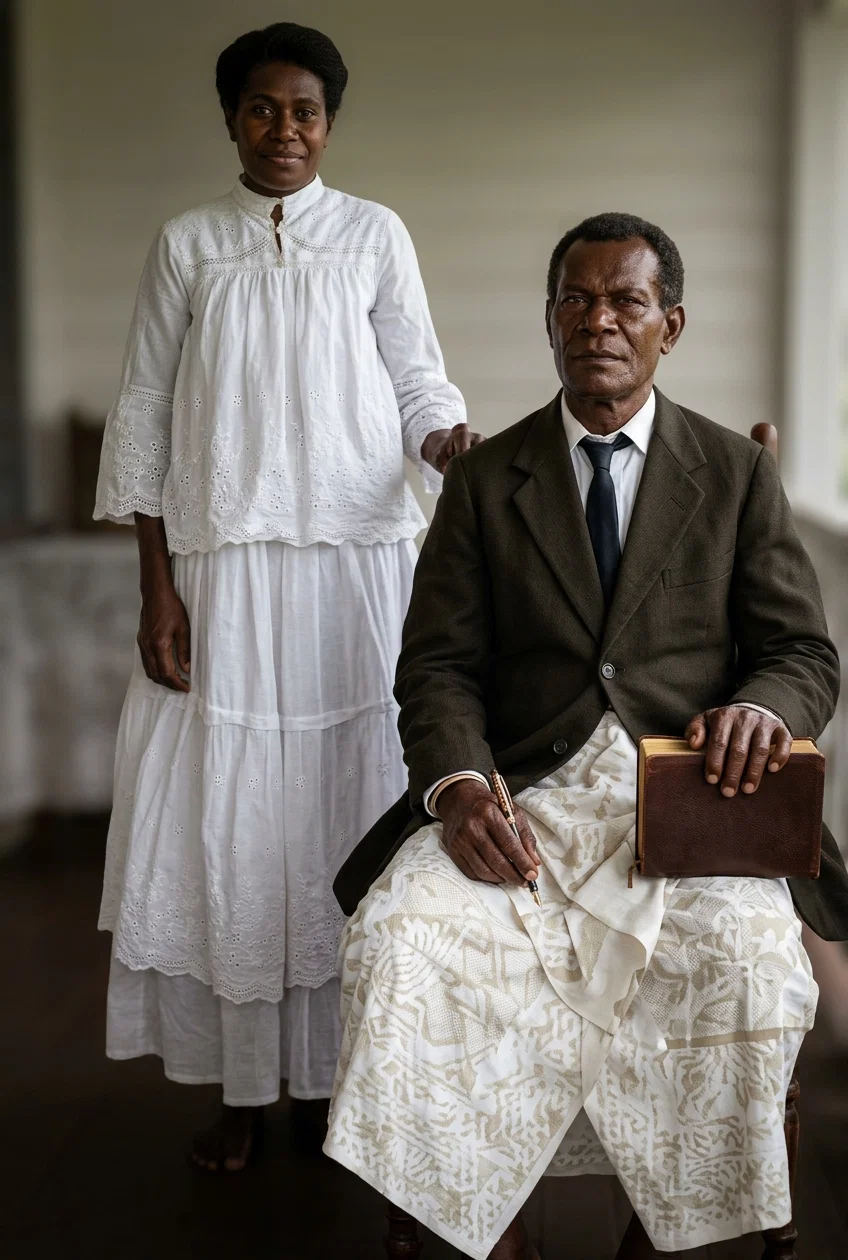
The time had arrived to commence a mission on the great island of New Guinea. The London Missionary Society had begun its work at Takiti in the far east and worked westward; island after island and group after group had been evangelized. The Loyalty Group being at the western extremity of the mission, New Caledonia being closed to us by the French, and the Presbyterians and Episcopalians being at work in the New Hebrides, it was clearly the duty of the young churches of the Loyalty Group to regard New Guinea as their foreign mission field, for it was a kind of unwritten law in the South Sea mission that when an island had received the Gospel it was to hand it on to the next. The question had been discussed at the annual meeting of the missionaries of the Loyalty Islands mission, and the directors in London had sanctioned our proposal and appointed me to carry it out. So I called a great meeting of the churches of Lifu, laid the scheme before them, and asked for volunteers from the native pastors and students in our seminary, with the result that all volunteered, they requesting me to select from their number those I considered most suitable. I felt, of course, that the best men were needed for pioneer work in such a place as New Guinea, and this is how it came about that Gucheng was the first native evangelist appointed to the New Guinea mission. The sacrifices which Gucheng and his wife made in leaving their comfortable home and pretty village and devoted people for the risks and privations of pioneer work among the cannibals of New Guinea will bear comparison with those made by European missionaries. Their homes are as dear to them as ours are to us, yet they cheerfully give up all for the sake of Christ and His kingdom, and place themselves unreservedly at the disposal of the missionaries.
Native Island Evangelist and Wife, Rescued by the Gospel, now Rescuing Others Through Its Ministry.
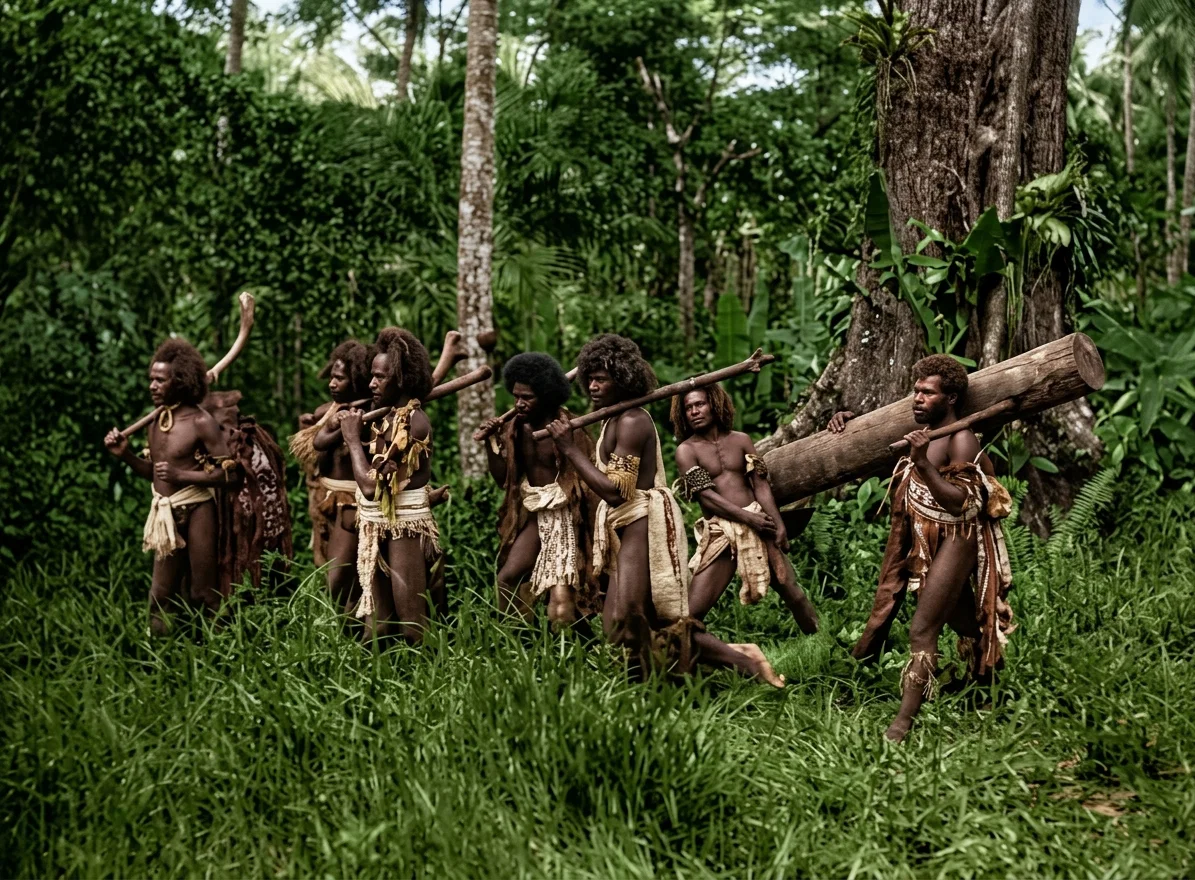
The Cannibal at Home—Dragging the Victim to the Oven.
In beginning a great mission in a sickly climate, among a savage and cannibal people, it seemed imperative to form a central station at a place tolerably healthful and safe.
As Gucheng was the first native teacher selected for work in our New Guinea mission, so he was the first located; he and Mataika (another Lifu native) were appointed to begin the work on Darnley Island; consequently, they were specially interested as we drew near our first landing-place since we left Lifu for New Guinea. The “sailing instructions” informed us that the anchorage was in “Treachery Bay,” a name given to the place on account of a boat’s crew having been massacred there, and that the natives were very wild and treacherous, and warned all visitors to be on their guard; so that when we dropped anchor in the bay without seeing a native our suspicions were aroused. There was no one to introduce us to this people, and none of us knew anything of their language; but acts of kindness are a language that people can understand all the world over, and that was the only language we were able to use in our first touch with these cannibal tribes in different points of our mission. The first man upon whom we tried this language was the leading warrior of the place, who is now the senior deacon of the church there. Soon after we cast anchor on that memorable Saturday evening he made his appearance on a hill, evidently to reconnoitre. We beckoned to him, and then jumped into our boat and met him on the beach. That meeting, like many others of our first meetings with the cannibals in New Guinea, was very different from the pictures in books and magazines of the missionary’s first landing among savages. I have often been amused at the pictures of Moffat and Williams compared with my own experience. Instead of standing on the beach in a suit of broadcloth with Bible in hand, the pioneer missionary in New Guinea might be seen on the beach in very little and very light clothing, with an umbrella in one hand and a small bag in the other, containing not Bibles and tracts, but beads, jew’s-harps, small looking-glasses, and matches; not pointing to heaven, giving the impression that he is a rain-maker, but sitting on a stone with his shoes and stockings off, surrounded by an admiring crowd, who are examining his white feet, and rolling up his wet trousers (he having waded on shore from the boat), to see if he has a white leg, and then motioning for him to bare his breast, that they may see if that is also white. The opening and shutting of an umbrella, the striking of a match, the ticking and movement of a watch—these things cause great surprise and delight and loud exclamations.
What we did when we met this savage on the beach at Darnley was to induce him to enter our boat and accompany us to the vessel, which after a few friendly demonstrations we succeeded in doing, though he was evidently very much afraid. We talked to him on board in a manner most effectual. Not knowing the way to his heart through his ear, we took the familiar road through his stomach by giving him a good dinner, then made him a few small presents and sent him away rejoicing, giving him to understand by signs that he was to return next morning when the sun was up and bring his friends with him.
It would have been interesting to know what was said around the fires in the coconut grove that night. Our presents would be handed round for inspection and gazed upon with longing eyes. They would naturally feel that there were plenty more where they came from, and the question would be, how to get them. On these occasions some propose stealing, others suggest murder and plunder; the wise men, however, advise barter and begging. They have probably had intercourse with some foreign vessel, or have heard of natives who have, where the murder and plunder theory has been tried with results far from encouraging.
Long before sunrise we heard unmistakable evidence of a crowd having assembled on the beach, all anxious to get on board, hoping, no doubt, to be treated like our friend the night before. After our morning bath on deck, during which there were loud exclamations at our white skins, we sent in the boats to bring them off to the vessel. On such occasions in our first contact with savages, we take the precaution to fasten a rope across the after part of the vessel, beyond which we do not allow the natives to go. Two or three of the crew are stationed in the bows of the vessel, the mate and one of his men stand behind the rope in the after part, keeping a sharp lookout on the crowd. All movable articles which might tempt the natives are put below and the hatches fastened. The way to and from the cabin is in the reserved part of the vessel, which the natives are not allowed to approach till we are acquainted with them. Neglect or contempt of these precautions has often led to very serious and fatal consequences. As a rule, pioneers should not allow natives who are savages and cannibals to get behind them. The temptation to a savage who is walking behind, with a club or tomahawk on his shoulder, is often very great; he knows of no tribunal in heaven or on earth to punish him, and is often led to kill, not from revenge, but from sheer ambition, knowing that if he is successful he will gain both approval and popularity from his countrymen.
Imagine, then, this crowd of savages on board our vessel, naked, and ornamented with paint, feathers, and shells, all talking at once, examining everything, peering into every place, pressing against the rope which they are trying to remove or surmount in order to get to the cabin, standing in the rigging to get a better view, some of them falling or being pushed overboard, amid the laughter of their friends. What were we to do with such a congregation on that memorable Sunday morning? How I longed to be able to speak to them! All we could hope to accomplish was to make a favorable impression upon their minds, showing by our conduct that we were different from others who visited them. To this end I conducted our morning service in the Lifu language. The crew joined our eight teachers and13their wives, who all appeared in Sunday attire. Seven nationalities were represented, from the educated European to the debased savage. Every shade of color might be seen, both in skin and dress, from white to black. It was a strange and most interesting sight. Never before or since have I preached to such an audience. We sang, to the astonishment and delight of the natives, “Jesus shall reign,” etc., and the hills sent back the response, in solemn and glorious echo, “Jesus shall reign.” We prayed together that God would direct, protect, and bless His servants in the great work they were beginning, for never did men feel more than we did then their absolute dependence upon divine help. The savages looked on in silence and wonder. After the service we mingled with them freely, and took some of the leading men into the cabin; then made them a few presents, and sent them away feeling (as I afterward found) that whoever we were we differed from those who had hitherto visited them. In the afternoon we visited the village, where we were kindly received, return presents being made by the people. Thus our intercourse began, and in three or four days we had gained their confidence and established the mission, placing Gucheng in charge.
I must not omit to record a very touching incident that occurred in connection with the settlement of Gucheng on Darnley. It happened on the morning of the fifth day that I was standing near the door of the grass hut that we had purchased from the natives as a lodging for our teachers till they built a suitable house for themselves. Our friends inside did not know that I was near. Their boxes and bundles had been landed, and all was ready for us to start for the point on the New Guinea coast where we intended, if possible, to form our next station. As I approached I heard one of the women crying most piteously; it was Gucheng’s wife. I stood for a few minutes outside, unwilling to intrude, for such grief seemed to render the place sacred. “O, my country! my country! Why did we leave our happy home? Would that we were back at Lifu again! These people will kill us when the mission vessel leaves, or they will steal all we possess.” Then I heard her husband, in tremulous tones, saying, “We must remember what we have come here for—not to get pearl shell, or trepang, or any earthly riches, but to tell these people about the true God, and the loving Saviour, Jesus Christ. We must think of what He suffered for us. If they kill us, or steal our goods, whatever we may suffer, it will be very little compared with what He suffered for us.” I could stand it no longer, but walked away till I recovered myself; then I entered the hut, and talked and prayed with them, and I am not ashamed to add that we wept together. Our party soon joined us, and when we walked down to the boat I need scarcely say that we were all sad and sorrowful; and as we pulled off to the ship, and beheld the weeping little group on the beach, surrounded by naked, noisy savages, one could not help feeling how little the world knows of its forest heroes.
On our return to Darnley we were delighted with the change that had already taken place. Gucheng and his party had evidently been hard at work; with the help of the natives they had built a neat cottage, a great improvement upon the surrounding huts. It contained a living and a bedroom; in the middle of the former stood a table and a bench, the legs being not on, but in the floor, and on the table were yams, bananas, and young coconuts, while outside were a crowd of laughing natives, who all seemed anxious to show how pleased they were to have Gucheng and his wife live among them. We spent the Sunday there, and had a most interesting service in the coconut grove—the best of all places for public worship in such climates.—Missionary Review.