DANIEL 7

2%

Pacific Press Publishing Company · Mountain View, California · Nov 29, 1905

FromSigns of the Times, Vol. 31, No. 48.

Read the full edition
CARRY yourselves back in thought to ancient Babylon, five hundred and forty-one years before Christ. Nebuchadnezzar had passed away after learning the great lesson that “the Most High ruleth in the kingdom of men, and giveth it to whomsoever He will.” Three of his successors had perished, and Babylon is disrupted by external and internal troubles. Nabonadius, a devout religionist, is on the throne. He gives himself to temple building, and associates with himself his inexperienced and dissolute son Belshazzar, to whom is committed the actual rule and defense of the empire.
In the very beginning of Belshazzar’s reign God gives to His prophet for the benefit of His children then and for all time, the divine, infallible forecast of the great dynasties of earth before any one of them has finished its career. He looked down through the ages and saw the tyranny, the cruelty, the oppression, of those who would be loyal to truth and duty, and sends this beacon of warning to the world, this message of comfort to His people. The vision covers the same ground in time and empire as that recorded in Daniel 2.
In Daniel 2 the kingdom of man is symbolized as to its glory and lasting qualities by various metals, in the image of a man.
In Daniel 7 the same kingdom of man in the same dominant phases is symbolized as to its character by wild and cruel beasts.

Meaning of Symbols.

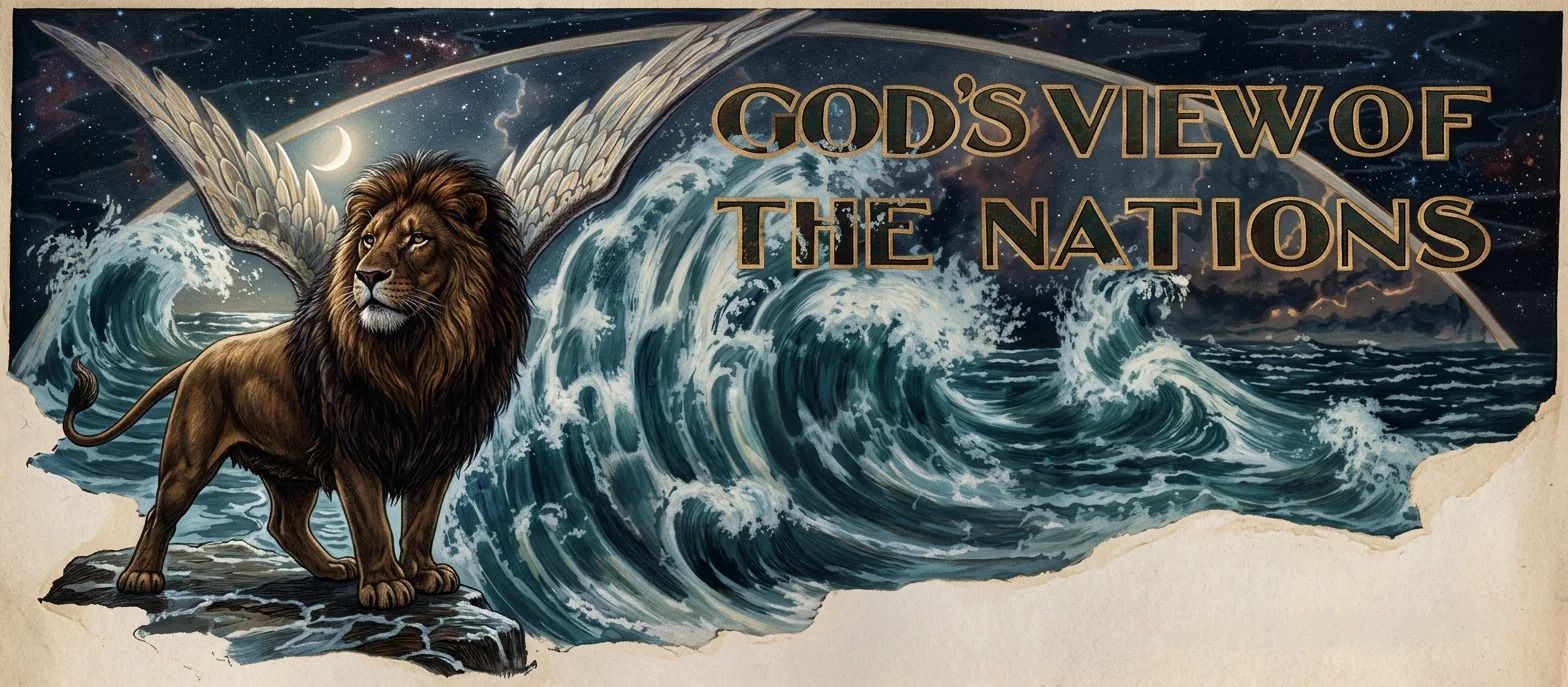
These beasts are represented as abnormal in appearance, possessing wings, multiple heads, and horns, and rising successively from a wind-swept sea.
The first was like a lion with eagle’s wings.
The second was like a bear raised up on one side, with three ribs in its mouth.
The third was a four-winged leopard with four heads.
The fourth was a terrible nondescript beast, with great iron teeth, strong exceedingly, devouring and breaking in pieces, and having ten horns.
The fifth is a little horn, arising later upon the same beast, and dominating all the other horns and the beast.
Elsewhere the Word of God, inspired by the same Spirit, interprets these symbols.
“Sea” and “waters” represent peoples, nations, tongues. Rev. 17:15; Isa. 8:7.
“Winds” symbolize war and strife. Jer. 25:32, 33; Rev. 7:1.
“Beasts” signify kingdoms, as do also “lions.” Dan. 7:17, 18, 23, 24.
The sum of the vision is this: The prophet looking down the ages upon the great sea of human life, sees as the result of war and strife four great successive world empires, of varied character, the last of which passes through several changes and forms to the end.
The first of these, the eagle-winged lion, represents Babylon, nearing her end. See Jer. 4:7, 13; 48:40; Hab. 1:8.
The bear represents the successor of Babylon, Medo-Persia, symbolized in Jeremiah by a wolf, and elsewhere in Daniel by a ram. Jer. 5:6; Dan. 8:20.
The four-winged, quadruple-headed beast is a symbol of Grecia, the four heads representing the four parts into which Alexander’s kingdom was divided a few years after his death. See also Dan. 8:21; 11:3, 4; Jer. 5:6.
The great and terrible beast is the iron kingdom of Rome; the ten horns the ten divisions of western Rome into which the kingdom was divided between the years A.D. 351 and 476.
These kingdoms are the Allemani, Franks, Burgundians, Vandals, Suevi, Visigoths, Anglo-Saxons, Ostrogoths, Lombards, and Heruli. The last of these arose in 476, and from that time to 493 there existed just ten divisions, no more and no less.

The Little Horn.

While the prophet considered the ten horns, he saw arising another little horn which lorded it over all the others. Of this little horn there are not less than eleven specifications in this chapter, as follows: (1) It arose in a ten-divisioned kingdom, verse 8; (2) Before it three of the ten fell, verse 8; (3) Strength and assumption compared with other horns, verse 20; (4) Diverse in character, verse 24; (5) Shrewd and far-seeing, verses 8, 20; (6) Blasphemous, verses 8, 11, 20, 25; (7) Persecuting, verses 20, 21, 25; (8) Presumes to change unchangeable law, verse 25; (9) Continues as persecutor a definite time, verse 25; (10) Dominion taken away, verse 26; (11) Power to persecute restored, verses 20, 21; Rev. 13:3.
These are fulfilled in the history of only one power in the world, either ancient or modern, and that is the Papacy. By this is not meant the Roman Catholic Church, in whose folds are many sincere Christians, notwithstanding her fearful departure from truth, but the Papacy state-recognized having dominion, or spiritual domination, over the Roman Empire during the time of the Dark Ages. Note the fulfilment, of which the space allotted to this article permits only the briefest mention:
1. The Papacy rose out of the ten kingdoms of Western Rome, through civil acknowledgment of her spiritual supremacy, obtained in various ways.
2. Before the rising influence of the Papacy there fell the three Arian powers, Heruli (493), Vandals (534), Ostrogoths (538).
3. Surely the papal form has been more stout than its fellow kingdoms. Many of them have utterly fallen; the Papacy abides.
4. The other powers were purely civil; the Papacy was “diverse,” religio-civil.
5. Other kingdoms have plotted and planned for the present; the Papacy for the far future,—man’s eyes in a beast.
6. It has been pre-eminently a blasphemous power, arrogating to itself powers and titles which angels would not assume, and demanding worship due only to God.
7. The Papacy, of itself and in its influence over the powers dominated, has martyred myriads of God’s children.
8. The Papacy, on its own confession, has thought to change God’s immutable law as respects the Sabbath.
9. The spiritual domination of the Papacy continued a time and times and half a time—three and one-half years, forty-two months, 1,260 days (Rev. 12:6, 14; 13:5)—which, according to prophetic time, a day for a year (Eze. 4:6; Num. 14:34), symbolizes 1,260 years. This period began in 538 when Justinian’s decree went into effect (given in 533) that “the bishop of Rome should be head over all the churches” and “true and only corrector of heretics.” It ended in 1798 when the papal domination over Europe was effectually broken by the capture of Pope Pius VI.
10. The civil dominion of the Papacy was taken away by Victor Emmanuel in 1870.
11. The power to persecute is not yet restored. It will be done by an acknowledgment of the papal claims as to what is authoritative in religious matters. That time hasteth greatly.

The Judgment.

Three great words of comfort God gives in this seventh chapter of Daniel. One is a description of the judgment scene, and the visitation of its sentence upon the oppressors of God’s people, the apostate governments of earth, which like cruel beasts have ravaged the vineyard of the Lord and persecuted Christ in the person of His own. Verses 7-12.

Christ and His Dominion.

In the closing of the career of these cruel earth-kingdoms a different scene takes place in the courts of heaven. The Son of Man is finishing His priestly work. He comes before the Father and to Him is given “dominion, and glory, and a kingdom, that all the peoples, nations, and languages should serve Him; His dominion is an everlasting dominion, which shall not pass away, and His kingdom that which shall not be destroyed.” Ps. 110:1; 2:7-9; Dan. 2:44, 45. He has demonstrated that “righteousness is life;” that eternal right is eternal might.

His People’s Glory.

God’s people are not forgotten. From the fiery furnace of Babylon to the last dungeon martyr or the auto da fé, God remembers them. Deprived of all justice, of all right, in the kingdoms of this world, they often have been; but when Christ shall come to His own, then “the kingdom and the dominion and the greatness of the kingdom, under the whole heaven, shall be given to the people of the saints of the Most High; His kingdom is an everlasting kingdom, and all dominions shall serve and obey Him.” See also Matt. 25:31. “And the ransomed of Jehovah shall return, and come with singing unto Zion; and everlasting joy shall be upon their heads; . . . and sorrow and sighing shall flee away.” Isa. 51:11.