The Holy Child Jesus

7%

Pacific Press Publishing Company · Oakland, California · Dec 24, 1902

FromSigns of the Times, Vol. 28, No. 52.

Read the full edition

The Holy Child Jesus

The Holy Child Jesus.—Just what spot in Bethlehem may be named as the place of the manger where Mary’s sweet Babe was laid on that night of so long ago, when “there was no room for them in the inn,” it matters not. The place may have been some cave or grotto used for the stabling of beasts, or some rude shelter from sun and rain erected in the courtyard of the caravansary or inn. The Bible never ministers to vain curiosity. It simply tells us of His lowly birth, as tho by it God would come in closest touch with the very lowliest, even with the brute creation.
Neither does it matter in which particular month or day of the month our Elder Brother was born. It certainly was not in midwinter, or the sheep would not, in all probability, have been in the open fields, watched over by the shepherds, with the sky for roof and walls, and the earth for a couch. The time of His baptism and crucifixion almost certainly indicate a much earlier birth date, in our September or October. If the precise date were essential or necessary, the Lord would not have withheld the knowledge. Heathen philosophy and customs succeeded in drawing a backslidden church over to the observance of the great Saturnalian carnival during the turn of the sun in December.
What We May Know.—But this we may know, that “when the fulness of the time came, God sent forth His Son, born of a woman, born under the law, that He might redeem them that were under the law, that we might receive the adoption of sons.” Gal. 4:4, 5. Angels of God attended His birth and heralded the glad news in rapturous, holy song, to the humble, trusting shepherds. Doubtless these shepherds represented the only class who were willing to receive the news and who would believe the glad message. Proud Pharisee, haughty priest, and self-exalted lawyers, scribes, and rulers could not receive the message, because they felt no need of the Gospel. The Son of God came in too humble a manner . He did not consult them as to the way, the place, or the manner of His coming. But the shepherds, learning the beautiful, tender, touching, trusting lessons of life in the care of their needy flocks and helpless lambs, were ready to believe the message and receive the Saviour, the only One who could minister to their needs.
“Behold, I bring you good tidings of great joy Which shall be to all the people; For there is born to you this day In the city of David A Saviour, who is Christ the Lord.”,
And then as they listened other shining messengers joined in the glad chorus.
“Glory to God in the highest, And on earth peace among men In whom He is well pleased.”
This is God’s message to “all the peoples,” to-day, to-night, as on that night.
Doubt Not.—There was no doubt on the part of the shepherds. The shining host was gone, but the hearts were not less glad. They said, “Let us now go even unto Bethlehem [not to see if the message was true, but], and see this thing that is come to pass, which the Lord hath made known unto us.” And the shepherds became God’s messengers with an exalted message. Luke 2:10–18.
God Uses the Humble.—“The secret of the Lord is with them that fear Him; and He will show them His covenant.” Ps. 25:14. It matters not what our circumstances in life may be, what may be our wealth or poverty, fame or station, or how men may regard us; if we are truly humble, ever looking to God for light, He will reveal to us the mystery of His goodness and power. Humble submission brings us into harmony with the great currents of life which control the universe, into harmony with Him “who worketh all things after the counsel of His own will.” But God is revealed to us that we may tell the glad story to others, and so impart the riches of His goodness to other souls in need—souls hungering and thirsting for the bread and water of life.
“Jesus”—“God-with-Us.”—The name of the holy Child was Jesus—Saviour. How He could save is revealed in another name He bears—“Immanuel,” “God-with-us.” Matt.1:21, 23. He was “born of a woman.” The eternal Son of God became man, flesh of our flesh, bone of our bone, blood of our blood, with all the inherited weaknesses, the pitiful infirmities, the sinful tendencies. He “was born of the seed of David according to the flesh.” Rom. 1:3. He “in all things” was made “like unto His brethren.” He also Himself in like manner partook “of flesh and blood.” Heb. 2:17, 14. While the eternal Son of God, He was a brother-man. Living in sinful environment, the heathen world sunken in the mire of lust and shrouded in the darkness of abominable wickedness, God’s own people at the lowest ebb of lifeless formality, Christ, the Anointed of God, “did no sin, neither was guile found in His mouth.” Yet He was counted sin for us that we might be counted righteous in Him. Not an ideal or an imaginary reckoning was this. What God counts to be so is so. “Him who knew no sin He [the Father] made to be sin on our behalf; that we might become the righteousness of God in Him.” 2 Cor. 5:21. And the making Him to be sin was demonstrated by His death.
All for Us.—The humiliation, the leaving of the courts of glory, the coming down from Creator of worlds to be one with His own fallen creatures, the suffering, the dying were all for us. He by faith fought the battle in the flesh against sin for us. He met the tempter by the weapon of the Word for us. He overcame, a perfect victor for us. He reigns in life for us. From His glorified humanity beats the infinite love and tenderness of His divine-human sympathy for every man and woman and child of earth. He did all that He did, became all that He was and is, that we might receive the adoption of sons, and so be one with Him forever.
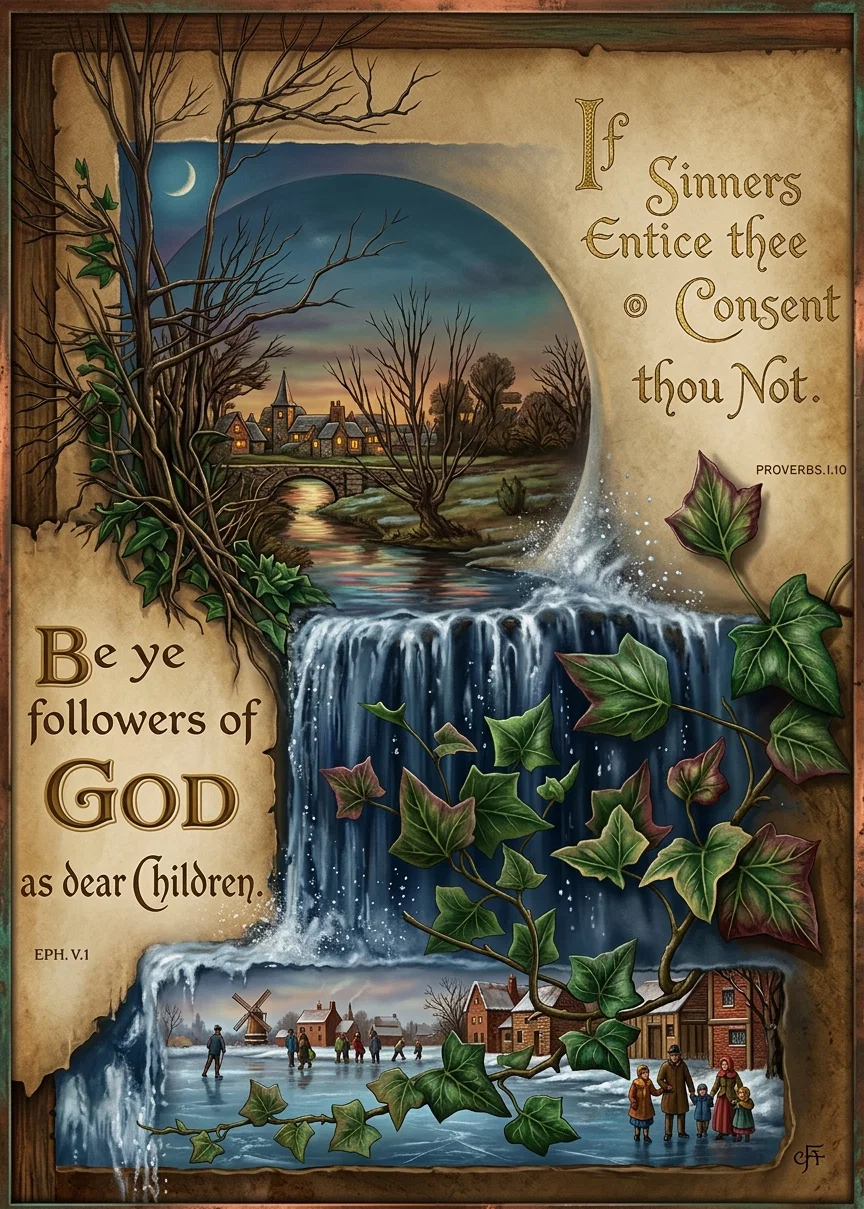
“Be Ye Followers.”—This does not mean that we shall mark out on rigid lines each act of our life, and shape every act as we think He would. Such a course would lead to dead Pharisaism. It is living fruit demanded, not dead works. The Event of Bethlehem teaches the way—lowliness, humility, humble submission to God. Such a one will long for God with unutterable longing. He will feed upon God’s Word. He will seek to know God’s will that he may do it. He will yield his own stubborn but weak will to the almighty will of God, and so obtain the power of God’s will to gladly follow in the way, resisting by the power of God’s life within all, the enticements of Satan and sinners. He may be led through lowly valleys, up steep mountains, in deserts of temptations, on heights of transfigurations, in dark Gethsemanes, up cruel Calvarys; but all the way it is the very best way; and the marks of the feet of the Child of Bethlehem are visible all along the path, and His mighty presence cheers us even unto the end. These are some of the wonderful lessons taught in the contemplation of the Babe of Bethlehem, not alone on one day of the year, but on every day. Reader, how does the glad message come to you? Is this Jesus your Brother, your Saviour?